Microsoft 365 suffers a ten-hour global outage; OpenAI disbands its robotics team
Today’s highlights
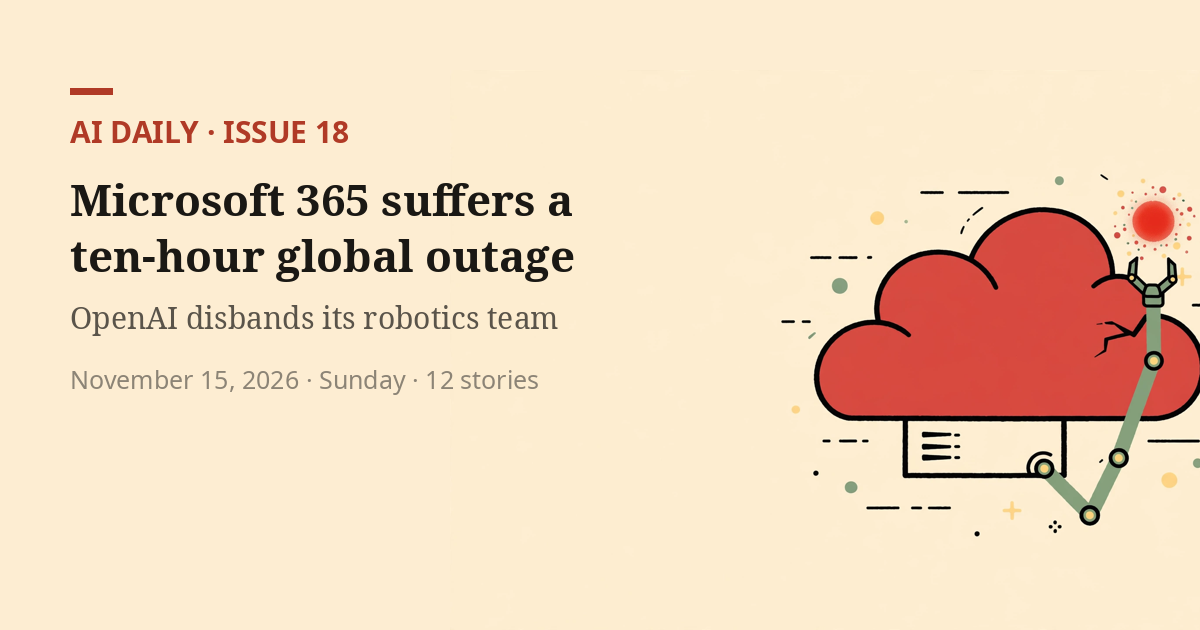
Microsoft 365 suffers a roughly 10-hour global outage across 74 countries and territories; broad recovery and an apology on November 13
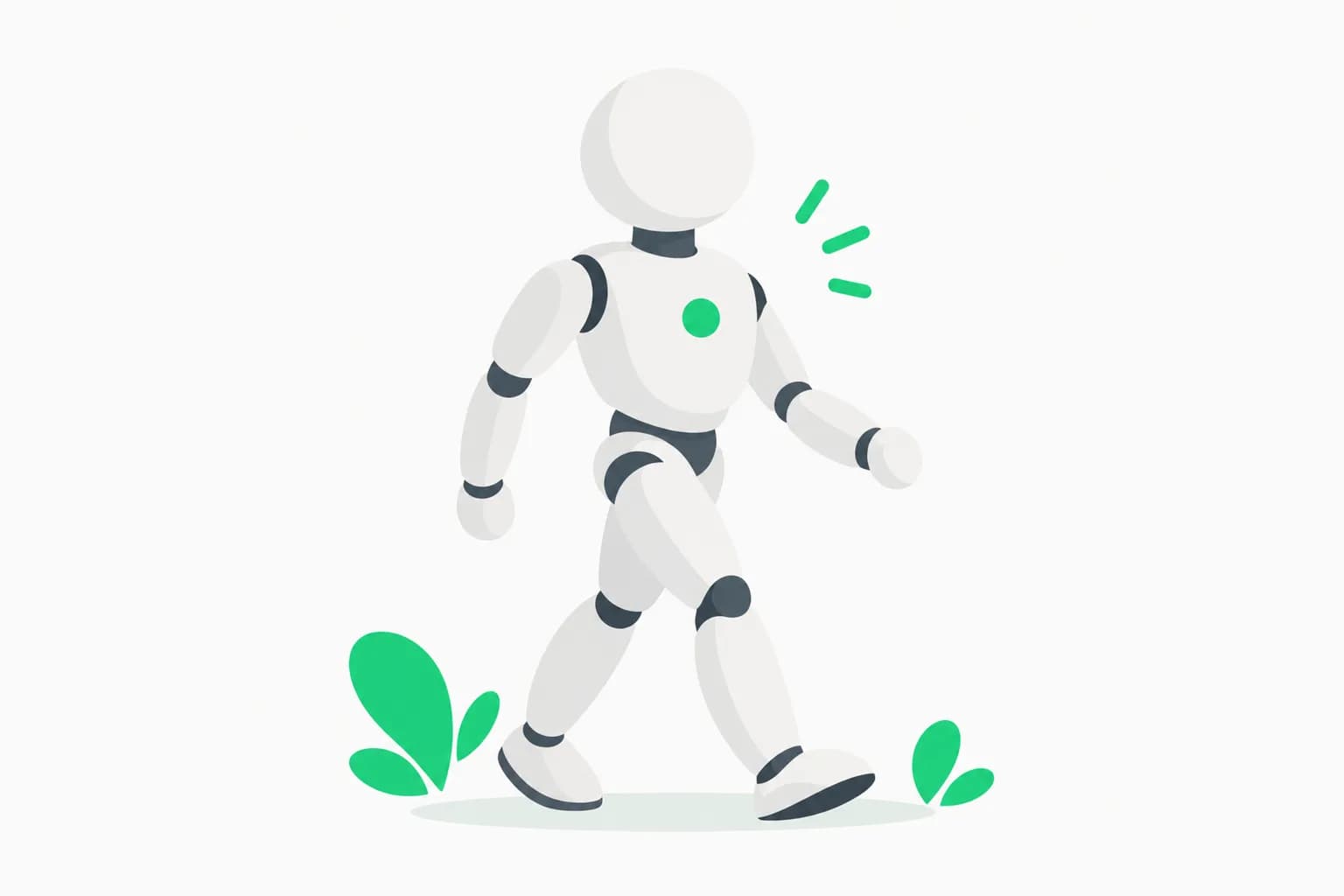
OpenAI disbands its standalone robotics team, betting general models can drive robots; Sierra releases Poppy 1.0
Meta Muse now places calls for paying US users; Aito M8 launches from 379,800 yuan
llama.cpp and ggml ship 1.0.0 together; Runway open-sources robotics model Praxis-1
FAA grounds all US flights for 4.5 hours; a developer builds a live flight map in half an hour
01Microsoft 365 suffers a roughly 10-hour global outage, hitting 74 countries and territories
Image source: USA Today
Microsoft 365 went down globally from around 1:00 p.m. ET on November 12, cutting off Outlook, Teams, SharePoint, Microsoft 365 Copilot and more. Downdetector logged nearly 130,000 Outlook failure reports at the peak and over 47,000 for Microsoft 365, with reports coming from 74 countries and territories.
Microsoft apologized on November 13 and said services were broadly restored. The company blamed a defect left by an earlier network gateway capacity upgrade, exposed by a recent network change, which made servers fail health checks and crushed available capacity; a fix has been deployed and a full incident report is promised. Microsoft stressed the outage had nothing to do with a cyberattack or AI agents, and found no evidence customer emails were stolen.
The outage also hit AI products: both OpenAI and Anthropic reported failures in features that connect to Microsoft 365. Microsoft extended some mail-processing timeouts to 48 hours so queued messages would not expire, and administrators can track the incidents as EX1550543 and MO1550821 in the admin center.
💡 Lumo’s take
The more concentrated cloud services get, the wider one outage's blast radius. The product lesson: never bet a critical path on a single cloud — mail, calendars and AI connectors all need a fallback plan, so that when things go down you protect the core flow first and send the notice second, instead of waiting for recovery.
02OpenAI disbands its standalone robotics team, betting general models can drive robots directly
Image source: Fortune
Fortune reported exclusively on November 13 that OpenAI has disbanded its standalone robotics team: researchers move into the main research organization led by Chief Research Officer Mark Chen, while applied robotics and hardware staff join the Applied organization under President Greg Brockman. An OpenAI spokesperson confirmed the change to Fortune, though the company published no blog post.
OpenAI's stated reason is a change of route: at the start of the year the team assumed robotics would grow out of video models like Sora, but general-purpose frontier models such as GPT-6 Astra can now drive robots directly. An Nvidia study from October put an Astra-powered agent at 74.8% success on the RoboLab-120 simulated manipulation benchmark, above the best specialized robot models at 51.0% — but that is a simulation score, not a real-robot result.
Follow-up reporting on November 14 added a real-hardware data point: in OpenAI's public StationeryBench comparison, Astra completed 7 of 100 trials on bimanual desk tasks, against 0 for rival MolmoAct2 — a directional gap, with absolute success rates still very low. The company says this is not a retreat, and the 2027 humanoid demo target stands.
💡 Lumo’s take
Robotics is shifting from a 'specialized model problem' to an 'application of general models'. The product lesson: measure a frontier model as your baseline first, then decide whether a vertical scenario needs its own trained model — get the order wrong and you burn money for nothing.
03Sierra releases Personal Agent Protocol Poppy 1.0; Shopify enables it for all merchants
Image source: Sierra official blog
Poppy, the Personal Agent Protocol co-developed by Sierra and Meta, reached version 1.0 on November 13. It defines how a personal agent identifies itself to a business, gets the user's authorization, and then calls the business's agents, websites and APIs — built largely on existing standards such as MCP, OpenAPI and UCP, with authorization over OAuth.
Adoption is fast: Shopify now publishes a Poppy file automatically for every merchant on its platform, covering more than 175 countries, with no extra work for sellers; Meta's personal agent Muse looks for Poppy first on every site it visits; and design partners including Mercury, Synchrony and Turkish Airlines are already live, with 60 new partners joining for a total above 100.
Poppy and the just-launched ChatGPT Wallet are the two wings of agent commerce: the wallet solves 'how to pay', Poppy solves 'who is at the door and what are they allowed to do'. Shopify also co-authored Poppy's commerce extension, letting an agent shop as a guest or sign in with the customer's account, and requiring it to ask the customer before sensitive actions.
💡 Lumo’s take
The agent economy is filling in its 'identity layer' — websites used to be unable to tell a person from an agent, and from now on every agent will have to show ID and get permission at the door. The product lesson: your website will sooner or later have to answer 'what happens when an agent shows up', so work out those rules early.
04Meta Muse now places phone calls for paying users in the US
Image source: TechCrunch
Meta's personal agent Muse can now place phone calls to US businesses for paying subscribers in the United States, starting November 12: it can book a table, ask about insurance, sort out broadband or book a DMV slot on your behalf. A small group of early adopters had been testing the feature since September; this is the full rollout.
The catch is the subscription: Muse paid plans start at $20 a month, and free users cannot use calls yet. Meta Chief AI Officer Alexandr Wang announced the feature on X, saying it takes over 'those calls you don't want to make'. Muse now has over 10 million users.
Muse is not alone: Google's Gemini and startup Instinct offer similar calling. But the other end of the line does not always cooperate — many businesses hang up as soon as they realize the caller is an AI. As AI voices get closer to human, telling a person from an agent on the phone will only get harder.
💡 Lumo’s take
The personal-agent battleground is moving from the chat box to the phone line — an agent that can call, queue and haggle for you sticks far better than one that only chats. The product lesson: the next opening in voice interaction is not 'does it sound good', but 'can it finish an annoying chore for you'.
05Aito M8 launches from 379,800 yuan with 800V platform and Huawei Qiankun ADS 5
Image source: PChome
The Aito M8 from Harmony Intelligent Mobility launched on November 13 at the Seres super factory in Chongqing, with ten variants across extended-range and pure-electric powertrains and five- or six-seat layouts, priced from 379,800 to 469,800 yuan. The company says it spent 1.5 billion yuan on eight architecture upgrades, driven by more than a thousand suggestions from the nearly 190,000 owners of the first-generation M8.
Driver assistance is the headline: every variant gets an 800V high-voltage platform, an L3-oriented driving architecture and Huawei Qiankun ADS 5, with parking-to-parking navigation and omnidirectional collision avoidance 5.0. The pure-electric version reaches up to 830 km of CLTC range; the extended-range version up to 1,526 km combined.
The cabin gets a panoramic screen, Huawei's AR head-up display, HUAWEI SOUND audio and a megapixel smart projection headlight that can throw a light carpet — or an open-air cinema — while camping. It is the first new model since Huawei and Seres reset their partnership in September, with Huawei leading core technology and product definition and Seres leading manufacturing and sales.
💡 Lumo’s take
Carmakers' battleground is shifting from 'who stacks more specs' to 'does the driving assist and cabin experience hold together as one system'. The product lesson applies to big-ticket goods too: collect real user feedback first, then fix it item by item against that list — the investment has to show where it went.
06llama.cpp and ggml ship 1.0.0 together, promising a stable C API
Image source: GitHub
llama.cpp, the foundational engine for local inference, shipped version 1.0.0 on November 13 together with its underlying tensor library ggml. After about three and a half years, reaching 1.0 means breaking changes to the public C API will now only arrive with major versions — reassuring news for every downstream project.
The release removes 35 deprecated functions, adds FP8 KV caching (cutting KV usage for Qwen2.5-7B at 32k context from 1,792 MiB to 896 MiB) and a host-memory cache for MoE experts, and hardens llama-server against SSRF, DNS rebinding and related issues; it also adds a /v1/audio/speech endpoint and a redesigned web UI.
Newly supported models include Kimi-K3.1-Pro and Ripple-65B-Preview. llama.cpp sits underneath countless local AI apps — from Ollama to desktop clients — so the 1.0 stability promise ripples through the whole local AI ecosystem.
💡 Lumo’s take
A 1.0 for infrastructure never means 'the features are done' — it means 'the interface stops changing'. The product lesson: when you build on open infrastructure, watch its stability promise more than its new features — only a stable interface lets you build upward with confidence.
07Runway open-sources robotics world action model Praxis-1 under Apache 2.0
Image source: Runway official site
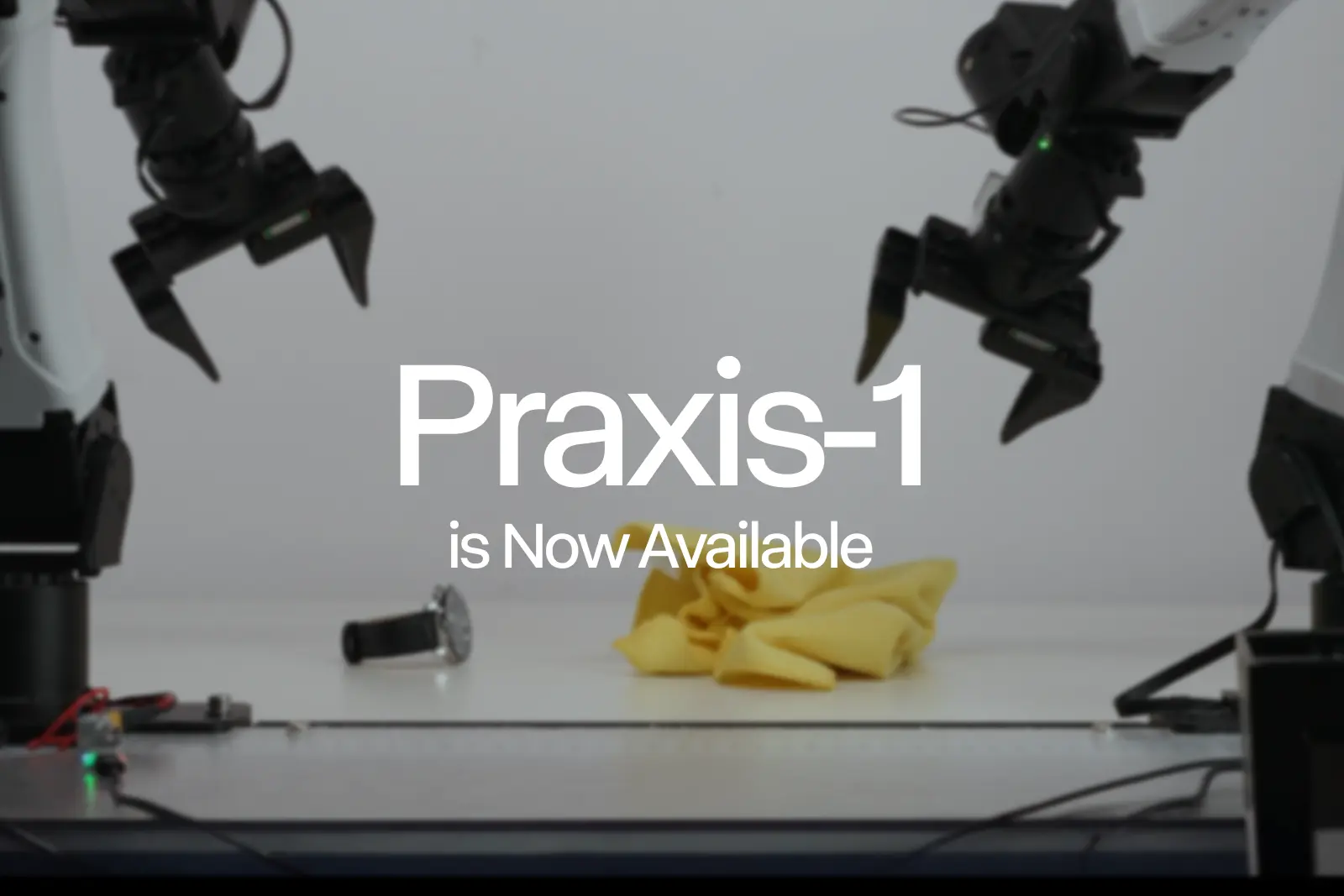
Runway opened the weights and inference/fine-tuning code for Praxis-1, its world action model for robotics, on November 11 under Apache 2.0, including for commercial use. The 27-billion-parameter MoE diffusion transformer predicts future video and robot actions together; three launch partners already run it on a legged humanoid, a six-axis industrial arm and a dual-arm warehouse robot.
On Nvidia's RoboLab-120 benchmark it reaches 46.2% success across 1,200 episodes — the best among published world action models, ahead of FLUX 3 Action at 42.9% and π0.5 at 28.0%. It runs on hardware from H100/B200 data-center GPUs and RTX 5090 workstations down to Jetson Thor on the robot itself, with full fine-tuning and LoRA support.
The contrast with OpenAI's move the same week is the story: OpenAI folded its robotics team into general models, while Runway open-sourced a specialized world model. Two routes are now colliding head-on — general models win on scale, specialized models on openness and deployability.
💡 Lumo’s take
Video-generation companies are turning 'world models' into a shared foundation for robotics firms. The product lesson: a world model plus light fine-tuning lets a small team give its own hardware a decent 'brain' without training a model from scratch.
08Claude Code Projects upgrade: the coordinator now reports proactively while threads run in parallel
Image source: AlphaSignal
Anthropic upgraded Claude Code Projects on November 13: the coordinator is now proactive — it answers progress questions directly in the main conversation and pushes thread status updates, so developers no longer have to open each thread to check. New additions include /btw for side threads, /fork to branch from a thread's current state, thread reminders and read-only share links.
Each thread is an independent cloud session drawing on its own usage allowance, with a limit of 200 new threads per day; threads that touched the local machine cannot be shared, for safety. Projects itself launched on September 17, so this is a feature upgrade, not a debut; it remains in public beta for Pro and Max only, with no Team or Enterprise support yet.
It fits engineering work that splits into independent tasks: profiling endpoints in parallel, migrating across repositories, or batch-fixing dependencies and bugs. Anthropic warns that several high-effort sessions running at once burn through plan limits faster, and small changes are cheaper in a single session.
💡 Lumo’s take
Multi-agent collaboration is shifting from 'humans watching agents work' to 'agents proactively reporting to humans'. The product lesson: the experience of parallel agents hinges not on how many threads you can open, but on whether the coordinator pushes 'things waiting for your call' in front of you.
09Perplexity open-sources decision model Decider v1.3, free on OpenRouter until November 19
Image source: MarkTechPost
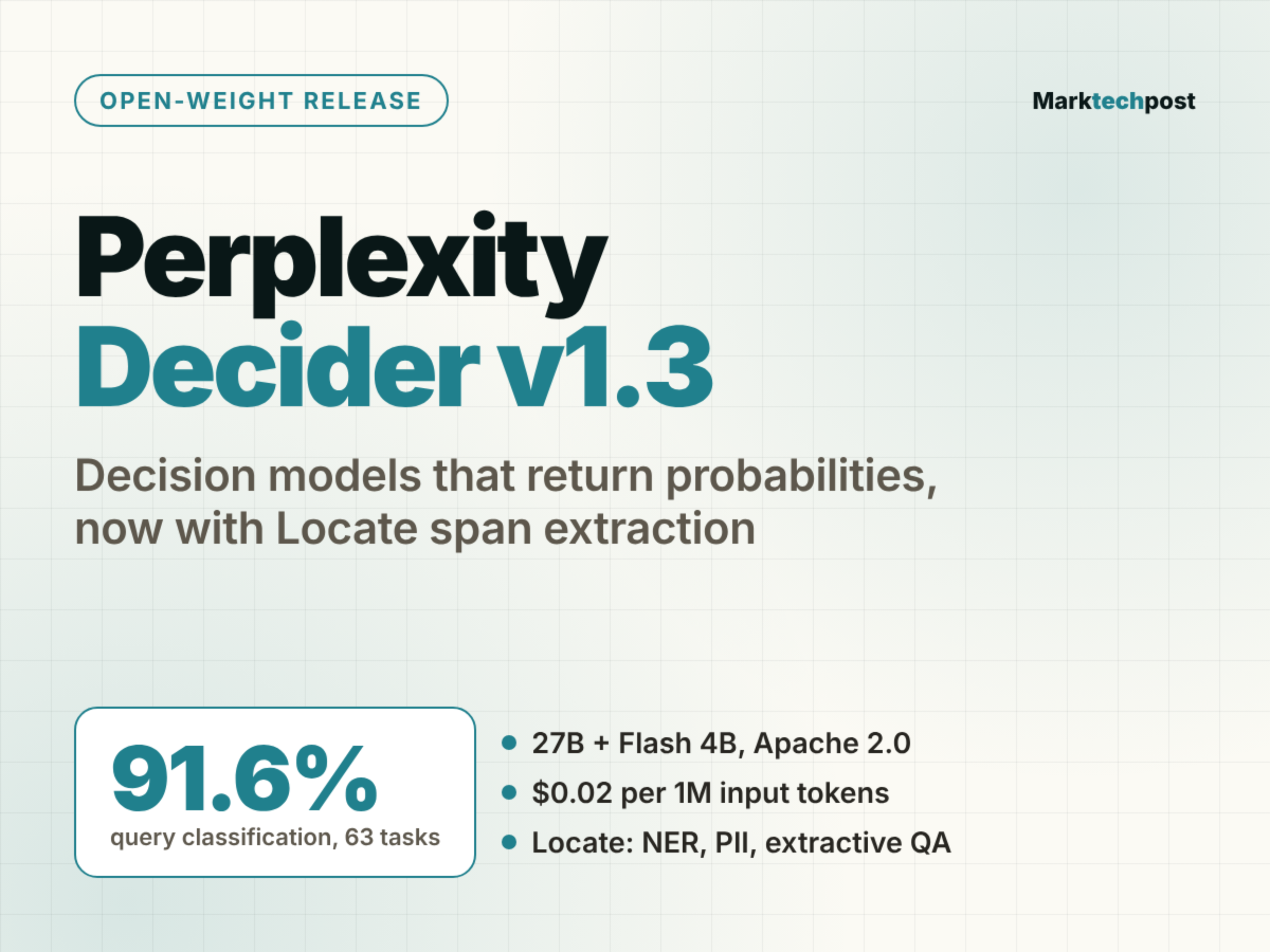
Perplexity released Decider v1.3, an open-weight decision model (27B, built on Qwen3.8-27B), alongside Flash v1.3 (4B) on November 12, with weights under Apache 2.0. Unlike chat models it generates no text — it outputs probability distributions, built for agent routing, verification and scoring; the new Locate feature extracts exact text spans with character offsets.
Self-reported results: 91.6% mean accuracy on 63 query-classification tasks, and a mean nDCG@10 of 83.99 on 72 retrieval and reranking tasks; API pricing is $0.02 per million input tokens ($0.01 for Flash), output free. Both models are on Hugging Face, the Perplexity Decisions API and OpenRouter, where they are free until November 19.
Mind the sourcing: all scores are Perplexity's own, with no independent verification; the full 27B weights need about 49 GiB of GPU memory, Flash about 8.5 GiB. Decision models are a category to watch — as agents multiply, 'who judges whether the answer is right' is becoming a business of its own.
💡 Lumo’s take
The next layer of agent division of labor is the 'referee' — generative models do the work, probability-output models score, route and verify. The product lesson: adding a cheap verification step to an agent beats swapping in a bigger generative model.
10MiniMax H3-Image tops the open-weights image boards four days after release, editing Elo 1,138
Image source: OrcaRouter
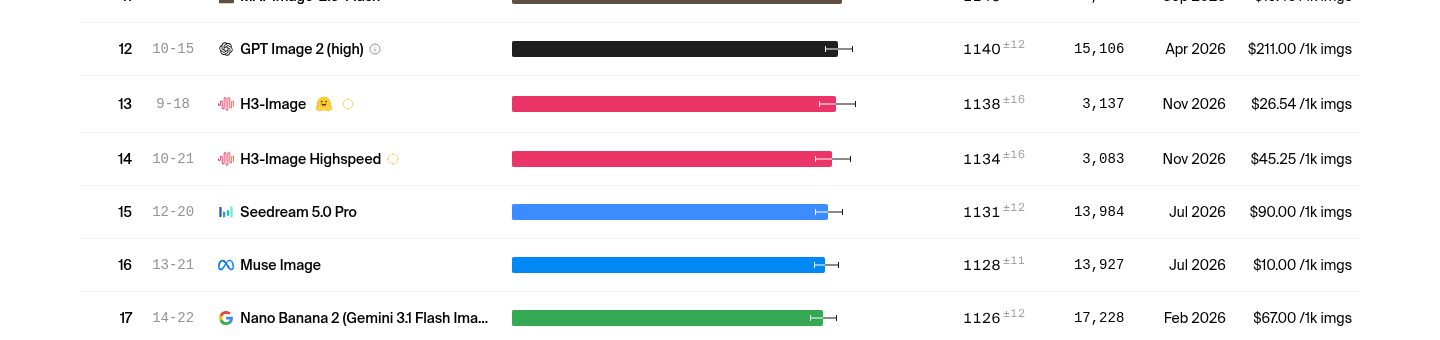
MiniMax-H3-Image, whose weights opened on November 11, sits first among open-weights models on Artificial Analysis's independent boards just four days later: Elo 1,138 on image editing (3,137 votes), 53 points clear of the next downloadable model; and Elo 1,066 on text-to-image, also first among open weights but only about 20 points ahead of Qwen-Image-2.1, inside the margin of error.
The gap between the two boards is the real finding: it is a stronger 'editor' than 'generator' — an architecture built around 16 reference images and a 16-megapixel canvas. On editing it sits between GPT Image 2 (1,140) and Seedream 5.0 Pro (1,131), models priced three to eight times higher per thousand images.
Two caveats: with only about 3,000 votes and a 95% interval of 1,122–1,154, the ranking can still drift, so 'provisionally first' is the honest wording; and the community licence excludes commercial use in the EU, UK, South Korea and the US, where using it in a product needs MiniMax's written authorization first.
💡 Lumo’s take
Competition among open image models is splitting from 'who draws best' into 'who edits best'. The product lesson: for retouching and editing products, the editing leaderboard's Elo matters more than the text-to-image board — users want edits that land, not fresh generations.
11AgiBot releases LIFE, a lifelong embodied intelligence framework: robots keep sensing with no instructions
Image source: Pedaily
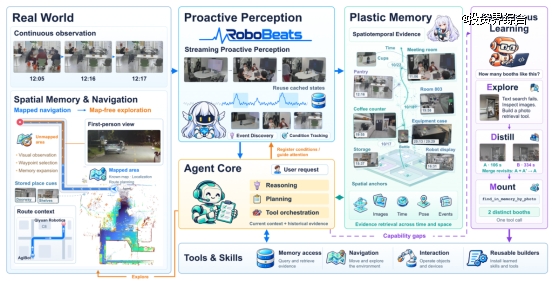
AgiBot released LIFE (Learning to Live), a lifelong embodied intelligence framework, on November 11, combining continuous perception, long-term memory and skill reuse: a robot that receives no instructions does not go 'offline' — it keeps watching its environment, saves what is worth remembering, and calls on it for later decisions. The paper, project page, RoboBeats models (0.8B/2B/4B) and SSS-Bench evaluation are all open.
Three parts work together: the lightweight decision model RoboBeats provides heartbeat-style condition tracking (the 2B version processes a frame in about 75 ms on a single RTX 5090); plastic memory stores raw footage alongside structured records, so the original image can be revisited later to extract new clues; and the EDM mechanism distills explored solutions into reusable tools.
On the numbers, mounting EDM-built skills lifted success on 597 held-out FindingDory queries from 37.5% to 65.8%; in a 24-hour real-robot video Q&A test, LIFE scored 29.5 out of 30 in 80.6 seconds on average, against 554.7 seconds for the Codex baseline. All figures are AgiBot's self-reported evaluation results.
💡 Lumo’s take
The next step for embodied intelligence is not 'do one task better' but 'keep accumulating while idle'. The product lesson: when you give an agent memory, don't just store conversation logs — store how the environment itself changes; that is what makes long-term memory valuable.
12FAA grounds all US flights for 4.5 hours; a developer builds a live flight map with Claude Code in half an hour
Image source: Hacker News
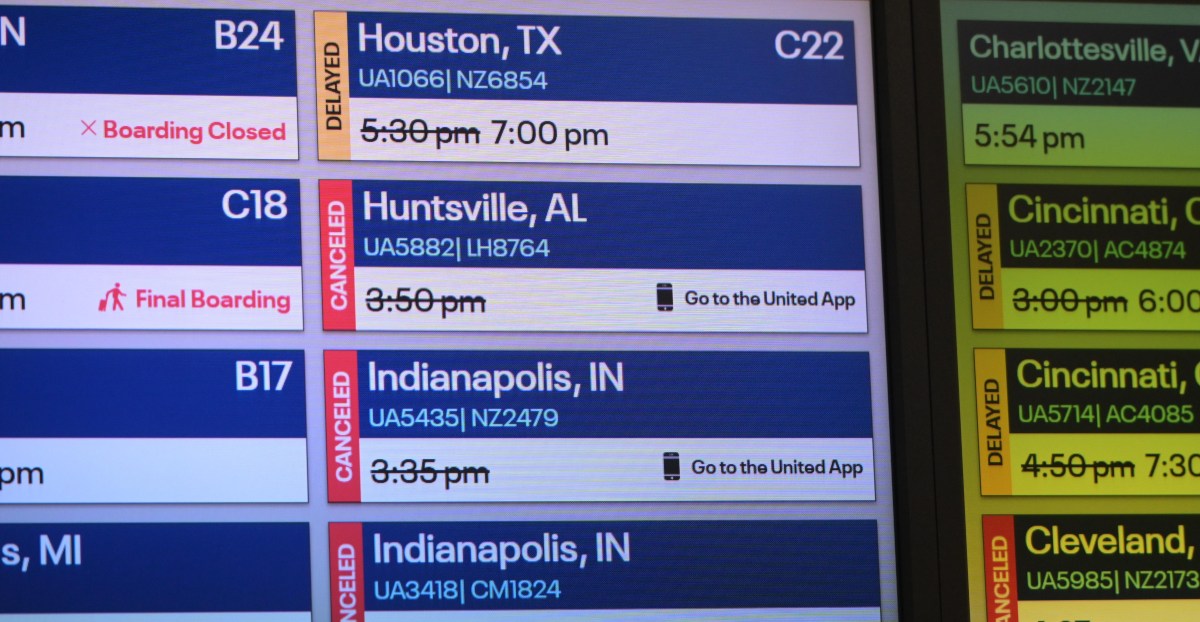
The US Federal Aviation Administration issued a rare nationwide ground stop on the afternoon of November 13 after air-traffic-control communication failures, lifting it after about 4.5 hours; FlightAware counted roughly 9,124 delayed and 5,901 canceled flights across the country. It was the first nationwide stop since January 2023 and the longest since September 11, 2001.
That same evening, a developer built grounds.top, a live map, with Claude Code: it pulls free ADS-B data and the FAA delay feed to show aircraft airborne, flights 'missing from the sky' and departure backlogs by airport. The author says it took about 30 minutes to build; posted to Hacker News, it reached 204 points.
Officials blamed overloaded switches and routers on the FAA's aging copper-wire telecom network, with no evidence of a cyberattack so far; the Department of Homeland Security said there was 'zero evidence' of a cyberattack or a rogue AI system, though the investigation has not ruled anything out.
💡 Lumo’s take
Breaking news is the best product demo stage — while others were still refreshing the news, he had already turned it into a working tool. The product lesson: a hot topic plus free public data plus AI coding can ship something people use the same day in about half an hour; speed itself is the edge.
A "breaking-news live page" generator: grounds.top proved that half an hour after a breaking story, a live data page can hit the Hacker News front page — but someone has to build it from scratch every time. Build a tool that takes an event keyword, aggregates public data sources (flight ADS-B, official status feeds, public RSS and social media) and uses AI to generate a single page with live numbers, a timeline and a map, live in ten minutes, embeddable and shareable. Who pays: local media, travel and aviation creators, and corporate comms teams (who need a status page when their own service goes down); what they lack is not the news, but a live page they can ship immediately. Why now: the traffic window for breaking news lasts only a few hours, and the first page live takes the traffic; public data sources keep multiplying while AI coding has pushed build cost down to about half an hour. Minimum MVP: one generic template plus three data-source integrations (free ADS-B tier, FAA status feed, official RSS), run by hand through three real breaking events to prove event-to-live can fit inside one hour. First validation step: ship a free page within an hour of the next breaking event and watch organic traffic and reposts; then test paid pricing — 299 yuan per event page, 999 yuan a month for media — and only build further if someone pays for a second one; win customers among local media and aviation creators, where the page itself is the ad.