Claude Turns a Prompt Into a Desktop App, and GPT-6 Learns to Design Proteins
Today’s highlights
Claude turns a prompt-built tool into a desktop app with one click, with three permission tiers, on all plans
GPT-6 designs proteins using only reasoning and code; 35 of 322 bind in lab tests
MCP turns two: 700M+ monthly downloads, with Skills, Tasks, and Elicitation in place
Ant's OceanLake launches, SenseTime's U1.6 goes open source, and Xiaomi posts ¥107.2B Q3 revenue
Honor's new flagship debuts overseas; Microsoft declares Code Red after the M365 outage
01Claude turns a prompt-built tool into a desktop app with one click
Image source: Claude official site
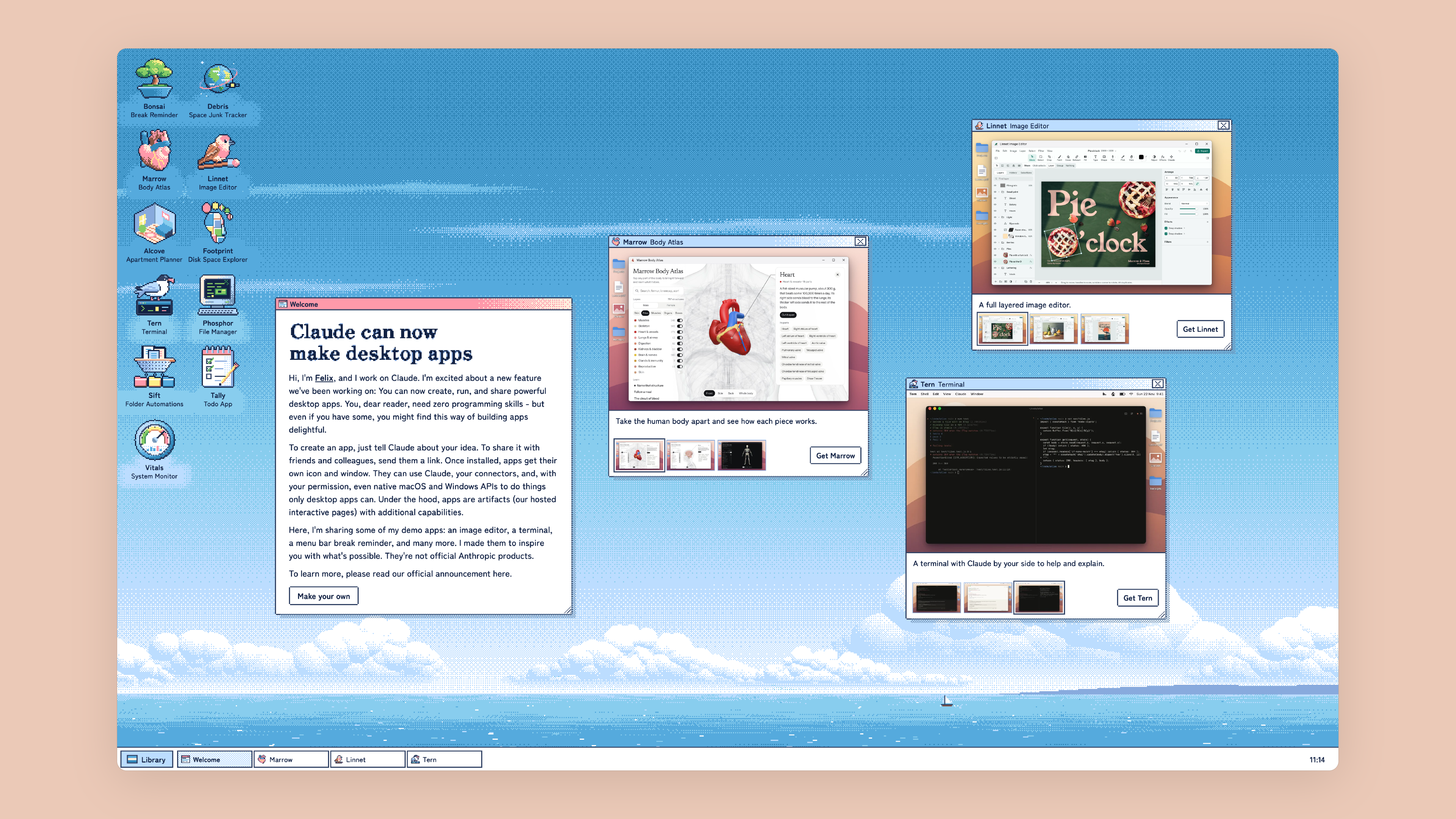
On November 24, Anthropic shipped 'Install as app' for Claude (beta): a small tool built from one sentence in Claude can now be installed as a standalone desktop app on Mac or Windows, with its own icon and window, instead of living inside a chat. It is rolling out to all plans with the Claude desktop app.
It works simply: describe the tool to Claude, try it as an artifact, then pick 'Install as app' from the Share menu. No packaging, no signing, no API key; edit the artifact and the installed app updates automatically. Installed apps keep using Claude and connected services such as calendar and email, and can send notifications or live in the menu bar or system tray.
Permissions come in three tiers, chosen by the user: Default can only do what a browser could; App permissions can request notifications, global shortcuts, and always-on-top windows; 'Full computer access' can run programs and read, change, or delete files, and must be confirmed again after every update. Full access is only for apps you made yourself, or on Team and Enterprise plans, apps made by people in your organization. Anthropic states plainly that it does not review apps before you install them.
Anthropic's own staff have already built things with it: Linnet, a layered image editor; Phosphor, a file manager; Sift, which organizes files by folder rules; Tern, a terminal with Claude at your side; and Vitals, a menu-bar performance monitor. There are limits: apps need an internet connection and a Claude sign-in to open, requests count toward plan usage, template artifacts such as Docs, Slides, and Sheets cannot be installed yet, and HIPAA-ready organizations and hybrid deployments are excluded.
💡 Lumo’s take
Another barrier to software just fell: turning a prompt into a tool you actually use used to mean packaging, signing, and distribution. Now it is one sentence. The interesting question moves one layer up: when anyone can conjure an app from a sentence, the scarce skill is no longer building it, but deciding what to build, for whom, and how they find it.
02GPT-6 designs proteins with reasoning and code alone; 35 of 322 bind in lab tests
Image source: OpenAI official blog
On November 24, OpenAI reported that its GPT-6 family has 'intrinsic' protein-design capabilities: using only reasoning and general-purpose coding tools, the models can design new protein structures and amino-acid sequences without calling specialized biology models to generate the designs. The preprint is out and has not yet been peer-reviewed.
The key evidence comes from the lab: with research partner Onava, OpenAI synthesized 322 minibinders from GPT-6.2's designs and tested them against 5 targets; 35 (10.9%) showed signs of binding, including 18 for IL-17A, 8 for VEGF-A, and 5 for PD-L1. In two antibody-redesign experiments, 128 of 182 redesigned VHH binding loops still bound (70%), and 179 of 272 therapeutic antibody fragments still bound their original targets (66%).
One discount applies: GPT-6.2 designed the 3D structures, but turning structures into testable amino-acid sequences and picking candidates for the lab still relied on specialized models such as SolubleMPNN. OpenAI also concedes that predicting complete protein structures remains a clear weakness. In computational tests, its latest internal model matched or beat specialized models on most of 14 protein tasks, and scored 43.7% on MotifBench scaffolding versus 27.8% for RFdiffusion.
The more striking part is control: the model follows plain-language instructions on binding sites and the number and arrangement of helices and strands almost exactly, turning 'describe the protein shape you want' into an executable design command. If this holds up, the 'have an idea, then wait for a specialist model' step in drug discovery gets squeezed hard.
💡 Lumo’s take
General-purpose models are eating specialized models' lunch, and this time it is not by calling a tool: reasoning plus code did the specialist's job directly. For builders, the signal is plain: any workflow that goes 'have an idea, then hand it to a specialist tool' deserves a second look to see how many steps the general model can now swallow whole.
03MCP turns two: 700M+ monthly downloads as Skills, Tasks, and Elicitation land
Image source: The Decoder
On November 24, Anthropic marked MCP's second anniversary with a scoreboard: MCP SDKs across languages now exceed 700 million monthly downloads, and more than 10,000 connectors are available for Claude. A year ago, monthly downloads were just over 90 million; in July they were 400 million. Total downloads have reached 5 billion.
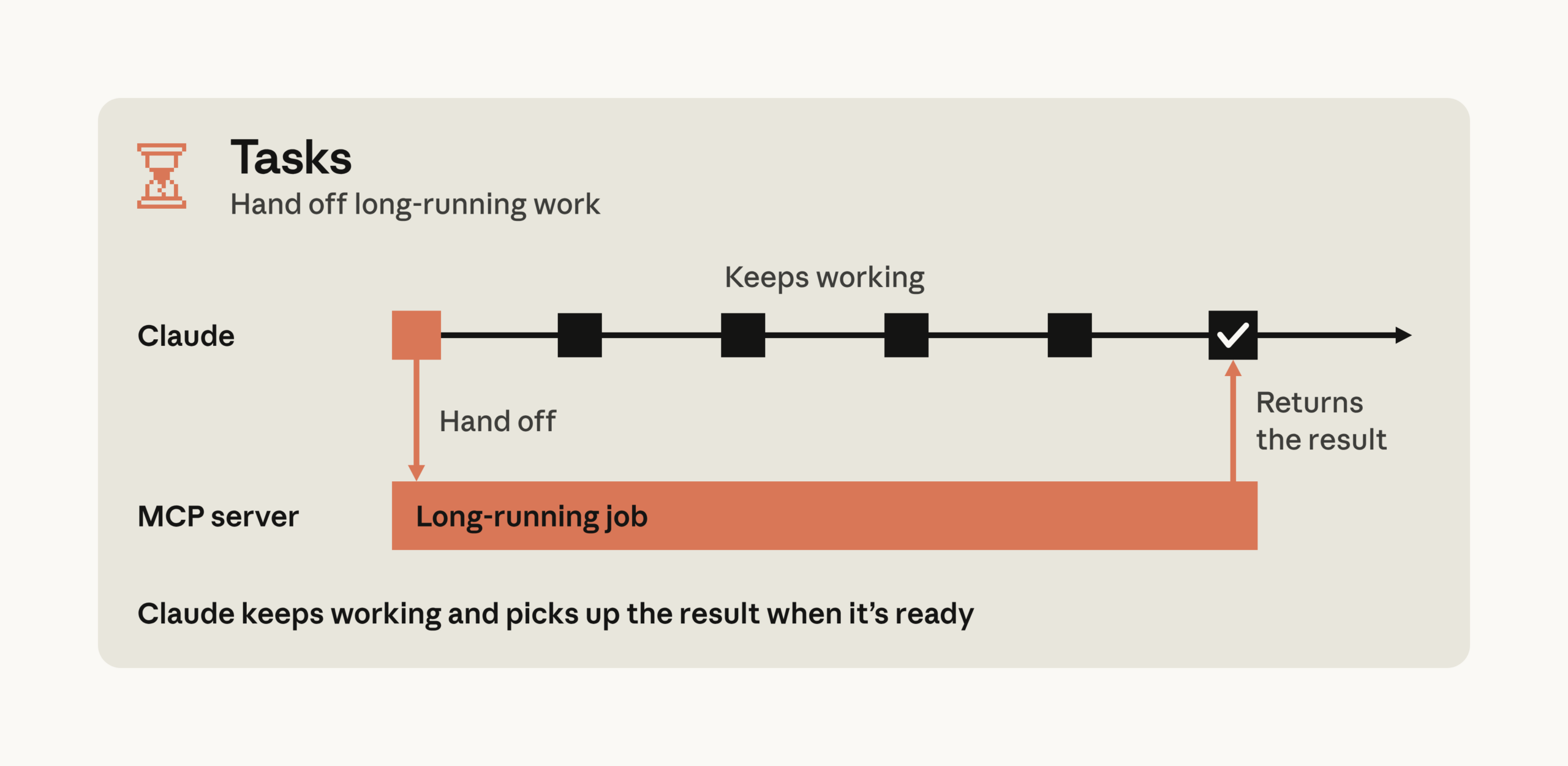
This update pushes the protocol from 'connecting tools' to 'letting agents work alone': Skills over MCP enters public beta, letting servers publish step-by-step playbooks alongside their tools for Claude to load on demand; Tasks and Elicitation are now generally available, the first letting Claude run multi-minute jobs in the background with a callback when done, the second letting it pause mid-task to ask a human for input; file uploads arrive soon, so Claude can pass PDFs, spreadsheets, and images to MCP servers without eating conversation context.
Tool Search comes with it: with many servers connected, Claude no longer needs every tool in context, saving over 85% of multi-server context usage. The protocol has been hosted by the Agentic AI Foundation under the Linux Foundation since December 2025, has more than 2,500 contributors, and its next specification release is planned for March 2027.
In two years, MCP has gone from an Anthropic house standard to the default wiring protocol for agents. For anyone building agent products, the implication is simple: stop writing separate wiring for each model. Ship the capability as an MCP server and it plugs into Claude, Codex, and a crowd of clients at once.
💡 Lumo’s take
The protocol war is over: 700M monthly downloads and 10,000+ connectors make MCP the USB-C of the agent world. The work worth doing now is not another protocol, but filling the gaps above it: good servers, reliable skills, and tools that help people manage a pile of servers.
04Ant's OceanBase launches OceanLake and open-sources its OceanSeek engine
Image source: QbitAI
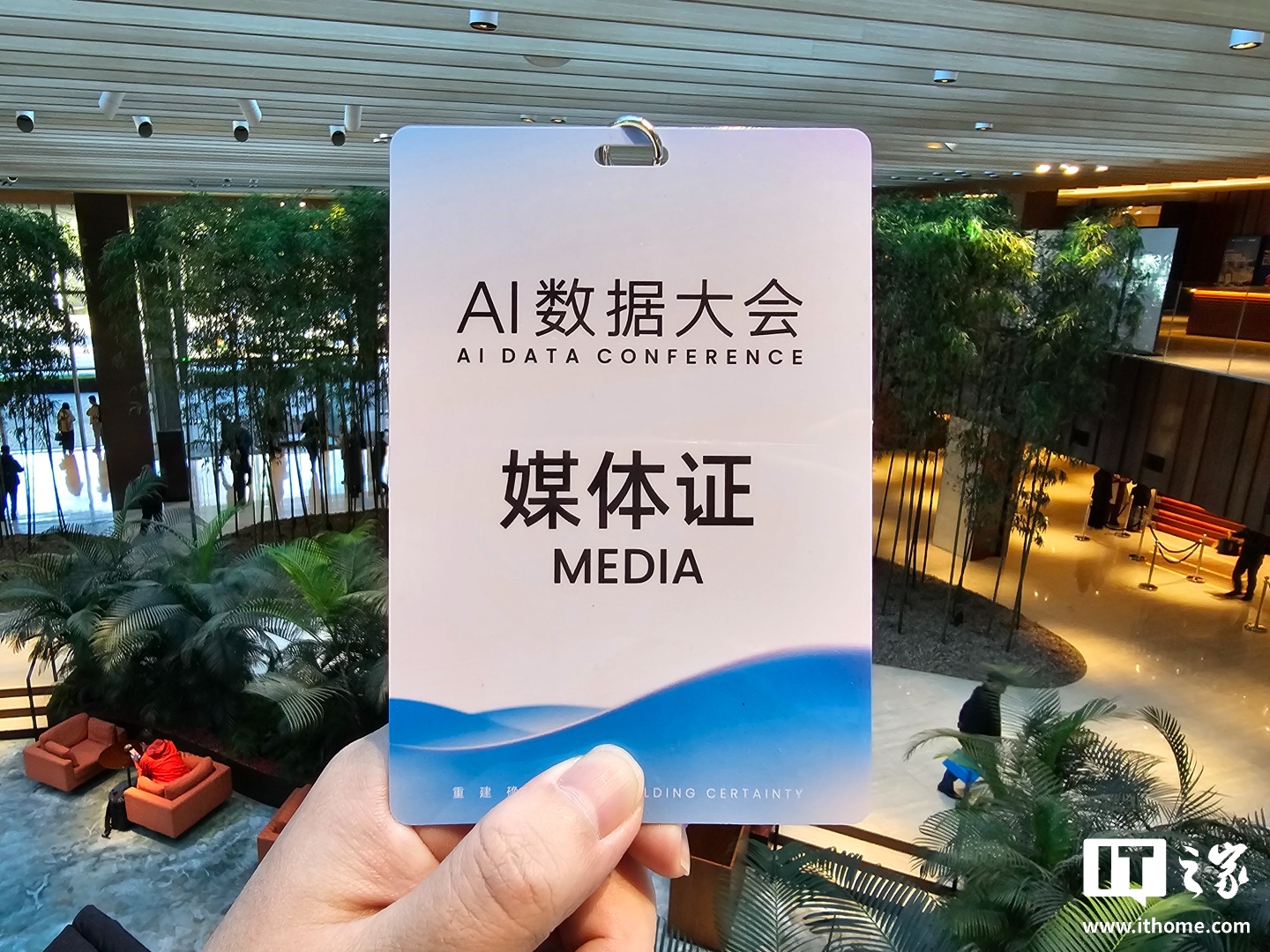
On November 24, Ant's OceanBase unveiled OceanLake, an integrated lakehouse AI data platform, at its AI Data Conference in Beijing, and open-sourced its core AI database engine as OceanSeek under Apache 2.0. OceanBase CEO Evan Yang's argument: model capability has become a commodity, so the challenge comes back to data.
OceanLake packs three capabilities into one platform: real-time transactions from databases, analytical computing from warehouses, and open storage from data lakes, managing structured, semi-structured, and unstructured multimodal data together. Enterprises can develop and govern data, run offline processing, and put the results straight into online analysis, retrieval, and agent applications on the same platform, with live business context for agents.
The deployment numbers are the hardest part of this launch: Ping An Life uses it to 'read' insurance and query business data by conversation, cutting typical data delivery from 2–5 days to about 15 minutes; Ant's Afu cut model-evaluation environment setup from days to minutes; more than 30 million 'flash apps' on Ant's Lingguang run on it. In a mixed search test over hundreds of billions of scalars and tens of billions of tags, P95 SQL response was 15.7 milliseconds.
This is the third piece of OceanBase's open-source stack: core database capabilities in 2021, the lightweight embeddable seekdb in 2025, and now OceanSeek for enterprise agent scenarios. For data product people, the direction is clear: the bottleneck for AI landing is shifting from 'is the model smart enough' to 'is the data foundation good enough to use.'
💡 Lumo’s take
Models are becoming utilities; the data layer underneath is the real moat. OceanLake's playbook is worth copying: it talks delivery time, not benchmark scores, and '2–5 days down to 15 minutes' opens wallets faster than any leaderboard. Data product folks should report their work the same way.
05SenseTime open-sources SenseNova U1.6: an 8B model that fixes its own image typos
Image source: IT Home
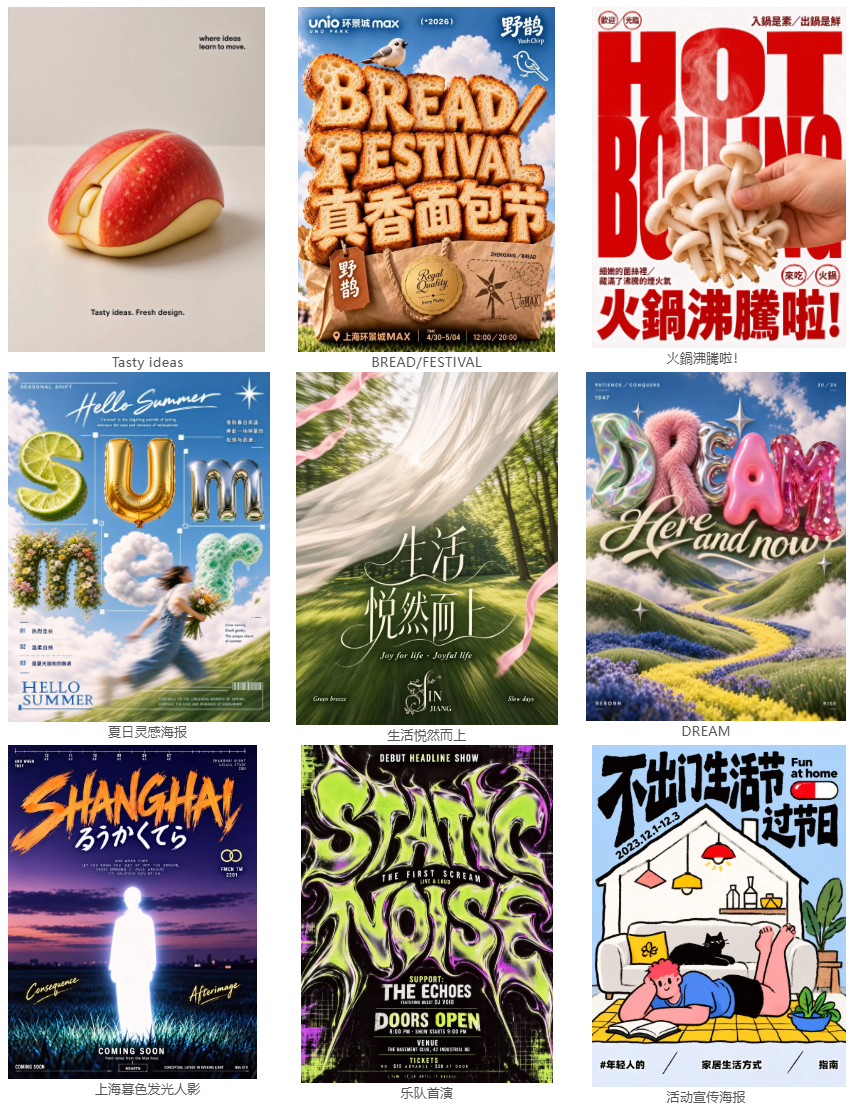
On November 24, SenseTime released and open-sourced SenseNova U1.6, a native multimodal model that brings 'native image self-correction' to an 8B open model for the first time. The same model works in two passes: draft first, then check the image's text against the prompt and generate a corrected version. No second model is needed to fix mistakes.
The numbers say self-correction works: on UltraTextBench dense-infographic tests, a single pass scores 86.04, rising to 92.28 with self-correction on; U1.6 Lite's aesthetic score is about 10% higher than the previous U1.5 Lite. Weights are open and the model is already on ComfyUI, so it can run and fix images locally.
It hits an old sore spot in image generation: the text inside the picture. Posters, menus, infographics: one wrong character ruins the whole image. The old fixes were drawing more samples and hoping, or bolting on a separate correction pipeline. Now an 8B model closes the loop itself, turning a lottery draw into an editing pass.
For people building small apps, a small, focused open model like this is often more useful than a flagship: it runs locally, slots into a workflow, and can be tuned when it misbehaves. Posters, infographics, and product images, where the words must not be wrong, are where it lands first.
💡 Lumo’s take
Image generation is moving from luck of the draw to having an editor: a model that checks and fixes its own work means small models can take jobs that used to need a flagship plus a human. If you build image tools, stop stacking more lottery draws and put self-checking and self-repair into the pipeline; success rate beats parameter count.
06Xiaomi posts ¥107.2B Q3 revenue as its robot clocks 8 hours on the factory floor
Image source: Xinhua Finance
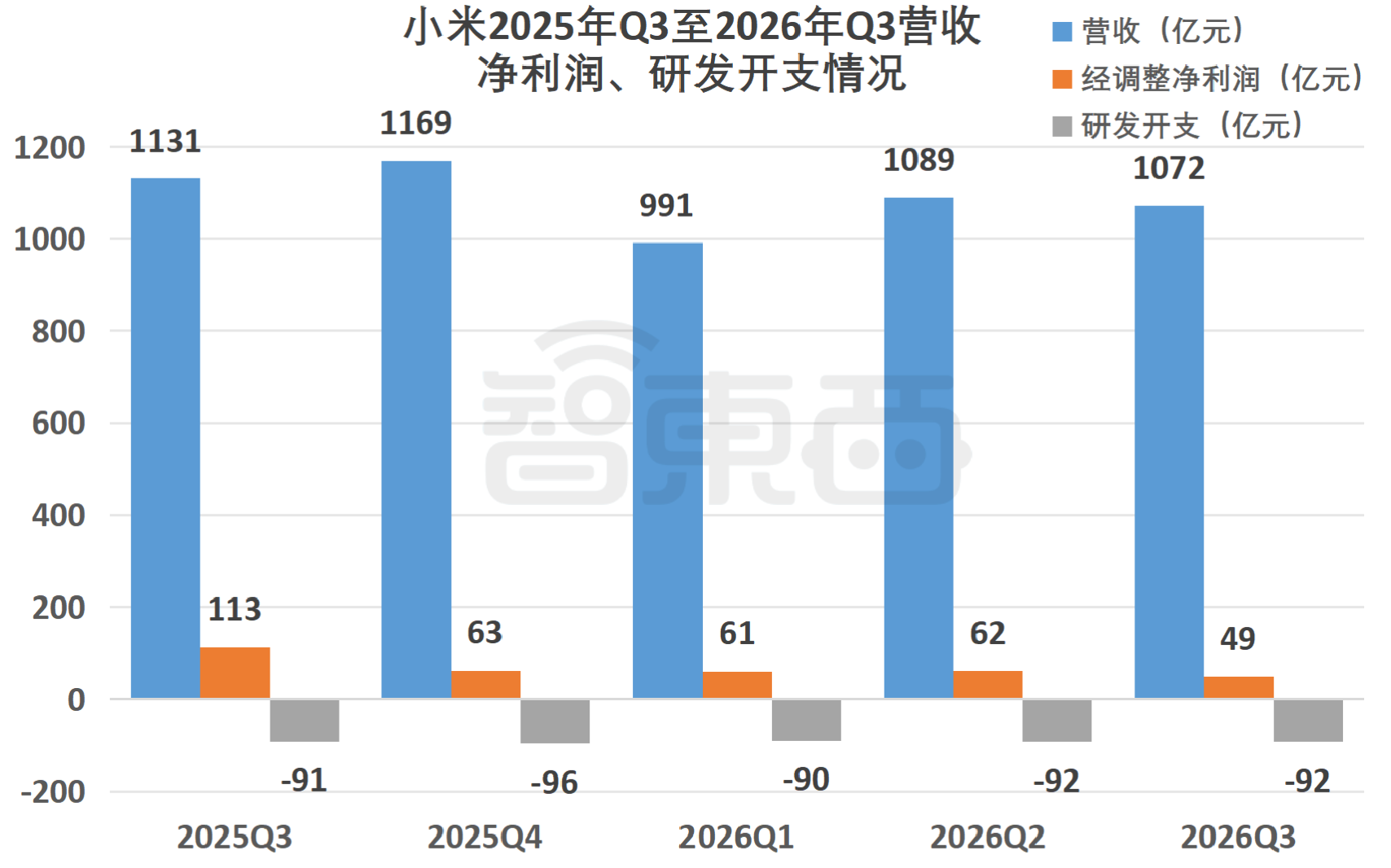
On the evening of November 24, Xiaomi reported third-quarter 2026 results: total revenue of ¥107.24 billion, down 5.2% year on year, and adjusted net profit of ¥4.884 billion, down 56.8%. President Lu Weibing called it the hardest quarter of his career on the earnings call: memory prices have risen 2–3x since the start of the year, and global smartphone shipments fell about 20% year on year.
The phone business is shrinking and getting more expensive at the same time: 30.7 million units shipped in Q3, down 29.3%, with a 12.1% global share, top three worldwide for 25 straight quarters; but average selling price rose 39.8% to ¥1,486, a record high, and its share of China's ¥6,000-plus market reached 4.4%. R&D spending was ¥9.2 billion in the quarter and ¥27.4 billion over the first nine months, with AI-related R&D accounting for over 30%.
The numbers to watch are in embodied AI: Xiaomi's new robot, built on data from 1,827 auto-factory workflows, has a bionic hand with 21 degrees of freedom, 26 motors, and 1,500 high-density tactile points across the palm. It has completed its first 8-hour stable shift on the auto factory's final-assembly line, recharging itself twice along the way. An agent closed-loop system built on the Xiaomi-Robotics-1 embodied foundation model has validated 50-plus tasks across 3 rooms and is now in trial operation at Xiaomi's youth apartments.
Chips and models are moving in parallel: the Xuanjie O3, O100, and D100 self-developed chips have all passed tape-out verification, and the AI Cube prototype packing all three runs 120B and 3B models locally. The MiMo-V2.6 series open-sourced in September costs roughly 1/20 to 1/60 as much per task as overseas peers at comparable intelligence.
💡 Lumo’s take
One earnings report tells three stories: phones are bleeding, premium pricing is stopping the bleed, and AI and robots are the bet. The number to watch is '8 hours': factory robots are no longer demo videos once you can grade them on continuous working time. Embodied AI's story is shifting from 'what it can do' to 'how long it can keep doing it.'
07Honor Magic 9 Pro Max debuts overseas: dual 200MP cameras with ARRI, RM5,999 in Malaysia
Image source: SoyaCincau
On November 24, Honor put the overseas debut of its new flagship, the Magic 9 Pro Max, in Malaysia: a single 12GB+512GB variant at RM5,999 (about $1,457), with pre-orders from November 24 to December 3 and sales starting December 4. A RM300 instant rebate brings it to RM5,699 during pre-order.
Imaging is the headline: both the main camera and the periscope telephoto are 200MP, the main on a 1/1.28-inch sensor at f/1.57, the telephoto on a 1/1.4-inch sensor at f/2.6 with 3.5x optical zoom, plus a 50MP ultra-wide and a 55MP front camera. Both 200MP cameras support CIPA 8.0 stabilization, with the main camera claiming gimbal-level 3-degree stabilization.
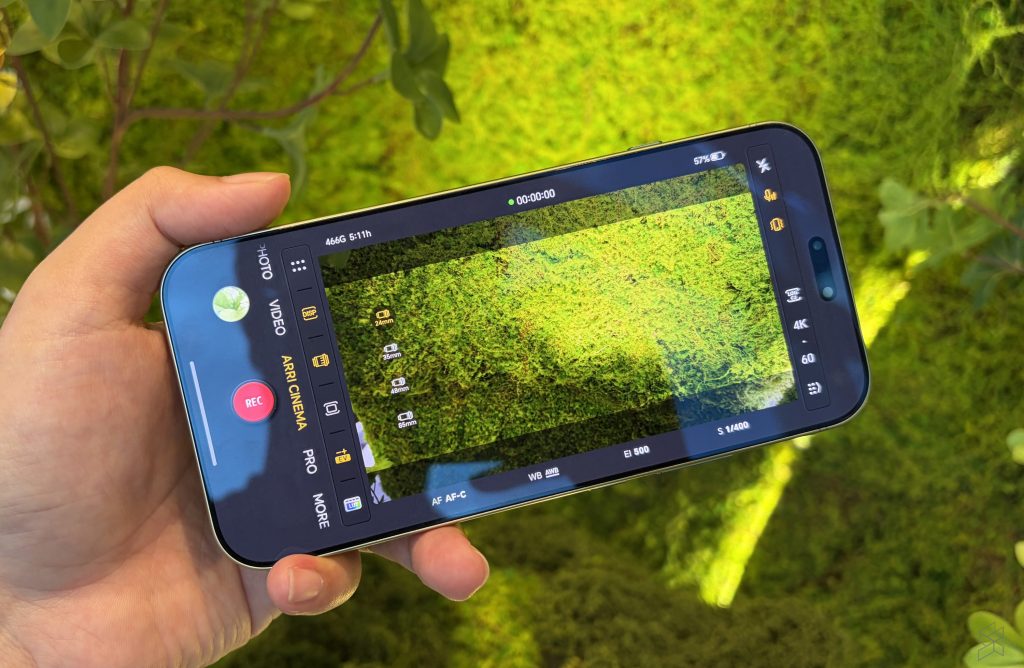
Honor brought in cinema equipment maker ARRI for the Magic series' 10th anniversary: the phone is the first to carry ARRI cinema color science, with ARRI LogC3 recording and 87 ARRI Looks across nine themes, plus ARRI 4K LiveVideo three-second moving images. Under the hood is Qualcomm's latest 2nm Snapdragon 8 Elite Extreme Gen 6, with an 8,000mAh silicon-carbon battery and 100W wired plus 80W wireless charging.
The 6.8-inch OLED peaks at 10,000 nits, the phone is rated IP68, IP69, and IP69K, and it has a dedicated AI Button that saves video highlights with a double press. Notably, Honor has also filled in cross-ecosystem connectivity: alongside AirDrop-style file sharing with iPhones, it supports native Apple Watch and AirPods connections. For Chinese flagships going overseas, 'works with Apple gear' is becoming a selling point.
💡 Lumo’s take
Phone cameras are now competing at the door of the film industry: ARRI color science in a phone turns 'cinematic' from a post-production skill into a factory default. For creators, the bar moves in a real way: shots that once needed rented gear and color-grading lessons now come straight out of a phone, so the contest shifts from equipment to ideas.
08Microsoft declares top-level Code Red after its worst-ever M365 outage
On November 12–13, Microsoft 365 went down globally for nearly 24 hours: Exchange Online, Outlook, Teams, and M365 Copilot were widely disrupted, with over 80% of affected services unresponsive at the peak. Microsoft's M365 Core president called it the worst incident in Exchange's history. On November 24, Reuters reported that Microsoft has declared an internal top-level 'Code Red' remediation in response.
The cause was not a cyberattack: Microsoft says a Windows defect introduced in July was triggered only under specific traffic patterns. Recovery was slowed by a 'thundering herd' problem, with users retrying en masse. CEO Satya Nadella has publicly apologized. The post-incident review also surfaced an organizational number: engineers exchanged more than 11,000 messages across 11 Teams channels coordinating the fix.
Code Red is Microsoft's highest-priority internal remediation signal: engineering teams must put service reliability and resilience first, targeting worldwide restoration within one hour of future incidents, isolating infrastructure so local faults cannot spread globally, and using AI agents to assist diagnosis.
The other side of the story is a warning: with AI capabilities such as Copilot running on the same cloud, an outage now takes down live AI workflows along with email. For teams heavily dependent on a single cloud vendor, 'what if the cloud goes down' is no longer an edge case for ops; it belongs in the business continuity plan.
💡 Lumo’s take
A company's top priority is usually set by an accident. What matters about Code Red is not just the 'restore within one hour' target, but the reality Microsoft is conceding: with AI assistants riding on the same cloud as the office suite, an outage now costs more than it used to. Disaster planning for products should be repriced on that basis.
09ElevenLabs in early funding talks targeting a $33B valuation as ARR hits $700M
Image source: IT Home
On November 26, Bloomberg reported that AI voice startup ElevenLabs is in early talks for a new funding round targeting a $33 billion valuation. Management plans to start the raise in the first quarter of 2027, while some potential investors want to move faster.
That valuation is 50% above the $22 billion of this September. What supports it is not storytelling but revenue: annual recurring revenue (ARR) has grown from $600 million in September to $700 million now, up about 17% in two months.
ElevenLabs was founded in 2022 by Mati Staniszewski and Piotr Dabkowski, and built its position on highly realistic AI synthetic voice and audio models, now used in audiobooks, games, and enterprise customer service. Its commercial products come in three lines: ElevenAgents for conversational workflows, ElevenCreative for multilingual content creation and dubbing (90+ languages), and ElevenAPI for low-latency developer integration.
One caution: these are still only 'early talks', and the valuation and timetable could change. But the direction is clear: voice is shifting from a 'model capability' business to a cash-flow business. ARR rising $100 million in two months says more about AI voice having moved past the storytelling phase than any demo video could.
💡 Lumo’s take
The valuation logic for voice AI has changed: the market is no longer paying only for 'how human the voice sounds', but for how fast ARR grows. ElevenLabs' three product lines are also worth copying: conversational workflows, content creation, and a developer API each eat a different layer without cannibalizing each other. Voice products should be sliced by 'who pays', not by 'how impressive the tech is'.
10Qube: an open-source, local-first personal AI assistant that lets you bring any model
Qube, launched on Product Hunt on November 24, is a free, open-source desktop personal AI assistant: not just a chatbot, it actually finishes jobs. It plans multi-step workflows, uses tools, checks its own output, and hands back real files, cited research, or filled-in forms. It can also run tasks proactively on a goal or schedule, asking only when a decision or a risky action needs a human.
Its pitch is 'your files never leave your machine': everything stays on your own computer, and you bring your own model — cloud models such as ChatGPT, Claude, Gemini, or OpenRouter, or local models via Ollama and LM Studio. Connected to Gmail, Slack, Notion, and more, it works and makes changes inside those apps directly.
Personal assistants of this shape are no longer rare, but Qube's combination hits a nerve for indie developers and small teams: open source, local-first, and model-swappable. It decouples the 'assistant' layer from any single big model; the model becomes a replaceable engine, and the assistant and its workflows are the product.
One caveat: Qube currently has only a Product Hunt page; no standalone official site or code repository has surfaced, so trying it means going through the Product Hunt page. Per that page it is free and open source, with no pricing model stated.
💡 Lumo’s take
Assistants are splitting in two: official ones tied to a single big model, and independent ones like Qube where the model is swappable and the files stay local. For builders, the second path is attractive because what users truly own is the workflow and the data, not a monthly subscription, and that is exactly where small teams can compete on a different axis from the giants.
11Letter Visitors: see who's on your website, right on your website
Image source: Product Hunt
Letter Visitors, which topped Product Hunt's daily leaderboard on November 23 (and the weekly board with 406 votes), does something counterintuitive: instead of opening yet another analytics dashboard, it overlays who is visiting right on your own website's pages: names, titles, and companies at a glance, plus session replays.
It also counts AI crawlers as visitors: it can identify AI agents such as ChatGPT, Claude, and Perplexity (verified against official IP ranges) and show which pages they read. For site owners wondering whether AI will recommend them, this is the first tool to single out AI visitors as a category. Identifying real people costs 50 tokens per person (about $0.50); new accounts get 2,000 tokens. AI-agent visibility is free.
Press Ctrl+L to bring up the overlay, with no tab-switching between dashboards. For indie sites and small product teams, the value is not 'one more stats panel' but putting 'who is looking, and at what' back where decisions happen: while you are editing a landing page, you can see who the last wave of visitors was and where they came from.
One caveat: visitor identification depends on a third-party database's match rate, which may differ for small sites versus large ones, and per-person token pricing scales with traffic. Running it on the free allowance for a week to check the match rate is the safer way in.
💡 Lumo’s take
The endgame of analytics is not a fuller dashboard but a closer one: overlaying data on the page you are already looking at removes a context switch from every decision. The more interesting move is the AI visitor it singles out: now that AI browses the web on people's behalf, 'has AI read me' is becoming as important a metric as 'has anyone visited.'
12An AI fire cannon blasts a barbecue sign's printed flames; officials clarify it was aiming at the real charcoal stove behind it
Image source: MyDrivers
At noon on November 19, at the Wanlong ski resort in Chongli, Zhangjiakou, Hebei, an automatic fire cannon at a barbecue stall suddenly activated and sprayed a jet of water straight at the stall's lightbox sign, which was printed with roaring flames. As video spread, netizens joked that 'the AI mistook a picture for a real fire.'
The reversal came fast: the resort and the fire department clarified that the cannon had not been fooled by a fake fire. It had sensed the real heat of the charcoal stove behind the sign and triggered exactly as designed; only the spray angle happened to land the water on the sign. Nobody was hurt, and the stall reopened 20 minutes later.
The funny part of this story is precisely the part that is not funny: an 'AI fail' meme took off, but the truth was that the device worked as designed and judged correctly. The error was in the onlookers' eagerness to imagine a failure. Stories about AI going wrong travel fast, but verification often only needs waiting for one official response.
For anyone who works with AI daily, this is a ready-made reminder: model or sensor, do not rush to a verdict when something looks wrong. First ask what it actually 'saw', then decide whether to laugh or to fix it.
💡 Lumo’s take
The joke in this closer is not an AI failure but the reversal: the device was right, and the crowd was too eager to watch AI fail. In the AI era, jokes expire fast, and laughing for three seconds before verifying has become a basic skill.
"One-sentence desktop app shop": turn everyday shop tools into desktop apps for owners who cannot code.
What it is: small offline shops (restaurants, nail salons, renovation crews, training schools) do their billing, rostering, and customer notes in WeChat every day, and nobody there writes software. Take an order, turn the request into a desktop app with Claude in one sentence: a roster, a quote calculator, a customer follow-up board, a stock reminder. Ship an installer; the owner double-clicks and uses it, no code, no setup.
Who pays: shop owners pay for 'half an hour of manual work saved every day', not for technology. Charge once per tool, then per change; that is an order of magnitude cheaper than hiring a developer, and far faster than learning to code. A happy shop introduces its peers.
Why now: Claude just shipped 'Install as app': a prompt-built tool installs as a desktop app with one click, with its own window and icon, updating automatically when edited. This used to need packaging, signing, and setup; now the barrier has collapsed. Posts about 'AI-made mini tools' are already gaining traction on Xiaohongshu, so demand is warmed up.
Minimum viable product: build 3 samples with Claude first (a restaurant roster, a nail salon booking book, a renovation quote calculator), record the screen, and post on Xiaohongshu and Douyin with the line 'one sentence turns your shop's little spreadsheet into a desktop app'. Take orders in the comments, only ones with a clearly described need.
First validation step: do the first 3 cases free in exchange for feedback and testimonial screenshots. Set prices only when someone asks what it costs, and take a deposit before starting. If nobody asks within a week, switch industries (try a training school's timetable tool) and test again.