01FCC clears SpaceX to deploy 1 million orbital data-center satellites
Image source: Reuters
On November 25, the U.S. Federal Communications Commission (FCC) approved SpaceX's 'Starmind' orbital data-center constellation: 1 million non-geostationary satellites running compute in space. The license requires deployment to begin no later than November 2033, reach 100,000 satellites (10%) by November 2035, and 500,000 by November 2038.
It is the largest satellite deployment authorization ever granted. A Gartner analyst called it 'peak insanity,' while Google has argued orbital data centers only make economic sense if launch costs fall to $200 per kilogram.
The logic of putting data centers in orbit is to sidestep the two bottlenecks of ground-based facilities: power and cooling. Space offers abundant solar energy and natural vacuum cooling, in theory scaling compute beyond what can be built on Earth. The price is an astronomical launch volume, plus the orbital congestion and light-pollution debates that come with it.
💡 Lumo’s take
'Moving the data center into space' sounds like science fiction, but it points at a real shift: the bottleneck for compute is moving from chips to power and cooling. For anyone building AI products, it is worth asking which applications that are unaffordable today suddenly become viable when compute itself becomes infrastructure deployed in orbit. The flip side of the astronomical numbers is that orbits, spectrum, and launch capacity are becoming the new scarce resources.
02XPeng IRON humanoid robot enters hardware mass production in January 2027
Image source: China News Service
On November 25, XPeng held its eighth Tech Day in Guangzhou, unveiling the Turing embodied architecture and announcing that its humanoid robot IRON will enter hardware mass production in January 2027. IRON is 1.70 m tall, weighs 62 kg, has 76 degrees of freedom and more than 1,500 tactile points, with over 80% tactile coverage in core areas. It carries three Turing chips delivering 2,250 TOPS, and a solid-state battery that charges in 20 minutes for 1.5 hours of work.
The Turing embodied architecture has three layers: System 2 for reasoning and planning, System 1 as a second-generation VLA (vision-language-action) model, and System 0 for real-time control. XPeng also launched an open platform for its robot ecosystem.
The first deployment is not a factory but XPeng's own stores: in Q1 2027, IRON will start 'internships' as a sales guide and tour guide in XPeng stores, with a formal public launch in Q2.
💡 Lumo’s take
Humanoid robots now have a concrete 'start date' for real work — an internship in the company's own stores before a public launch. It is a smart path: a store is a controlled, semi-open setting that yields real interaction data without betting everything on harsh factory conditions on day one. The open platform is the part to watch: once robot hardware ships at scale, the scarce piece is no longer the body but what it can do — writing skills for robots could become the next opening for small apps.
03OpenAI begins testing 'Private Inference', isolating customer data even from itself
Image source: OpenAI official site
On November 26, OpenAI CEO Sam Altman announced on X that the company has begun small-scale testing of 'Private Inference'. Part of OpenAI's enterprise offering Private Intelligence, it uses confidential computing to isolate customer data so that even OpenAI's own staff cannot see prompts or outputs during inference.
It ships alongside Zero Data Retention (ZDR) and Private Safety Processing (PSP): the former means prompts and model outputs are not retained after processing, while the latter applies automated safety review to sensitive workflows. Private Intelligence itself was previewed at DevDay on October 30; the new step on November 26 is the start of customer testing.
Only a small number of customers are in the test so far, and technical details, the customer list, launch timing, and pricing have not been disclosed.
💡 Lumo’s take
The hardest barrier for AI in the enterprise was never capability, but 'will my data be seen?' OpenAI is now selling 'even we cannot see it' as a feature, turning privacy from a compliance clause into a product capability. The takeaway for anyone building enterprise AI: as model vendors start competing on the ability not to see, data isolation and zero retention can be written into your own product promise — they are becoming a new currency of trust.
04Shengshu releases Motubrain 2.0 world action model, topping five of six robot benchmarks
Image source: Shengshu official site
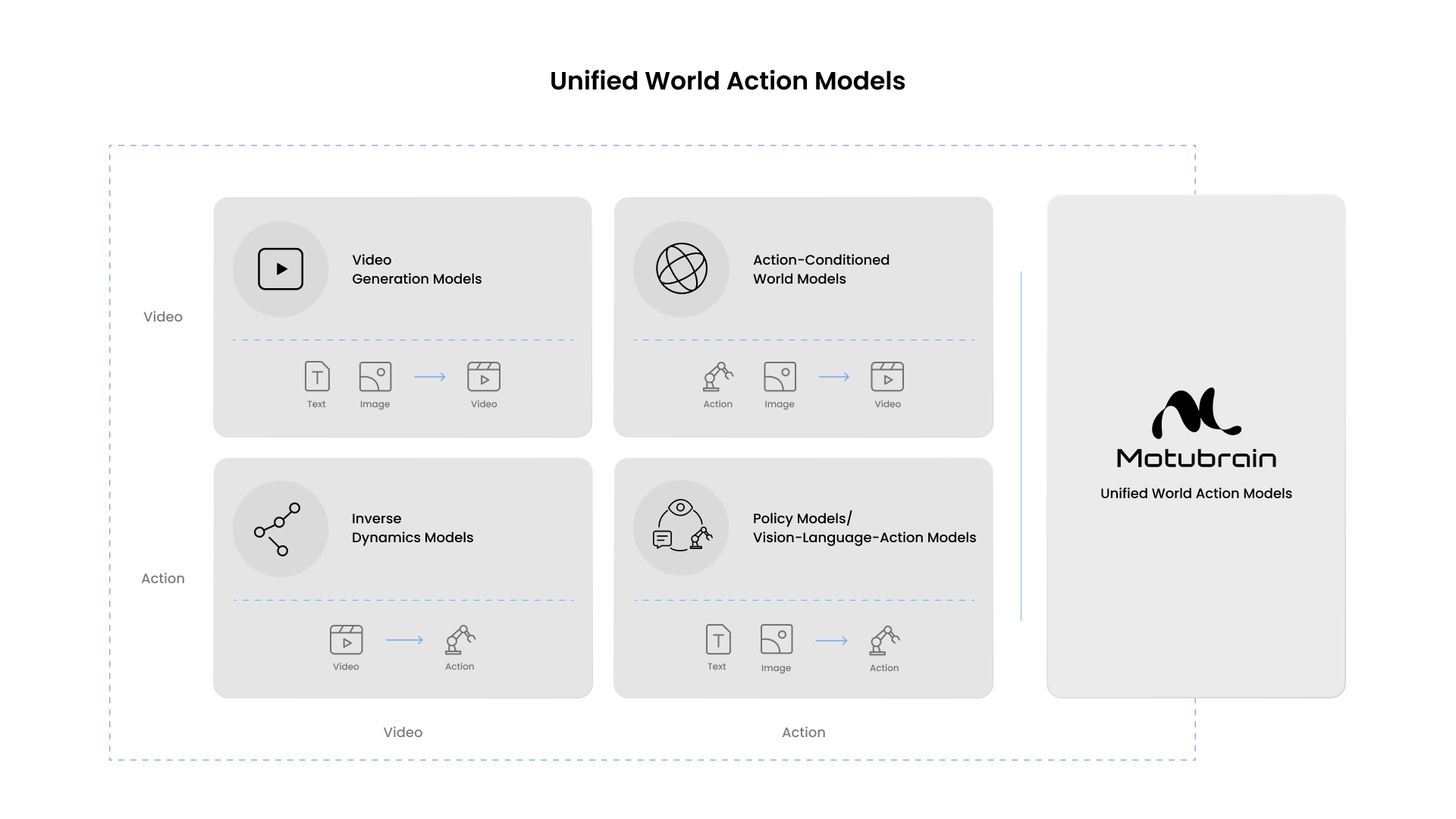
On November 25, Shengshu Technology released Motubrain 2.0: a 20-billion-parameter world action model (WAM) paired with the Motubrain-Harness agent system, to be open-sourced soon. The model was trained on 2.5 million hours of multi-source data, and an 8.33-billion-parameter Nano version is also available.
Across six robot manipulation benchmarks, Motubrain 2.0 ranked first in five. On the RoboDojo composite benchmark it scored 41.28, ahead of GPT-6 Astra at 28.97, Claude Opus 5.5 at 39.40, and Claude Fable 5.1 at 27.60.
Shengshu previously livestreamed Motubrain's pretraining for 25 days. This release packages 'world model plus action execution' into a system that can directly drive robots, rather than a model that only predicts video.
💡 Lumo’s take
World models are moving from 'can imagine' to 'can do': predicting the world is not enough — the model has to get real work done on a real robot. The lesson from Shengshu's approach is to score on hard robot-manipulation metrics, not on how good generated video looks. For anyone building embodied applications, the part worth trying is the open-sourced Harness — once a world model can directly drive a robotic arm, countless 'see it once and do it' tasks in homes and stores start to have a repeatable solution.
05Huawei found guilty on 10 of 12 counts; sentencing set for September 2027
Image source: Fox Business
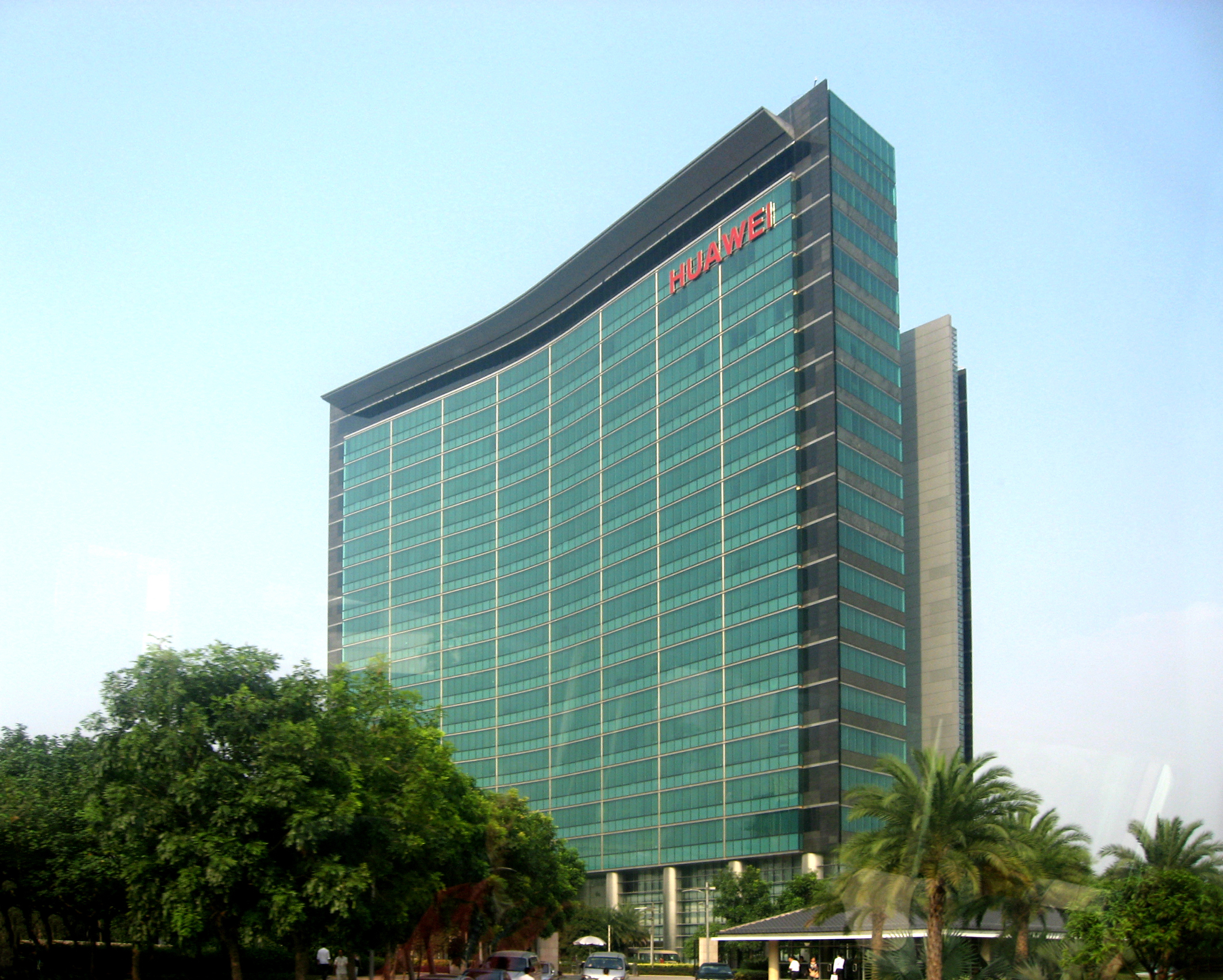
On November 24, a federal jury in Brooklyn found Huawei guilty on 10 of 12 counts, including conspiracy to steal trade secrets, wire and bank fraud, violating Iran sanctions under the International Emergency Economic Powers Act (IEEPA), and money-laundering conspiracy. The two acquittals were for racketeering conspiracy and obstruction-of-justice conspiracy.
The case dates back to charges filed in 2018 and went through years of proceedings. Sentencing is scheduled for September 14, 2027. Huawei said it will pursue legal action.
The verdict lands as U.S.-China tech competition and export controls keep tightening. For Chinese tech companies, the case matters beyond itself: trade secrets, sanctions compliance, and financial channels are becoming three lines that overseas expansion must respect at the same time.
💡 Lumo’s take
This is not a piece of tooling news, but it draws a line that everyone building AI or hardware for overseas markets has to respect: technology, compliance, and financial channels are now judged together. Models can be open-sourced and code can flow across borders, but the red lines around trade secrets, sanctions lists, and payment paths are only getting tighter. Before building a product, ask: does any part of your supply chain, data source, or payment flow sit near one of those three lines?
06Gemini 4 Neon sets a day-one paid API usage record; Perplexity burned 120B+ tokens in three days
Image source: Google official blog
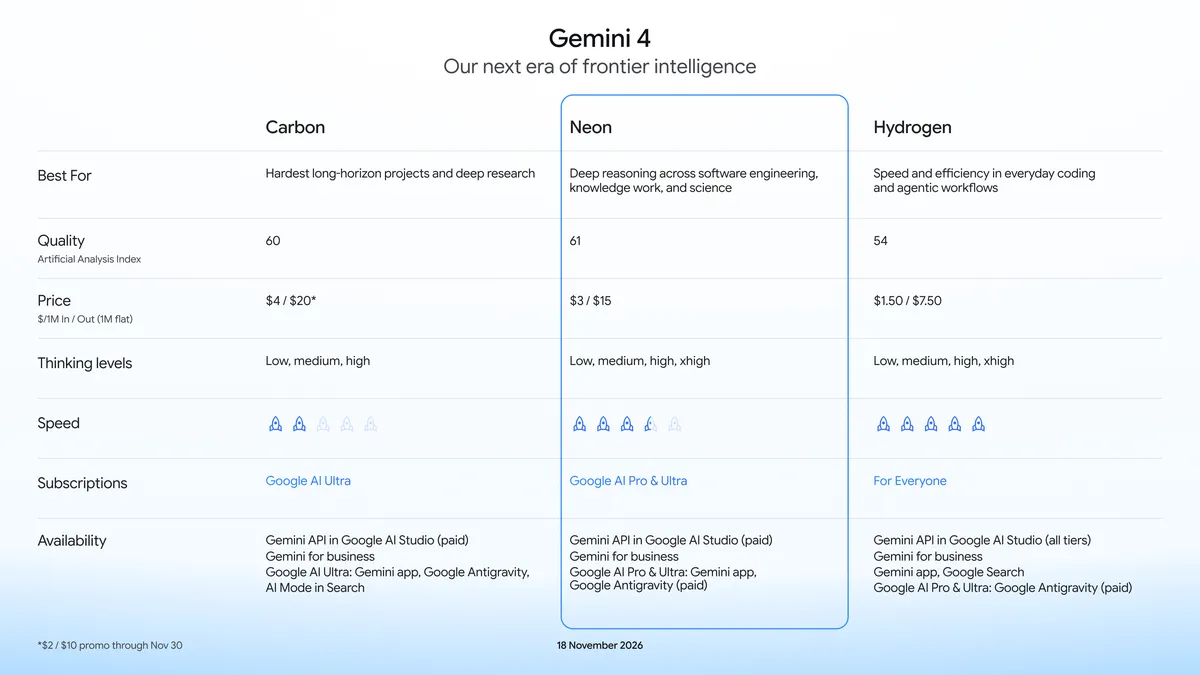
Google CEO Sundar Pichai said Gemini 4 Neon set a day-one usage record for a new model on Google's paid APIs. Neon launched on November 18, priced at $3/$15 per million tokens (input/output) with a 1-million-token context window; after Antigravity adopted it, daily token usage rose 82% versus six weeks before the Argon launch.
Perplexity CEO Aravind Srinivas said the company ran more than 120 billion Neon tokens in three days: 36 billion on Monday and 44.52 billion on Tuesday, up 23.5% day over day.
On Artificial Analysis's Intelligence Index, Neon scores 61, ranking third; on the Coding Agent Index it ranks first with 58.6. A model setting usage records within a week of launch shows agent workloads becoming the largest source of inference demand.
💡 Lumo’s take
Neon's record is not 'another stronger model' — it is 'agents are becoming the main source of inference demand': one customer burned 120 billion tokens in three days. The math for AI builders has changed — from 'how much does one call cost' to 'how many tokens does one agent task burn'. Whoever can keep an agent's token usage under control and explain the cost structure will hold the pricing power in the next round.
07Google Workspace MCP servers and CLI go GA; MCP becomes mandatory from February 2027
Image source: Google Workspace official blog
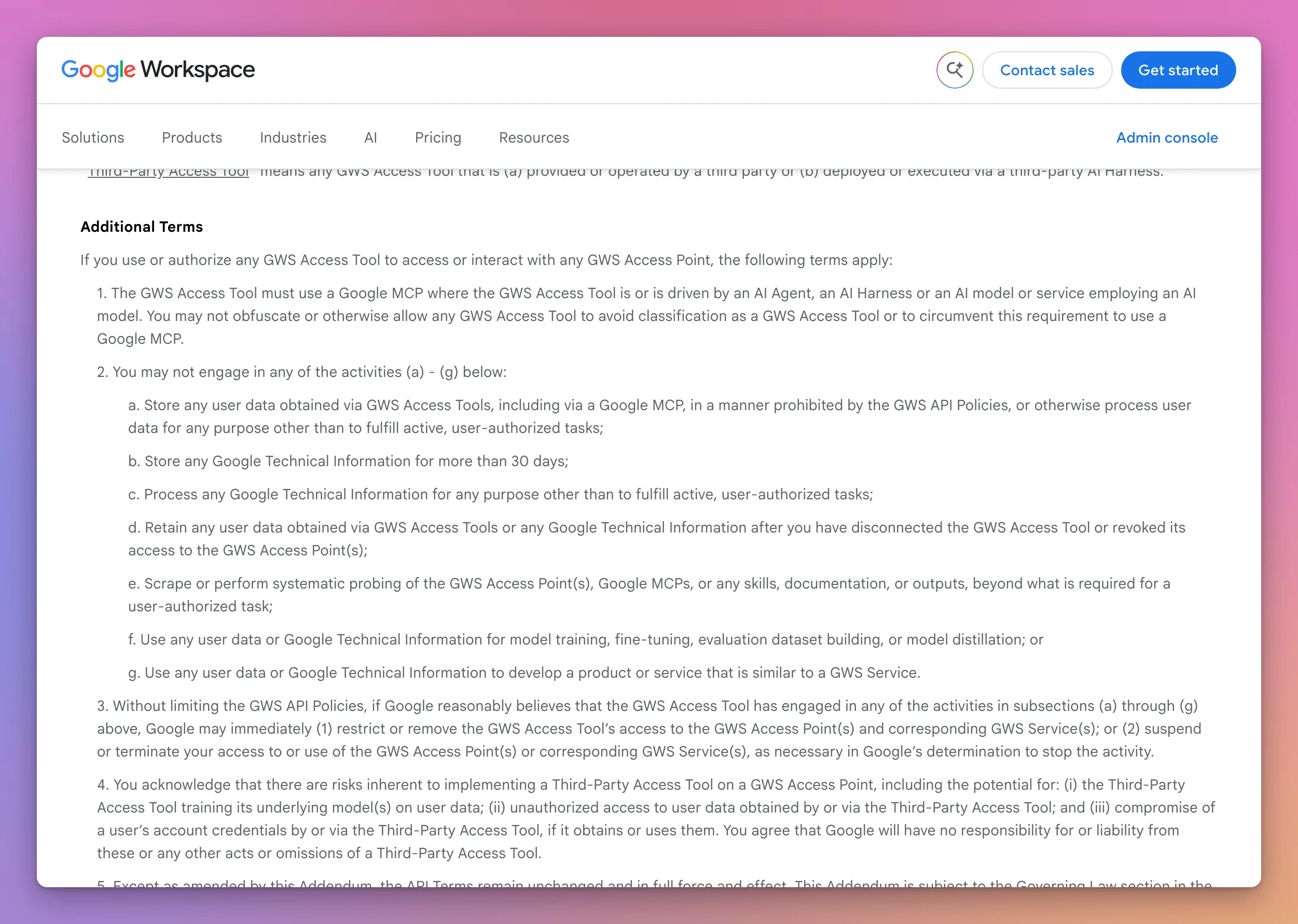
On November 24, Google's Workspace MCP servers and the official CLI tool gwscli went generally available: eight managed MCP servers covering Gmail, Drive, Docs, Sheets, Slides, Calendar, Chat, and Tasks, letting agents read and write documents, send mail, and manage calendars directly inside Workspace.
The new Workspace AI Tools Addendum draws a hard line: AI agents may no longer call Workspace REST APIs directly and must go through MCP. Enforcement begins February 1, 2027, with violating calls throttled at Standard Tier limits. Derived data (vector embeddings, memory indexes, and similar) carries a hard 30-day TTL and is deleted on expiry.
Billing starts April 1, 2027: the Standard Tier includes 5,000 free requests per day per product, while the Scaled Tier offers no free MCP allowance.
💡 Lumo’s take
This is the moment MCP went from 'optional protocol' to 'mandatory channel': Google is backing MCP with its most profitable productivity suite and writing 'agents may not call the API directly' into the contract. The signal for developers is clear — connecting agents to enterprise data is turning from a bonus into a requirement. The design details are worth studying too: the 30-day hard TTL and tiered billing solve both anxieties at once, that agents remember too much and that agents cost too much to call.
08OpenAI preprint claims matrix multiplication exponent is exactly 9/4 — not yet peer-reviewed
Image source: Preprint (AlphaXiv)
On November 24, OpenAI's math team published a 111-page preprint, 'The matrix multiplication exponent is nine fourths,' claiming that the matrix multiplication exponent ω equals 9/4 (2.25) over all fields. The paper includes a partially completed formalization in Lean. The Hacker News thread drew 1,034 points and 583 comments.
The key caveat: this is a preprint and has not been peer-reviewed. An upper bound was already published in October; the new contribution is the lower bound. As of November 25, no named expert had publicly reviewed whether the lower-bound proof holds. Three related manuscripts in October were withdrawn over sign errors.
Even if the result holds up, it will not make inference cheaper in the short term: real hardware still uses Strassen-style methods, and these algorithms are 'galactic' — beautiful in theory, impractical at real-world scale.
💡 Lumo’s take
A 50-year-old math problem may have been solved 'exactly', but 'claimed' and 'confirmed' are still separated by peer review. The right way to read this news is as a signal, not a conclusion: matrix multiplication underlies all AI computation, so every reduction in the exponent eventually flows into training and inference costs — but in the short term, what decides your bill is engineering, not the exponent in a paper. Understand it first, get excited second.
09Tencent open-sources DFly2 draft model, speeding Hy4 flash long-form generation up to 4.2x
Image source: GitHub (Tencent AngelSpec)
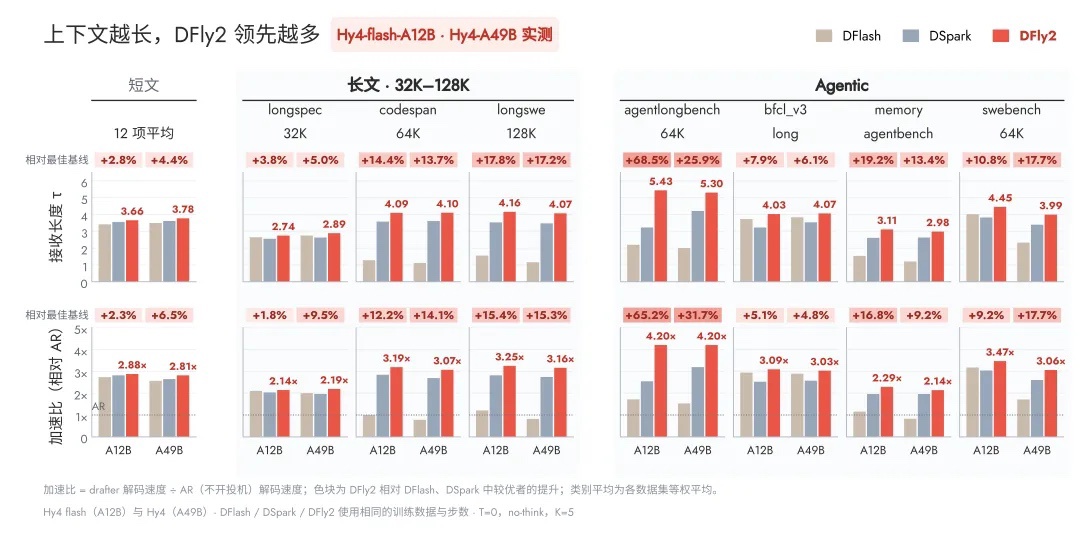
On November 26, Tencent's Hunyuan team open-sourced DFly2, a speculative-decoding draft model for Hy4 flash that changes neither the target model's weights nor its outputs. It reuses the target model's KV cache and a sparse index (up to 2,048 key positions), adding no extra KV memory.
Across 19 public benchmarks, DFly2 beats both the DFlash and DSpark baselines; long-context generation runs about 3.2x faster, with a best case of 4.2x. Weights are released under Apache-2.0, training code is merged into AngelSpec, and drafter weights for DeepSeek-V4.1-Flash and GLM-5.3-Flash are included.
Speculative decoding works on a simple idea: a small model guesses ahead and the large model only verifies. Correct guesses are accepted directly, skipping the large model's token-by-token generation. DFly2's twist is that the draft model guesses while standing on the target model's own KV cache, so its guesses are more accurate.
💡 Lumo’s take
The inference-cost battle is shifting from 'use a smaller model' to 'make the large model compute fewer steps': speculative decoding changes neither the model nor its outputs, yet speeds long-form generation 3–4x through engineering alone. For anyone running inference services, this is a high-return optimization; for ordinary developers, Apache-2.0 weights plus ready-made checkpoints mean you can try it via AngelSpec without training your own draft model. Note also that DeepSeek and GLM versions shipped alongside — this approach is becoming a cross-model commodity.
On November 26, VAST released Tripo H3.5 Preview, a high-precision AI 3D foundation model now live on Tripo Studio. In 192 blind comparisons of untextured models, H3.5 took first place 82 times (42.8%), a win rate 2.3x that of the runner-up.
OCR accuracy for untextured relief text jumped from 46.1% in H3.1 to 90.7%, and the model can now generate native watertight meshes directly, with printability checks and automatic repair launching alongside.
For 3D creators, H3.5's significance is not 'it looks more like the real thing' but 'it is ready to use once generated': watertight meshes plus printability checks close the last mile between AI 3D generation and 3D printing.
💡 Lumo’s take
AI 3D generation has hit a dividing line: the contest used to be about 'does it look right', and now it is about 'can it go straight to print and production'. H3.5 lifts relief-text recognition from 46% to 90% and adds watertight meshes with printability checks, moving 3D generation from 'producing a render' to 'producing a deliverable'. Anyone making small goods, cultural products, or figurines can start doing the math seriously — generate from a sentence, print directly, list it for sale. That pipeline only truly works starting today.
11MyClaw 3.0 tops Product Hunt's daily chart with a six-engine multi-agent team
Image source: MyClaw official site
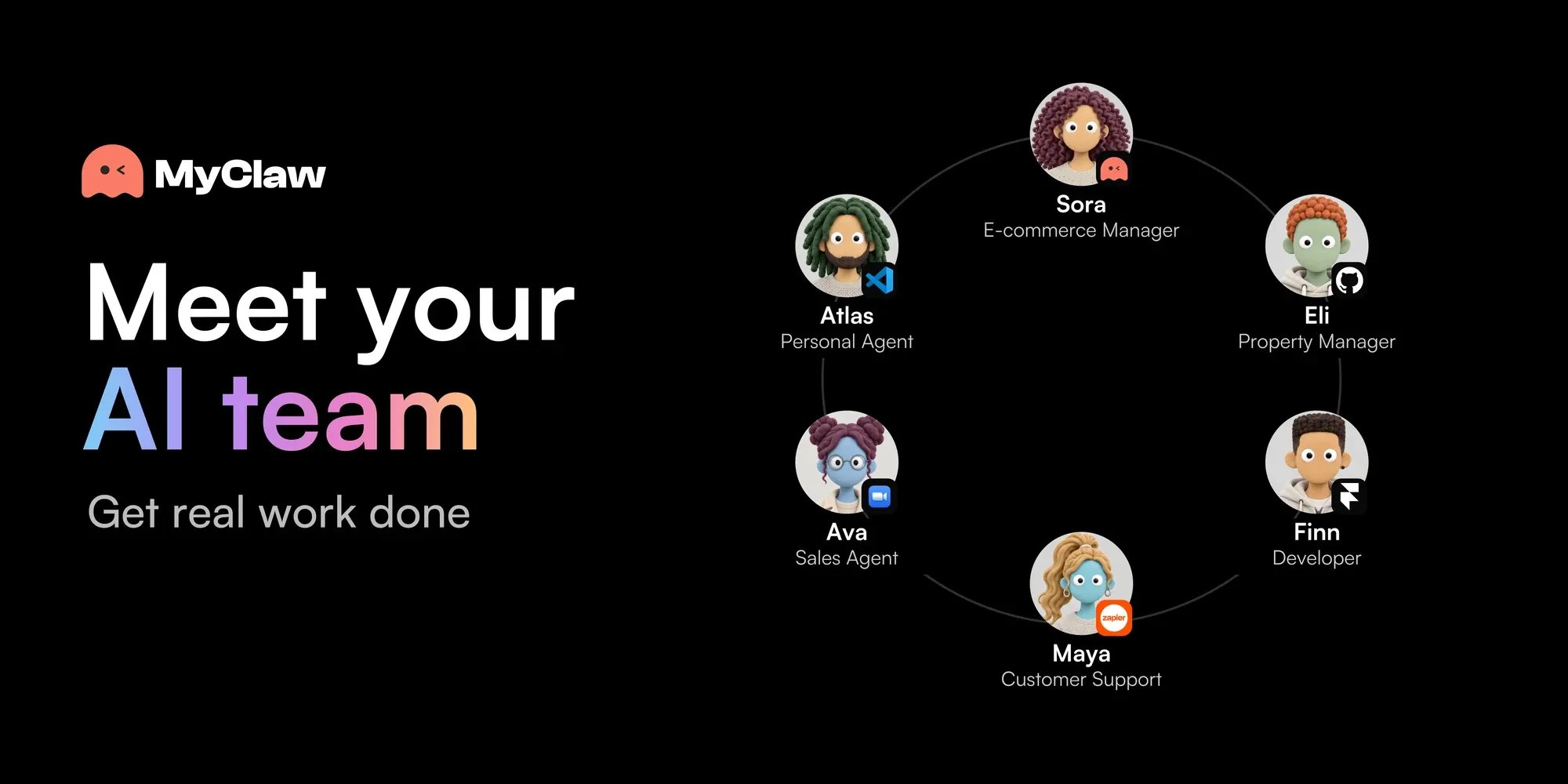
On November 26, MyClaw 3.0 launched on Product Hunt and took the day's top spot with 334 votes. It is a hosted multi-agent team product: users get teammates by role (researcher, content creator, and more), with a choice of six engines — OpenClaw, Hermes Agent, Pi, Claude Code, Codex, and DeepSeek Harness — and support for 50+ models.
Agents share memory across the team and run on always-on cloud computers, so tasks keep going while the user is offline. Pricing is Pro at $20/month (4,000 credits), Max at $40/month, and ULTRA at $200/month. Version 3.0 was announced on X on November 18; November 26 was its Product Hunt launch day.
💡 Lumo’s take
Multi-agent products are moving from 'one agent, one task' to 'a team online 24 hours': role-based teammates plus shared memory plus offline execution — the competition is now about collaboration, not single-agent capability. The pricing logic is worth studying: it sells 'team hours' by credits, not software by seat. For indie developers, the real opening is not cloning MyClaw, but assembling a ready-made 'small team' for one specific kind of work — say, a two-agent team for content ideation and publishing — and selling it to the people who need it most.
12Canva MCP is now generally available, no waitlist
Image source: Canva official newsroom
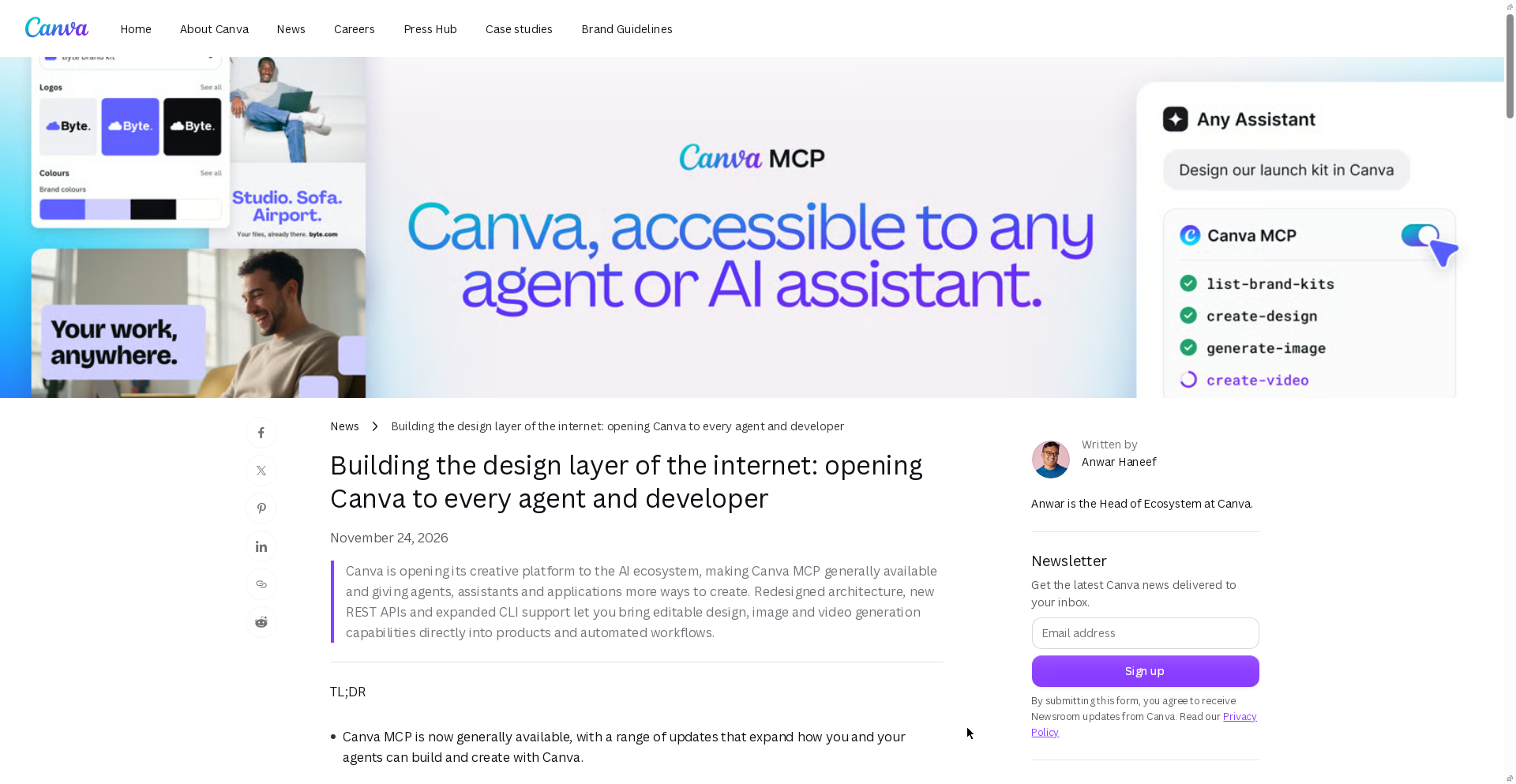
On November 23–24, Canva announced that its MCP offering is now generally available: the remote MCP server at api.canva.com/connect/v1/mcp has no waitlist, letting agents generate and edit exportable designs, images, and videos, remove backgrounds, and use Magic Layers.
The same release opens REST APIs, an expanded CLI, and service accounts, plus the Canva Craft image model. Since October, nearly 500,000 people have signed up for Canva through MCP, MCP usage rose 93% from September to October, and 72% of CLI commands in October came from agents.
Canva frames the shift as moving from 'a place to design' to 'the design layer of the internet': any product can embed design capabilities without building design tools from scratch.
💡 Lumo’s take
Design tools are becoming the 'hands' of agents: people used to open Canva to make graphics; now agents call Canva directly to produce designs. For AI builders, 'generate an image' is becoming 'deliver a design that can be edited, exported, and dropped into a workflow'. The numbers are the telling part: 72% of CLI commands now come from agents — agents are already the main users of Canva's developer tools. If you build tools for agents, ask first whether your tool is easy for an agent to call.
13Doodle: a stick-figure AI companion living on your taskbar
On November 25, Doodle launched on Product Hunt and ranked 7th for the day. It is a small Windows desktop companion: a stick figure living on the taskbar. Press Ctrl+Shift+Space to ask a question, Ctrl+Alt+Space for local dictation, and set reminders in plain English.
Its memory lives in plain-text notes stored locally (Documents\Doodle, e.g. me.md), which users can open, edit, and delete themselves. For things it cannot do, it can write a plugin itself (Doodle Evolution): tested in a sandbox first, and installed only after the user approves.
It is free to start, with Pro at £12/month. Its charm is precisely its smallness: it does not chat, does not act cute, and does not upload data — it only works when called.
💡 Lumo’s take
AI companions are splitting into two extremes: ever more human-like large models on one side, and deliberately tiny things like Doodle on the other. Its clever move is making privacy something you can see — memory is just a .md file on your own drive. For anyone building desktop utilities, this is a trick worth learning: you do not need more features. Doing 'local, transparent, and on-call' to the extreme is itself a product position.
'One-sentence custom 3D print shop': a user describes the figurine, desk ornament, or creative trinket they want in one sentence, and AI generates the 3D model, runs an automatic printability check, and sends the order to a 3D printing service.
What it is: a single-page site — type one sentence, generate the model via the Tripo API, show the render with a printability report, quote a price by volume and material, and hand the order to a local print shop for production and shipping.
Who pays: small Taobao, Xianyu, and Etsy sellers offering custom figurines, desk ornaments, and wedding or birthday keepsakes — plus ordinary people who want a one-of-a-kind gift but cannot model in 3D.
Why now: Tripo H3.5 launched today, winning 42.8% of 192 blind comparisons, lifting relief-text recognition to 90.7%, and generating native watertight meshes with printability checks and auto-repair — the broken-mesh problem that used to block AI 3D printing is now fixed.
Minimum MVP: one page plus the Tripo API plus one local print shop, running the full loop from sentence to model to quote to order to delivery.
First validation step: do not write code yet. List 10 AI-generated ornaments as pre-orders on Xianyu and Xiaohongshu at 39–99 yuan, and see whether real orders arrive within three days. Build the tool only if orders come in; switch product lines if they do not.