Anthropic jumps 17% on its debut as Alibaba's quarterly AI capex hits RMB 50.5 billion
Today’s highlights
Anthropic closes up 17% on debut, topping a $2 trillion market cap at the open
Alibaba's AI capex hits RMB 50.5 billion in the quarter; AI product revenue tops $10 billion a year
ByteDance's SeedRealtime 1.0 API goes live as Nvidia stops shipping H200 chips to China
Gemini for Mac gains computer use; OpenAI extends dots to Plus users
HeyGen Avatar 6 and RTX Spark: digital humans and local compute land on the same day
01Anthropic closes up 17% on its first trading day, topping a $2 trillion market cap at the open
Image source: Investopedia
On November 19, Anthropic listed on the Nasdaq under the ticker ANT, in the largest IPO in AI history. Priced at $83 — above the original $70–78 range — the offering raised over $81 billion, leaving the company with an expected $220 billion in cash reserves.
Shares opened at $111.50, 34% above the IPO price, and touched about $115 intraday before closing at $97.17, still up 17% on the day. At the open, the company's market value topped $2 trillion, passing Meta, Tesla and Walmart, trailing only Apple, Amazon, Alphabet, Nvidia and Microsoft.
More than 813 million shares changed hands on day one, beating SpaceX's first-day volume of 522 million shares in June. In his opening-bell speech, CEO Dario Amodei said going public puts the company in a stronger financial position and "only strengthens our resolve to do the right thing" on safety.
The debut was seen as the biggest test yet of the AI trade, coming as markets question the returns on AI spending — and the strong first day shows investors are still willing to pay up for a leading AI lab.
💡 Lumo’s take
AI labs are moving from a "burn cash on research" story to a public-company story, where valuation follows cash flow and commercialization rather than technical leads alone. For independent builders, the signal is clear: money is concentrating at the model layer, so small products should aim at the application layer and vertical use cases, not at competing on models.
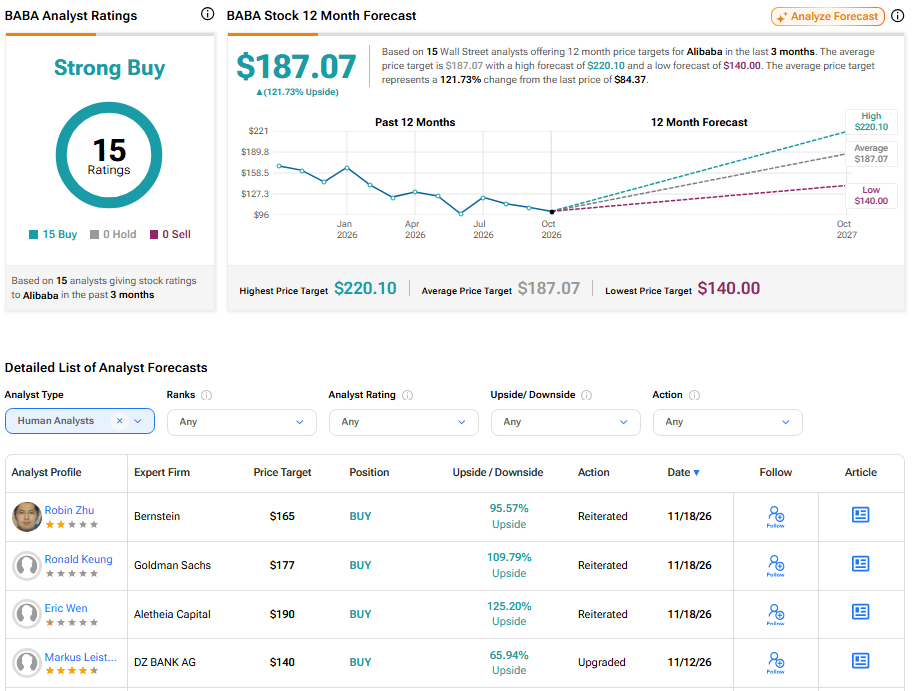
02Alibaba's quarterly revenue hits RMB 271.5 billion as AI capex jumps 60% to RMB 50.5 billion
Image source: Zhidx
On the evening of November 19, Alibaba reported results for the second quarter of fiscal 2027 (July–September): revenue of RMB 271.52 billion, up 9.6% year over year; net income of RMB 64.42 billion, up 213%, driven mainly by investment gains; adjusted net income of RMB 19.91 billion, up 92%.
AI is the main story. AI cloud and compute services revenue reached RMB 60.97 billion, up 53%, with revenue from external customers up 64%; AI-related product revenue hit RMB 17.92 billion, growing triple digits for the 13th straight quarter, an annual run rate of about RMB 71.7 billion — over $10 billion. The AI labs and applications segment grew 51% to RMB 4.44 billion, with losses narrowing about 24% quarter over quarter.
Spending is just as aggressive: capital expenditure of RMB 50.48 billion, up 60%, mostly to expand computing capacity, while free cash flow outflow widened to RMB 34.47 billion. CEO Eddie Wu said on the earnings call that Qwen is already training its next-generation model on T-Head's domestic chips, and from 2027 most of Alibaba's new AI chips will come from T-Head.
The report also set the next targets: cloud revenue growth of 30%–45% next fiscal year, possibly back above 50% in calendar 2028; Qwen4-Max (2.4 trillion parameters) is out, and a next-generation video model is coming soon.
💡 Lumo’s take
Big-tech earnings have become the scoreboard of the AI race: AI-related product revenue now runs above $10 billion a year, while a single quarter's spending hit RMB 50.5 billion. For builders, the more interesting line is elsewhere — Alibaba wrote agent products like the e-commerce edition of Qwen Work, which runs multi-step jobs for merchants automatically, into its earnings. Agents are turning from demos into line items.
03Volcengine rolls out SeedRealtime 1.0 API: a real-time audio-visual model that sees, hears and speaks at once
On November 19, Volcengine fully launched the API for SeedRealtime 1.0, Doubao's real-time audio-visual calling model. SeedRealtime unifies audio, video, timing and expression in a single end-to-end model, enabling real-time multimodal interaction — seeing, hearing and speaking at once — and replacing the traditional ASR+VLM+TTS cascade.
The model itself was first introduced in August; the news here is scale: SeedRealtime video calling is now fully live in the Doubao app, and the 1.0 API is open to developers. In end-to-end human evaluation, audio-visual conversation rhythm problems were cut in half versus cascade systems.
Three capabilities stand out: joint audio-visual understanding — resolving homophones from visual context and tracking temporal references; proactive interaction — speaking up when the scene changes and calling tools; and natural rhythm — sensing conversational state in real time, speaking when it should and staying silent when it should, while filtering out side chatter and background noise.
Official examples include identifying people at a group dinner, reading a flight board at the airport, flagging exhibits at a museum and correcting coffee-machine technique. Target uses are voice assistants, smart hardware, companion apps and real-time customer service — real-time AI is moving from conversation toward getting things done.
💡 Lumo’s take
Real-time multimodality going from demo to callable API is one of the most builder-friendly shifts of the year: a "seeing and speaking" assistant used to need three stitched pipelines, and now it takes one model and one call. The first real openings are not chatbots but specific scenes with a camera — livestream selling, in-store guidance, equipment repair walkthroughs, where the picture itself is the input.
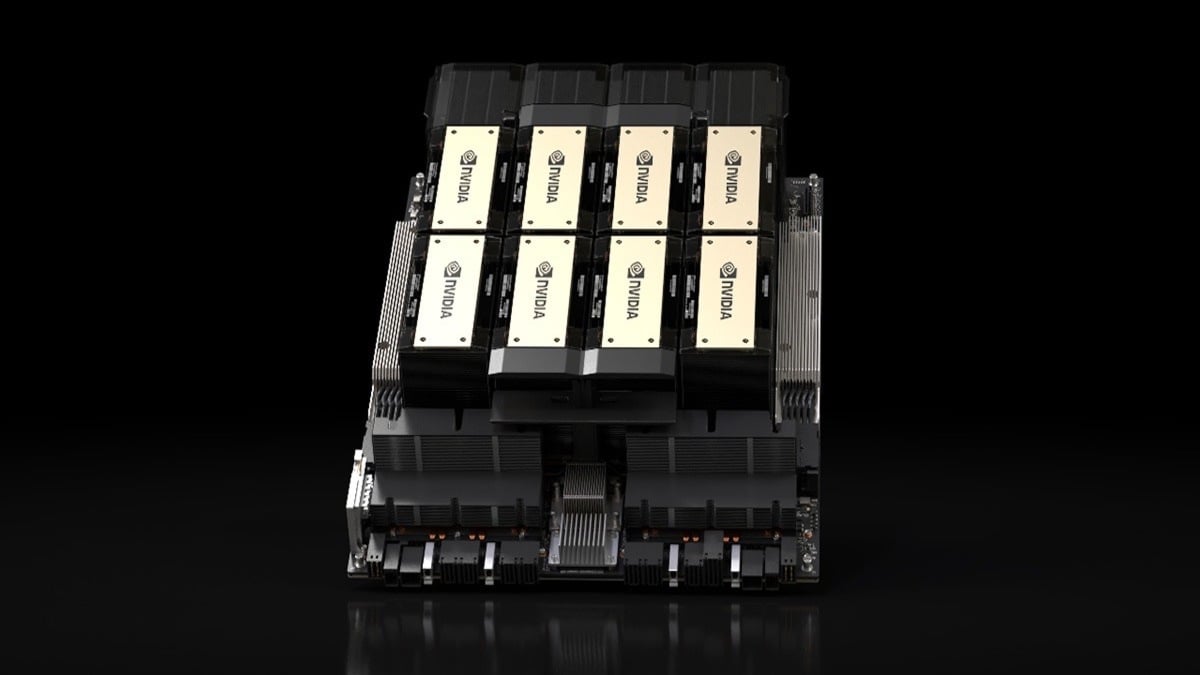
04Nvidia stops shipping H200 chips to China, wiping out $2.4 billion in quarterly sales
Image source: Technology.org
Interim Nvidia CEO Colette Kress confirmed on the November 17 earnings call that the company has stopped shipping licensed Hopper data center chips, including the H200, to China, and that the new quarter's guidance excludes that business. Those shipments were worth $2.4 billion last quarter, about 2% of Nvidia's total revenue.
The channel had only just opened in January, when the US eased H200 export licensing and approved ten Chinese buyers case by case, including Alibaba, Tencent and ByteDance, taking a 25% cut of the deals. But Beijing has restricted H200 imports while pushing domestic alternatives, and about 600,000 H200 chips are reported to be held in Hong Kong awaiting import approval.
Nvidia gave no reason for the halt and did not say whether it is permanent. On November 16, the US Commerce Department issued new rules on remote access to advanced chips, and Nvidia's board created a new export-compliance oversight committee. More advanced architectures such as Blackwell and Rubin remain banned from China.
For Chinese AI labs, the options are narrowing: wait for Beijing's approvals, rely on domestic chips, or find other paths. On the same day, Alibaba's earnings revealed Qwen is already training its next-generation model on T-Head's domestic chips — the shift to homegrown compute is moving from rhetoric to actual training runs.
💡 Lumo’s take
Chip controls are shifting faster than the technology itself: a door opened in January closed in November. Builders should treat compute supply as a first-class risk — model choice, deployment location and domestic-chip compatibility used to be architecture-review topics; now they decide whether a product can keep shipping at all.
05Gemini for Mac gains computer use, handling multi-step tasks in the background
Image source: MacRumors
On November 19, Google added computer use to Gemini for Mac: Gemini can click, type, work menus and forms inside an isolated window, completing multi-step tasks in the background while the user keeps working in the foreground, with a live preview of what it is doing.
Key actions require user approval, and users choose which apps Gemini may operate. Google's examples are specific: batch-editing photos, preparing listings for resale platforms, and turning metrics and screenshots into a presentation — repetitive, fixed-step work.
The feature is available to US English users on Apple Silicon Macs with a Google AI Plus, Pro or Ultra subscription, starting at $4.99 a month for Plus. The timing matters too: macOS 27.3 will add clearer app-permission prompts, letting users limit exactly which apps and folders an AI can access.
From Claude's computer use to Gemini on the Mac, controlling the computer is turning from a lab capability into a standard desktop feature. The contest is shifting from "how smart is the model" to "how much work can it safely finish on the user's machine".
💡 Lumo’s take
The personal-agent battleground is moving from the chat box to the desktop: whoever can reliably run errands on the user's computer gets closest to an assistant that stays with the user long-term. For independent builders, the opening is in vertical "errand-running" — batch-listing for small merchants, batch photo edits for creators — while the generic control layer belongs to the big platforms and the scenario know-how stays with the builder.
06OpenAI extends dots to a small group of Plus users and all Business Standard users
Image source: 9to5Mac
On November 19, OpenAI engineering lead Thibault Sottiaux announced that the company is starting to test its always-on proactive assistant, dots, with a small number of ChatGPT Plus subscribers, while rolling it out to all ChatGPT Business Standard users. Previously, dots was limited to Pro, Business Premium and Enterprise plans.
Dots, launched by OpenAI in September, is powered by GPT-6 Astra and GPT-6.1 Terra, has its own cloud computer, and can keep working across more than 4,000 connected apps even when the user is offline. Recent additions include custom instructions, iOS widgets and Shortcuts, and messaging through iMessage and RCS.
It is not yet clear whether Plus users will get the same usage allowances as higher-tier plans. But the direction is clear: OpenAI is moving the "long-term, memory-holding, proactive" assistant form from premium tiers toward a much wider audience.
It echoes another story in this issue: Google let Gemini take over the Mac desktop on the same day. The two giants are converging on the same race — personal agents are no longer competing on whose model is stronger, but on who moves into the user's daily workflow first.
💡 Lumo’s take
Bringing dots to Plus means personal assistants are moving from premium novelty to mass default. For builders, the lesson is not OpenAI itself but the form: always-on, proactive, cross-app, with memory — those four traits together are what separates an "assistant" from a "question-answerer", and they make a ready checklist for small products.
07AMD and Unsloth bring XDNA 2 NPU support to 100+ local agentic AI apps
Image source: AMD official newsroom
On November 19, AMD and Unsloth announced that AMD XDNA 2 NPUs are the first neural processing units supported by Unsloth Desktop, letting more than 100 compatible agentic AI applications and workflows run low-power inference on the local NPU through the Unsloth Desktop API.
Covered apps include Hermes Agent, OpenClaw, Open WebUI, Cline, LangChain and GitHub Copilot. Unsloth Desktop offers an OpenAI-compatible endpoint, while Lemonade and FastFlowLM serve and run models on the NPU; the apps' other functions keep using the CPU and GPU.
The logic is practical: an AI assistant that stays online all day needs sustained inference, and an NPU's strength is low-power, always-on operation — moving "always-running inference" off the GPU leaves the GPU for genuinely heavy work. Running locally also means data never leaves the device.
This is the second "local AI" story in this issue — RTX Spark desktops went on sale the same day with the same pitch. Together they show local compute forming a full chain: chips (NPU/GPU) plus desktop software (Unsloth) plus apps (100+ agents), turning the personal computer into a portable AI workstation.
💡 Lumo’s take
This is the first "agent-first" use of an NPU: not benchmarks, but 100-plus agent apps running around the clock on low power. For independent builders, "local agents" are graduating from hobbyist toys to shippable products — the hardware and software paths for a cloud-free, out-of-the-box local assistant are both paved now.
08HeyGen launches Avatar 6: native 2K talking-head video from a single photo
Image source: HeyGen official site
HeyGen launched Avatar 6, its new audio-driven digital-human model, on November 17, and it reached No. 2 on Product Hunt's daily chart on November 19. It needs just one photo and about 30 seconds of video to build an avatar, reads the script and matches gestures and expressions automatically, and supports two avatars talking in the same frame.
The headline number is 84.4%: shown side by side with real footage, Avatar 6 is indistinguishable 84.4% of the time, up from 44.4% for the previous Avatar V. Every frame is native 2K. Avatar 6 gestures to match what is being said — pointing, counting, directional motion — instead of replaying the same loop.
The first video is free, with paid plans from $29 a month; it supports API and MCP, so developers can call it from Claude or ChatGPT to generate video. HeyGen also benchmarked it against Seedance 2.5, Wan 3.0 and other video models.
Digital humans are moving from "it moves" to "it looks real": the last bar was lip sync, and this generation's bar is gestures, expressions and meaning lining up. For creators making short videos, courses or talking-head content, the cost of "one photo, one channel" just dropped again.
💡 Lumo’s take
Each generation of digital humans compresses a different cost: the last one compressed "showing up on camera", this one compresses "acting". For small teams, the opportunity is not building a better avatar model but using one to mass-produce content that previously needed a real person on camera — product explainers, course narration, multilingual distribution, one photo per persona.
09Enrichable launches as open source: an AI spreadsheet that researches every row with cited web sources
Image source: Product Hunt
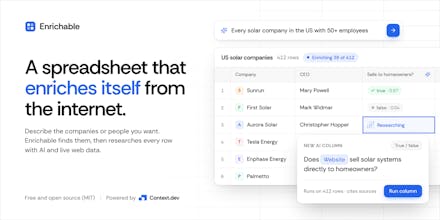
Context.dev launched Enrichable, an open-source (MIT) AI spreadsheet, on Product Hunt on November 19: describe a list or import a CSV, ask one question per column ("Who is the CEO?"), and it researches every row with live web data while keeping the sources so you can check its work.
It can also find work emails, draft outreach messages and export the results. You can use it with a Context.dev account or self-host with your own API keys. This is Context.dev's 10th launch on Product Hunt.
The form is worth noting: it is a spreadsheet, not a chat box — questions are columns, answers are cells, sources ride along on every row. For research work, "checkable row by row" matters more than "right in one shot", and the table turns verifiability into the interface itself.
Tools that turn the web into structured data are forming a clear product line: Pomerado turns websites into APIs, Enrichable turns list research into a verifiable table. For teams that bulk-process public information, open source plus self-hosting means the data pipeline stays in their own hands.
💡 Lumo’s take
The spreadsheet is the most underrated AI interface: a chat box is for asking once, a table is for checking a hundred times. Enrichable's smart move is building "sourced" into every row — when building data products, nailing "every cell traceable to its source" matters more than chasing perfect answers, and it is what makes users willing to pay for data.
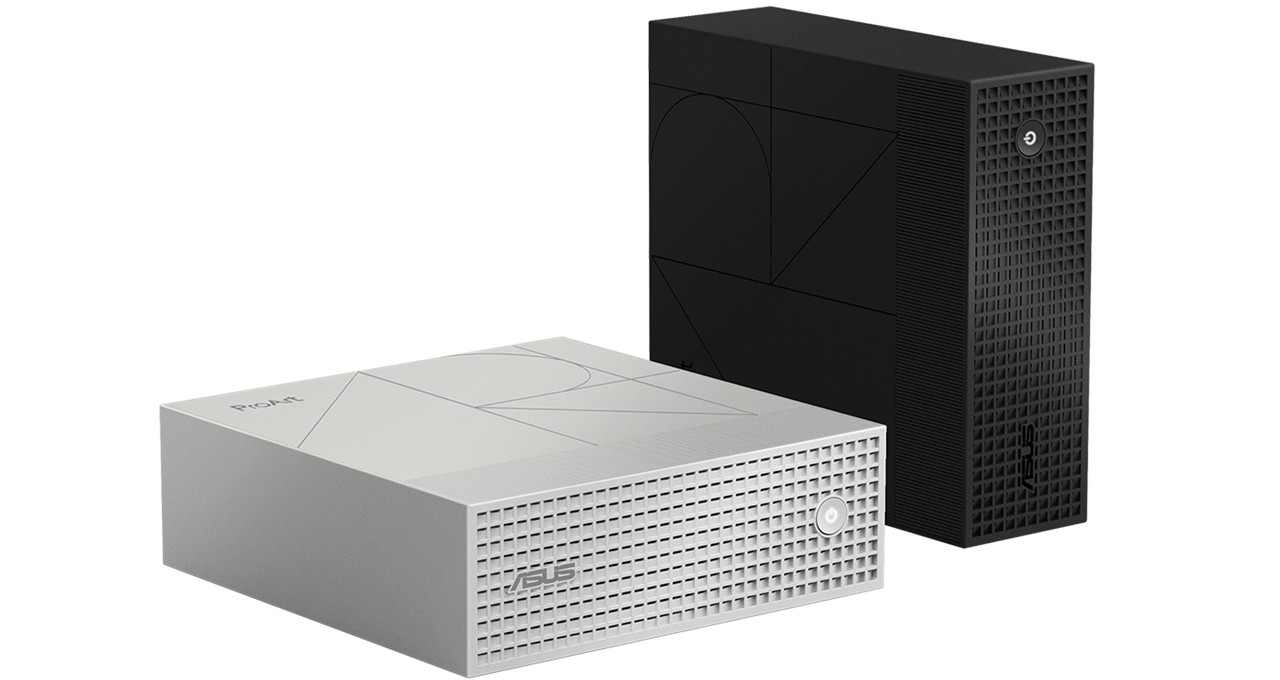
10Nvidia's RTX Spark compact desktops go on sale from $4,399, running 120B-parameter models locally
Image source: NVIDIA official blog
On November 18, Nvidia's official blog announced that the first RTX Spark compact desktops from Asus, Dell and MSI are on sale now, positioned as "a Windows PC for running local AI agents, always on, 24/7". They pack a 20-core Grace CPU, a Blackwell GPU with 6,144 CUDA cores and up to 128GB of unified memory, delivering up to 1 petaflop of AI performance.
Nvidia says the machines can run 120-billion-parameter models locally, render 90GB-plus 3D scenes in real time and edit 4:2:2 video in real time. Running locally has direct benefits: code and files stay on the device, with no per-token cloud charges for those tasks.
On price, The Threshold reports the MSI EdgeMesa N AI+ starts at $4,399 (64GB/1TB) and the Asus ProArt GR1X at $4,499; Acer, Gigabyte and HP versions follow later, along with the Microsoft Surface RTX Spark Dev Box at $5,999.99. The software stack is catching up too: Adobe's apps now run natively on Windows on Arm, and Blender 5.3 adds DLSS 4.5 ray reconstruction.
This is not a gaming PC but an "always-on local agent host": Nvidia's blog explicitly suggests running Hermes Agent or NemoClaw blueprints on it and fine-tuning models, keeping agents and scheduled tasks running on the desktop around the clock.
💡 Lumo’s take
The hardware form of local AI is settling: not bigger is better, but "always on, big enough, quiet" — a mini PC on the desk running a 120-billion-parameter model with agents working around the clock. For independent builders, "local-first" products finally have hardware you can actually buy: get the agent running reliably on a machine like this first, then think about the cloud.
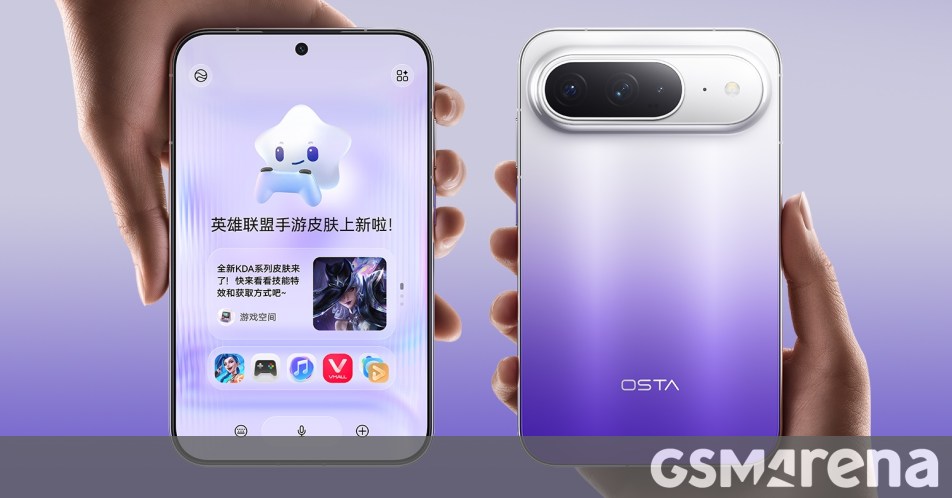
11Huawei's new sub-brand Osta debuts today with the wide-screen O1 Pro, now on pre-order
Image source: GSMArena
Huawei's first new phone sub-brand since selling Honor in 2020, OSTA (Chinese name Xingmang, or "Starlight"), debuts today, with its first device, the OSTA O1 Pro, positioned as a HarmonyOS AI phone and already on pre-order at Huawei's online store.
What is officially confirmed: a 16:9.5 wide-slab design with dual rear cameras, three colors (Nebula White, Starry Night Black, Starlight Purple), and 12GB+256GB and 12GB+512GB configurations (the purple version also comes in 16GB+512GB and 16GB+1TB). Full specifications and pricing will be announced at today's launch event.
Rumored specs (a 6.39-inch 1.5K display, Kirin 9030S chip and the like) are not officially confirmed and are not cited here as fact. Huawei also announced that the Mate X8 and Mate 90 Air will launch on November 24.
The interesting thing about Osta is not the hardware specs but the positioning: a wide slab plus a HarmonyOS AI phone, betting on the "phone as AI assistant" form factor. With several launches in one week, the AI story in China's phone market is moving from "AI features" to "AI brands".
💡 Lumo’s take
When a big company launches a new brand, the bet is never on one model but on whether a new category can stand on its own: Osta bets on the "wide slab plus HarmonyOS AI" combination. For builders, the playbook is the more interesting part — open pre-orders and reveal the design first to build suspense, then announce specs and pricing at the event, splitting one launch into two rounds of attention.
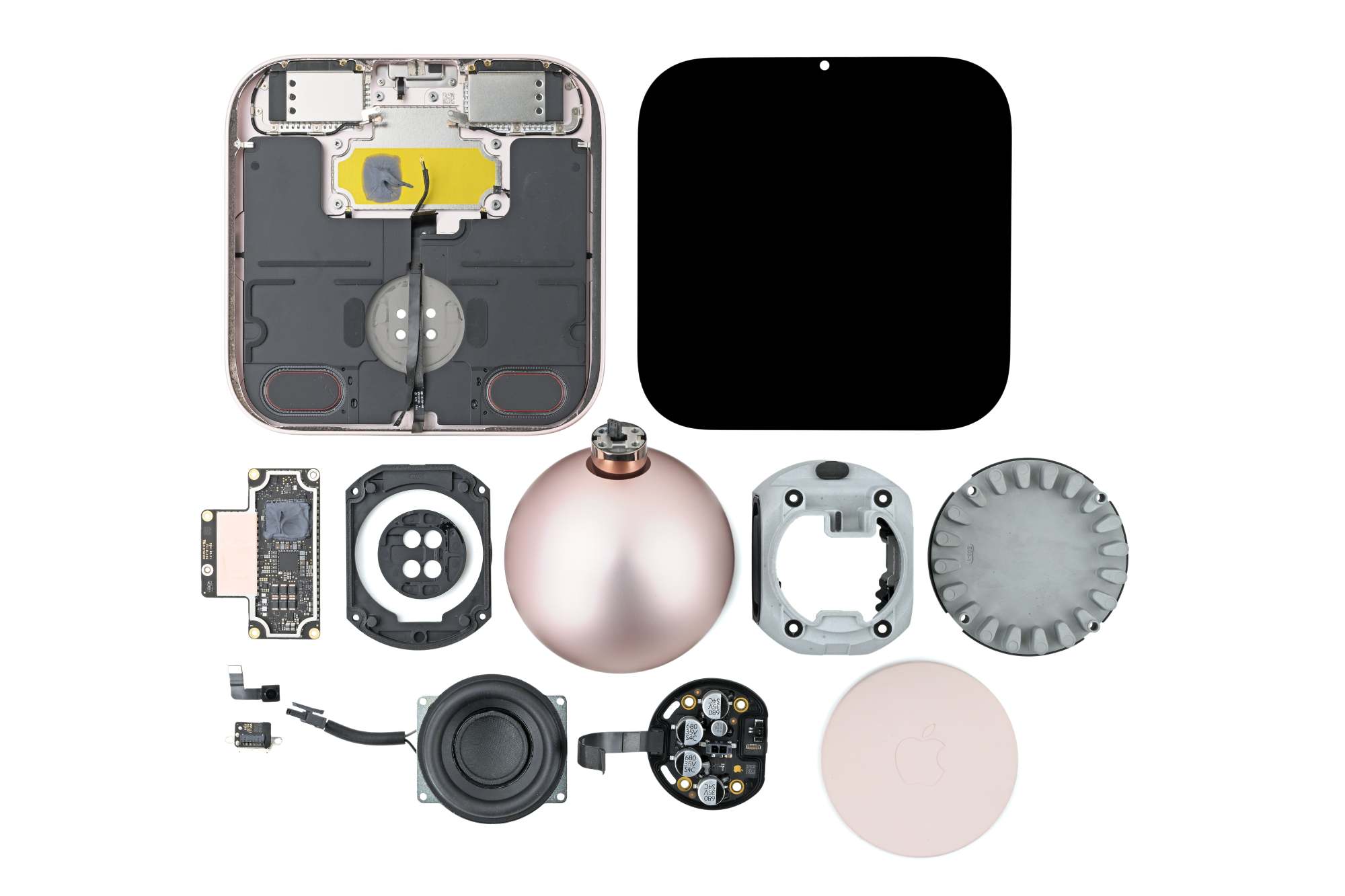
12iFixit tears down Apple's HomeView: speakers glued shut in a big repairability step back
Image source: iFixit
iFixit has torn down Apple's HomeView smart-home hub, which went on sale November 13, and the verdict is blunt: a big step backward for repairability. The display adhesive was harder to separate than on any recent Apple product, and the speaker connectors were glued in place — the teardown ripped out leads and snapped a speaker in two.
The problems do not stop there: a metal heat spreader under the logic board is glued down, so removing the board risks bending it; the pivot screws sit at an awkward angle that needs a special ratchet; and one bracket mixes Phillips and Torx screws, forcing bit changes throughout. The only bright spot is a modular, replaceable USB-C port.
Inside, iFixit confirmed an A18 chip with 8GB of memory and 64GB of storage. No repairability score was given, but the conclusion is that the device was "designed for factory assembly, not long-term repair". That runs against the repairability progress of recent iPads and the second-generation HomePod — other Apple products on sale at the same time prove the company can do better.
HomeView is meant to sit on a kitchen counter for years, and hard-to-repair means a single failure can scrap the whole device. Before buying, it is worth asking: for a device that "never moves", who fixes it when it breaks, and at what cost?
💡 Lumo’s take
Repairability is becoming a hardware product's "hidden spec": invisible on the spec sheet, obvious the day it breaks. iFixit's teardowns are worth reading because they turn "how fixable is it" into a shareable fact — small hardware teams can borrow the move directly: put repair-friendliness on the design checklist, where it counts as both a cost item and a reputation item.
"Real-time shop assistant": an AI guide for physical stores that sees, explains and hands out coupons, launched by scanning a code. What it does: build a phone-based video-call assistant on real-time audio-visual models like SeedRealtime — shoppers point their phone at a shelf, a menu or an exhibit, and the AI explains what it sees, recommends items and issues an in-store coupon to redeem on the spot. Who pays: physical stores, expo organizers and tourist sites, which face rising customer-acquisition costs and want fresh ways to pull people in; charge RMB 5–10 per redeemed visit, or RMB 499 per store per month. Why now: SeedRealtime has just made "see, hear and speak at once" available as a fully launched API, with the experience already proven in the Doubao app; what used to take three stitched-together pipelines now takes one model and one call. Minimum MVP: pick one category (hotpot ordering or a scenic-spot tour), with a scan-to-open video call, three fixed demo scenarios and a coupon hand-off. First validation step: take the demo to three nearby stores, collect a deposit from one before building in bulk; find early customers through local merchant groups and store-review creators.