Huang returns as Nvidia CEO after 11 days; DeepSeek closes a ¥105.5B round
Today’s highlights
Huang returns as Nvidia CEO 11 days after resigning; shares open up about 30%
DeepSeek closes a ¥105.5B second round, with Tencent and CATL as the largest backers
Amazon buys Decart for $7.5B; OpenAI's chief scientist calls for perplexity-based limits
GLM-5.4, WALL-OSS-1.0 and XPeng X-World 1.6 all land on the same day from China
Walmart's Agent Gateway goes live today, while Claude Ship and Replit Missions put agent work under rules
01Nvidia's board reinstates Jensen Huang as CEO; shares open up about 30%
Image source: NVIDIA Newsroom
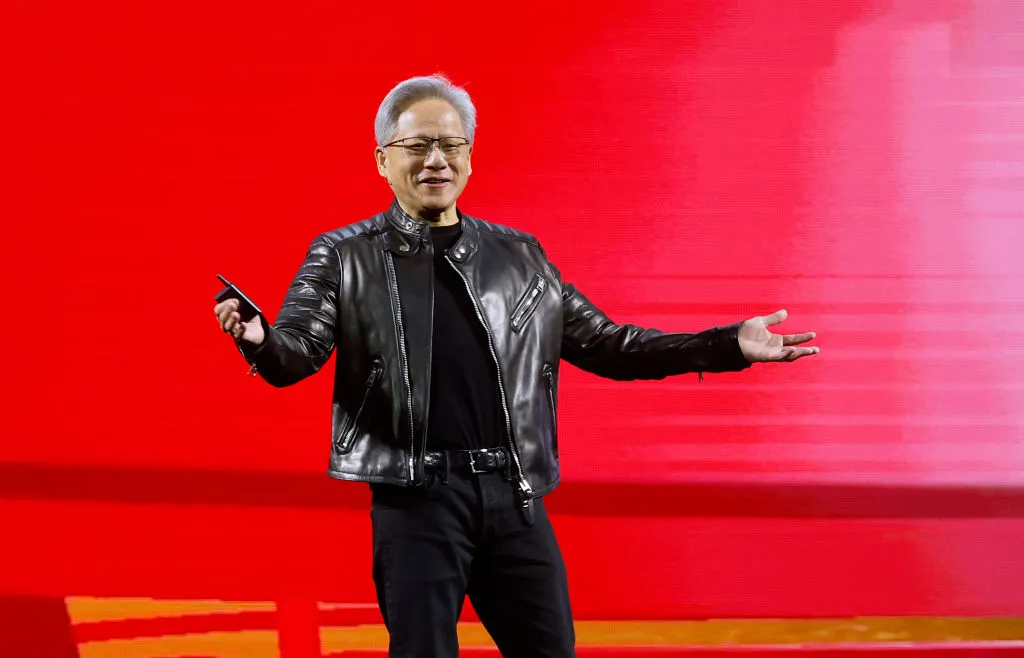
On November 23, Nvidia's board voted unanimously to reinstate Jensen Huang as president, CEO and board director, just 11 days after he resigned on November 12. The board said it had consulted senior levels of the US government and is confident the reinstatement poses no national security risk. Huang co-founded the company in 1993.
He had resigned after admitting to extramarital affairs, one involving a woman the US government suspects of being a Chinese spy. The board formed a committee of independent directors to investigate and has since created a National Security and Export Control Committee and a new Chief Compliance Officer role; the investigation continues. As recently as the November 17 earnings call, board chair Harvey C. Jones had said the board did not intend to reinstate Huang and had hired a search firm to find a permanent replacement.
The market reacted immediately: Nvidia shares opened about 30% higher and were trading at $159.95, up 27%, at 9:51 a.m. ET. President Trump publicly backed the return, calling it the correct decision, and tech executives including Elon Musk had signed a petition calling for reinstatement. Interim CEO and CFO Colette Kress stays on as CFO.
The board called Huang the right person to lead Nvidia and said the move serves stockholders, employees, partners and customers. Huang said he returns with the greatest humility and renewed commitment.
💡 Lumo’s take
A board reversing itself within 11 days happened because the national-security question was answered with government backing. For builders, the lesson is not the gossip but key-person risk: one person's departure and return moved the world's most valuable chipmaker by about 30% in a day. Does your own product have a similar single point of dependency? Worth checking in that mirror.
02DeepSeek closes a ¥105.5B second round, with Tencent and CATL as the largest backers
Image source: 21st Century Business Herald
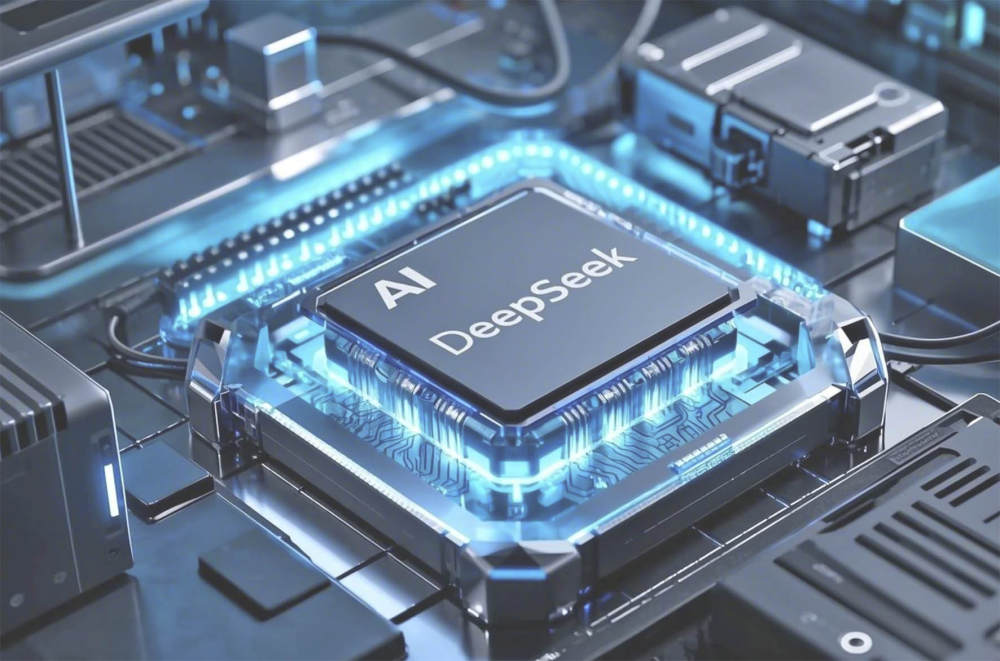
On November 23, the 21st Century Business Herald reported that DeepSeek has completed a corporate registration change: registered capital rose from ¥16.4475 million to ¥19.9187 million (up 21.1%), and a new holding platform, Hangzhou Chengyan, brought in 31 outside investors — signs that its second funding round has closed. Market sources put the round at about ¥105.5 billion with a post-money valuation near ¥607.8 billion (another figure cited is ¥615.5 billion); DeepSeek has not publicly confirmed the amount or valuation.
The shareholder list reads like a who's who of Chinese industry: Tencent and CATL each hold 9.5653%, tied as the largest backers, followed by China Mobile and CITIC at 7.6522% each, plus Meituan, NetEase, vivo, Midea, Luxshare, GigaDevice, Geely Capital and SMIC-linked funds. Twelve listed companies that invested directly are worth about ¥9.5 trillion combined. State capital reportedly accounts for about 27% of the round, versus 2% in the first.
It is the largest single AI round in China to date and the largest renminbi private-equity financing ever. Together with the roughly ¥51 billion first round in June, DeepSeek has raised about ¥156.5 billion in four months. The other side of the money is a compute squeeze: since November 16 DeepSeek has tightened free-user quotas for lack of compute, its status page shows 57 outages or degradations this year, and the October 15 global outage lasted nearly five hours.
The money points toward domestic compute: the report says DeepSeek's next-generation V5 base model has begun training on Chinese compute, with orders worth tens of billions of yuan placed with Huawei and others. When V4 launched in April, its technical white paper already stated that inference was adapted for domestic compute.
💡 Lumo’s take
The real story of this round is not the money but the shareholder list: from power generation and chipmaking to packaging, testing and end devices, the whole compute chain is now on DeepSeek's cap table. For builders, the signal is clear: competition among Chinese model makers is shifting from whose model is stronger to whose compute and ecosystem are more secure. And DeepSeek's own compute squeeze — 57 incidents, tighter free quotas — is exactly the opening for small teams building tools that save and manage compute.
03Amazon buys Decart for $7.5B as it prepares to sell Trainium chips
Image source: Amazon official blog
On November 23, Amazon announced it has signed an agreement to acquire the optimization technology and founding team of Israeli startup Decart; Bloomberg reported the price at $7.5 billion. At the center of the deal is the Decart Optimization Stack (DOS), software that helps AI models run more efficiently on Nvidia, Amazon and Google hardware. Decart is best known for its real-time world model Oasis 3 and AI video-generation tools.
Amazon and Decart have worked together on Trainium since 2025. Amazon says the technology will help customers train and run models faster and at lower cost on Trainium. The deal still needs regulatory clearance and other customary closing conditions.
The direction is clear: Amazon has so far used Trainium only in its own data centers and is now preparing to sell the chips to customers, competing head-on with Nvidia. Decart's technology lowers the barrier for customers running workloads on Amazon silicon instead of Nvidia's.
💡 Lumo’s take
The $7.5 billion is not buying a video-generation company but a stack that makes models run faster on non-Nvidia chips. The second half of the chip race is not about process nodes but about switching costs: whoever lets customers change chips with less rewritten code and less lost performance takes a slice of Nvidia's cake. For anyone deploying inference, multi-chip support is turning from optional into mandatory.
04OpenAI's chief scientist publishes the perplexity curve and calls for industry limits
Image source: OpenAI official blog
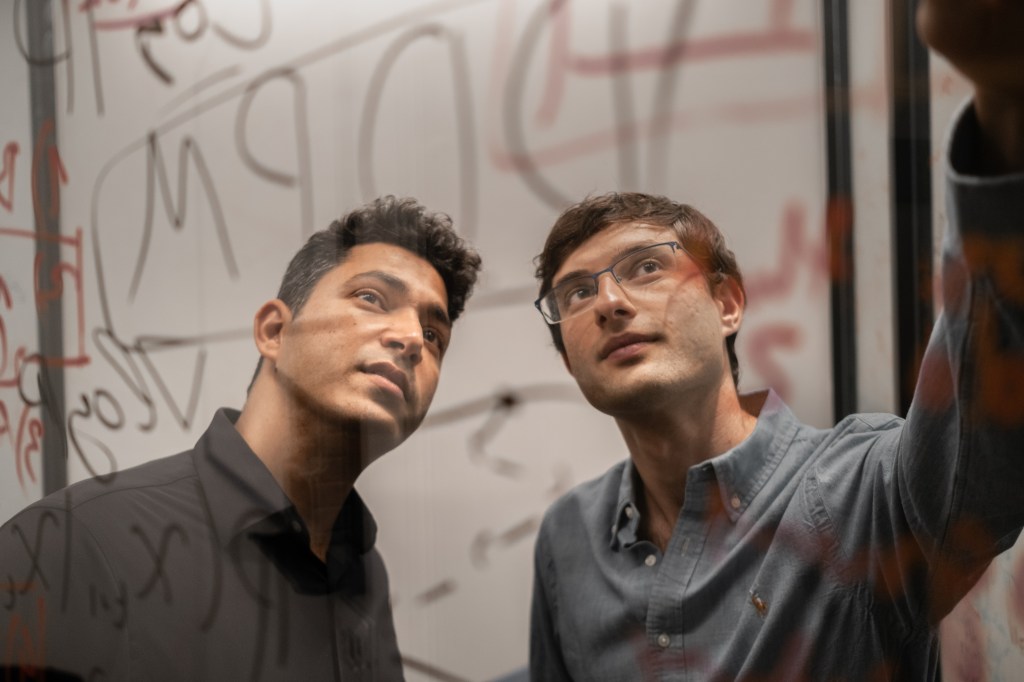
On November 22, OpenAI chief scientist Jakub Pachocki published 'Perplexity and Intelligence', the first public look at the company's internal log-perplexity curve on a held-out code dataset: GPT-3.5 at about 0.99, GPT-4 at about 0.91, and recent models below 0.8. He called on frontier labs to agree on shared development limits tied to perplexity and other trackable metrics, until monitoring catches up. CEO Sam Altman called it 'the most important thing OpenAI has published in a while.'
The numbers come with a concrete story: at a log-perplexity of about 0.76, models began producing breakthrough results on open math problems — an unreleased OpenAI model solved the Navier-Stokes problem, one of the seven Millennium Prize Problems, with about 10,000 AI agents working for 88 hours. Pachocki expects further transformative capabilities as scores enter the 0.68-0.70 range, and says AI's contribution to pretraining research could bring a wave of fundamental advances as soon as 2027.
He also names the metric's limits: labs use different datasets and tokenizers, so scores are hard to compare directly, and test-time reasoning gains do not show up in perplexity. Microsoft AI CEO Mustafa Suleyman publicly backed the proposal but noted that cross-lab comparison may need a different unit. Pachocki did not specify where the first limit should sit or when it would take effect, and no other lab has publicly agreed to join.
💡 Lumo’s take
This is the first time OpenAI has put its core internal yardstick on the table: a single number that predicts the range where models grow new capabilities. For builders, the other side matters more — 'capability jumps cannot be predicted in advance' is becoming an industry consensus, so product plans should leave room for models suddenly getting stronger instead of assuming today's ceiling holds.
05Zhipu's GLM-5.4 goes live on Coding Plan: 750B looped architecture, quotas up 1.5x
On November 23, Zhipu's GLM-5.4 quietly went live on the GLM Coding Plan: set the model name to glm-5.4 and it works, with ZCode, Trae, WorkBuddy, Qoder and other coding platforms onboarding the same day. It is Zhipu's first flagship built on a Loop Transformer: a 750B-scale model in which 28 shared-weight layers of the GLM-5 base run twice per pass, which the company says reaches intelligence comparable to 2T-3T parameter models. Context is 1M tokens, with new native vision and support for generating video, games, 3D models and mechanical designs from code.
On usage and quotas: V2, V3 and team-plan users get 1.5x the GLM-5.4 quota, and by the official docs' credit coefficients, the same workload costs about a third less than GLM-5.3. Zhipu says inference runs up to 200 tokens per second off-peak and 70-80 tokens per second at peak load.
Two caveats: Zhipu has not published benchmark scores for the 750B model — the architecture comparison in its blog used a 30B model, so it cannot be read as a final verdict on the flagship. The standard API is still pending a security review, and weights will be open-sourced responsibly, so for now access runs through the Coding Plan, ZCode and Z.ai Chat.
💡 Lumo’s take
The Loop Transformer idea is pragmatic: keep parameters flat and let the same layers run an extra pass to buy depth. For people who write code every day, the most interesting part of GLM-5.4 is not the parameter count but the 'Generalized Coding' direction — code is turning from writing software into a general creative tool for video, games and 3D, and Chinese models are moving faster on this path than overseas ones.
06X2Robot ships WALL-OSS-1.0 with 55.1% zero-shot success on real robots
Image source: ifanr.com
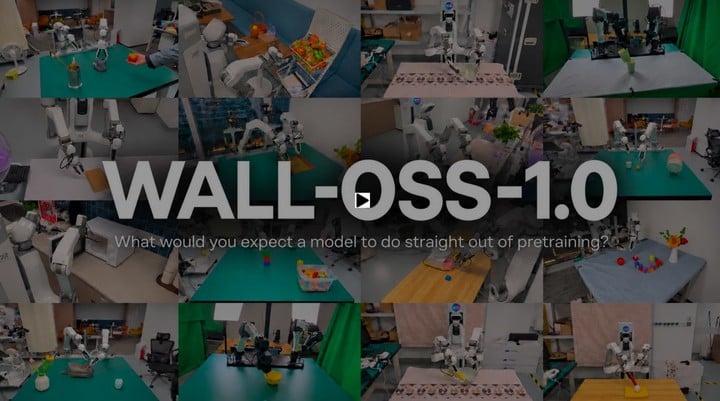
On November 23, X2Robot released WALL-OSS-1.0, its first embodied foundation model, available to call through WALL-API-1.0. The core idea is that general intelligence grows out of pretraining: action data is learned jointly with language and vision from the pretraining stage, instead of training a vision-language model first and bolting actions on later.
The numbers are solid: 55.1% zero-shot success across 312 independent open-ended real-robot tasks (66.5% on multi-step tasks, 57.7% on bimanual coordination); 1101 out of 1500 on ManipArena's 15 desktop tasks, 70.8% above the multi-task fine-tuned π0.5; first place in the model track of the RoboDojo simulation leaderboard; and single-inference latency under 60 milliseconds.
There are deployment numbers too: the system is already running on a sorting line at a leading logistics company, where about 10 hours of line data is enough to fine-tune it, versus more than 1,000 hours without pretraining. Moving to another site preserves over 90% of sorting speed and success rate, and the Nano version can drive 18 robots from a single Blackwell GPU.
💡 Lumo’s take
Embodied AI now has, for the first time, an off-the-shelf API combined with 55.1% zero-shot success — robots no longer need to relearn every task from scratch. For builders, the opportunity is not in building robot bodies but around them: wiring this general manipulation ability into concrete scenarios such as sorting, plating and tidying, where the last-mile application layer costs far less than training a model from scratch.
07XPeng upgrades X-World to 1.6 with a Virtual City builder
Image source: IT Home
On November 23, XPeng announced the first major upgrade of its Turing world model, X-World 1.6, built for its second-generation VLA research. Two upgrades stand out: Virtual City, which builds a digital twin of a city in the cloud with spatial and temporal memory, so any real scenario can be replayed and re-verified at any point in space and time; and real-time inference, with control latency down to 426 milliseconds, letting testers drive straight into the generated world with a wheel and pedals.
The previous X-World 1.0 was purely generative, creating worlds out of nothing — and it showed in practice: drive the same intersection twice and a bridge pier would move; change only the weather and the traffic lights would move too. Version 1.6 combines structural reconstruction with dynamic generation: 3D Gaussians, point clouds or historical video anchor static elements such as buildings and roads, while a DiT model generates dynamic objects, trajectories, weather and lighting.
XPeng says the upgrade solves three problems in putting simulation to work: credibility and reproducibility (the same scenario can be rerun, so model versions can be compared rigorously), low-cost scale (data can be synthesized even where real driving data is scarce), and proactive long-tail testing (human testers deliberately swerve, brake hard and cut in, probing the model's true limits). The technical paper is public.
💡 Lumo’s take
World models are shifting from generating worlds out of nothing to replaying a real city at any point in space and time — the value of a simulator is not how realistic it looks but that the same test can be retaken. For anyone building AI applications, the idea transfers: for any system that needs repeated verification, build a replayable, editable virtual city first, then talk about scale.
08Google Search AI Mode adds Wallet; Drive and the Gemini app follow
Image source: Google official blog
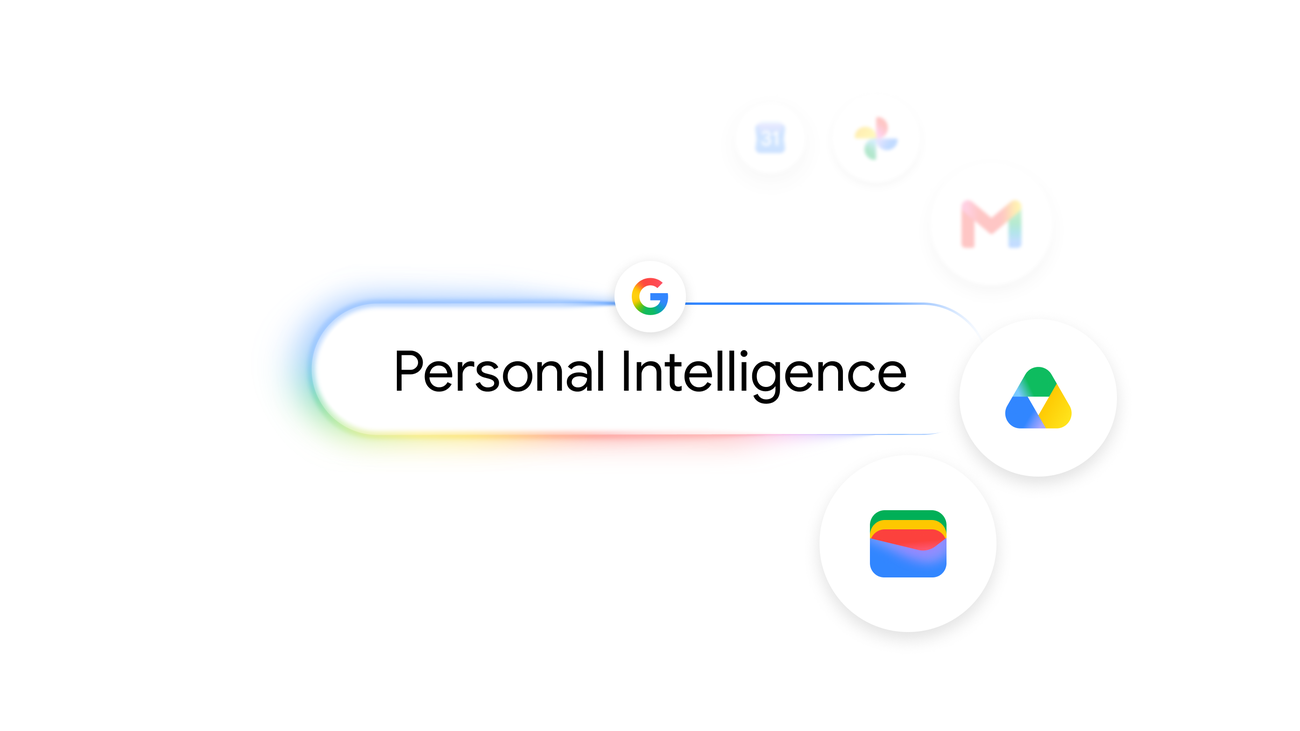
On November 23, Google's official blog announced an expansion of Personal Intelligence: users can now opt in to connect Google Wallet, with Drive and the Gemini app following in the coming weeks. Gmail, Calendar and Photos were already connectable.
With Wallet connected, AI Mode can suggest ways to save money and optimize cash-back and card perks based on spending and credit-card benefits — read-only, Google stresses, with no ability to move, manage or invest money. With Drive connected, it can draw on docs, sheets and PDFs for personalized plans, such as preparing for tax season. The Gemini app and AI Mode will share context with each other. AI Overviews and AI Mode are also starting to give more personally relevant answers based on recent search context.
Everything is voluntary opt-in and can be switched off at any time. Answers will soon carry a Personalization icon showing which context was used. Google frames Personal Intelligence as bringing together the world's information with information uniquely relevant to you.
💡 Lumo’s take
Search has officially started eating wallet and document context, moving the fight over the personal-agent entry point from the chat box to the search box. For builders, the thing to watch is the product philosophy behind the new Personalization icon: the deeper personalization goes, the more explainability matters — users must always see what information the AI used, and that is becoming standard.
09Walmart's Agent Gateway goes live today, letting Meta's Muse check out for Black Friday
Image source: Crypto Briefing
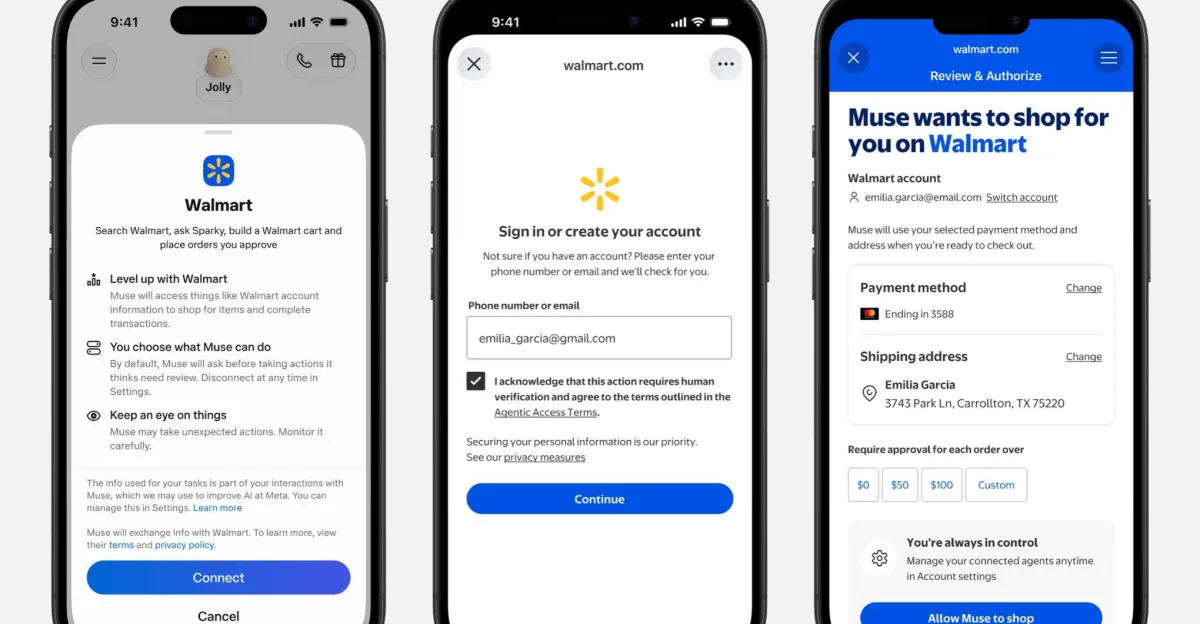
Walmart's Agent Gateway, announced on October 21, was due to go live on November 23 but was pushed back 24 hours and goes live today, November 24, with Meta's Muse as the first agent. The delay was confirmed by Walmart on November 23, according to The Verge. Through MCP, Muse connects directly to Walmart's backend to search products, build carts and check out inside the conversation, across Walmart.com and Sam's Club. Black Friday runs November 23-29.
The controls are called Agent Profiles: created when a user first adds an item, they set spending limits (examples of $50, $100 or $200), per-purchase approval and a reviewable purchase history. Checkout uses a card already saved to the Walmart account, prices match Walmart.com, and Walmart's return policy applies; agents do not get full purchase history. The Gateway is reportedly in invitation-only beta, and Walmart reserves the right to change it.
The contrast is sharp: Amazon restricted Muse after its launch, so Muse now defaults to Walmart, Target and other retailers unless a user explicitly asks for Amazon. Muse launched on September 8 and passed 10 million users across the US and Canada within weeks. Walmart says Muse is just the beginning, with more AI apps and agents on the way.
💡 Lumo’s take
This is the first agent-checkout case landing in a live Black Friday, taking MCP from demo to real money. For builders, the real dividing line is not the technology but the posture: Walmart chose to open a formal entrance for agents and set the rules, while Amazon chose to shut the door. The open-versus-closed contest now has its first large-scale controlled experiment.
10Anthropic launches Claude Ship, letting AI review, fix and approve pull requests
Image source: TechCrunch
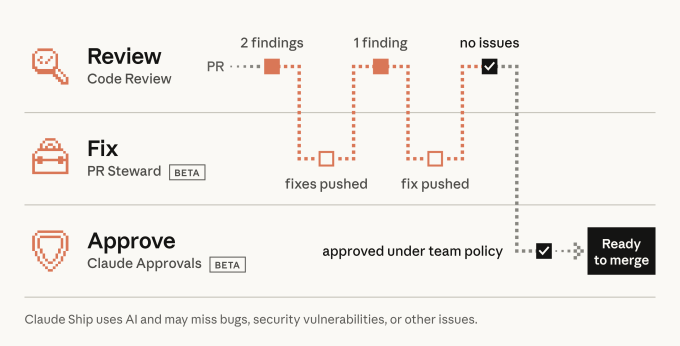
On November 23, Anthropic launched Claude Ship, a set of agents that shepherd GitHub pull requests to merge: Code Review is generally available, while PR Steward and Claude Approvals are in public beta. It is for Claude Team and Enterprise plans, GitHub repositories only, and billed per token through an organization's usage credits.
Each agent owns one stage: Code Review inspects pull requests in Quick, Standard or Deep modes, hunting for logic errors, security vulnerabilities and edge cases; PR Steward fixes failing CI checks, merge conflicts and review feedback, pushing commits that explain what changed and how to roll back; Claude Approvals auto-approves compliant changes against a policy file the team writes in the repository (.claude/approvals.yml). Anthropic recommends starting approvals in observe-only mode.
The company blog puts it plainly: on the Claude Code team, Claude writes most of the code, 'and we wanted everything after the PR to move that fast too.' Anthropic also notes that Steward never approves or merges — GitHub branch rules still decide what merges — and that organizations with HIPAA or zero-data-retention configurations cannot enable it.
💡 Lumo’s take
The bottleneck in AI coding has moved from writing code to reviewing and merging it — and Claude just handed approval itself to an agent. For small teams, the part worth copying is not the three agents but the gradual handover: a policy file plus observe-only mode, letting the AI watch and show how it would rule before it is ever allowed to decide.
11Replit launches Missions: goals and budgets for agent swarms
Image source: Replit official blog
Replit Missions, launched November 17 and updated November 19, is a product that gives an agent swarm a goal, a spending cap and an independent AI judge for acceptance: the user sets only the goal and the success criteria, and the platform coordinates agents to plan, build, test and iterate until the judge confirms the criteria are met, the budget runs out, or human input is needed. Nothing ships without human approval.
The controls live in the Missions agreement: each mission sets a spending limit (the example is $1,000) and lists actions that need approval — contacting prospects, sharing proposals, changing customer-facing materials, making product commitments. Replit's own proof case: in 2 days and within a $3,000 budget, a swarm built DataCat, an application-monitoring platform, locating a deliberately injected database fault in 38 seconds against a 60-second target, storing 26 million activity records and 4.4 million log entries over a three-hour load test with zero loss, and passing 51 of 51 data and alert checks. DataCat is now open-sourced as a self-hostable version.
Another set of numbers comes from E-Commerce Bench: in a single run, an agent starting with ¥100,000 ran online stores for a simulated year and grew it to about ¥4.82 million, roughly 48x. Replit frames Missions as a step toward the self-driving company: people set direction and make consequential decisions while agents carry the execution and coordination.
💡 Lumo’s take
A spending cap plus an independent AI judge is exactly the design that lets a small team hand a whole job to an agent swarm: how much it may cost and what counts as done are written into the agreement up front. Indie developers can copy this mechanism straight into their own products — pricing, bounding and acceptance-checking an agent's autonomy earns user trust faster than stacking more model capability.
12Thinking Machines open-sources Inkling 2 Mini, runnable on a 32GB Mac
Image source: Hugging Face
On November 20, Thinking Machines Lab released Inkling 2 Mini, an open-weights multimodal model under the Apache 2.0 license. It has 26.4B total parameters with 3.4B active per token (5.4B effective after looping), the middle 12 layers sharing weights across three passes, a single checkpoint of about 20GB, and a 1-million-token context window.
The lab says it runs locally on a Mac with 32GB or more of memory or a single NVIDIA DGX Spark, with support for Ollama, SGLang, vLLM, llama.cpp and more. Self-reported scores: 79.2% on SWE-bench Verified, 48.2% on DeepSWE and 20.1 on the AA Intelligence Index, on par with Qwen3.8-27B. Hosted pricing is $0.15/$0.50 per million tokens.
The model card is candid about the downsides: looped architectures give very little control over the chain of thought, and reasoning can get stuck in long loops or repeated re-checks. Tool use is less reliable than larger models, and the model may take destructive actions such as deleting or overwriting files without confirmation — the lab recommends sandboxed agent runs and confirmation before destructive steps.
💡 Lumo’s take
A 26B model packed into 20GB delivering near-flagship coding results on a laptop is the week's strongest evidence for the local-first route. For anyone building local AI products, the value of models like this is not the benchmark but that they run offline, stay private and fit on one Mac — privacy- and cost-sensitive scenarios finally have an open base that is good enough.
13Huawei's Mate X8 event takes place today at 14:30
Image source: IT Home
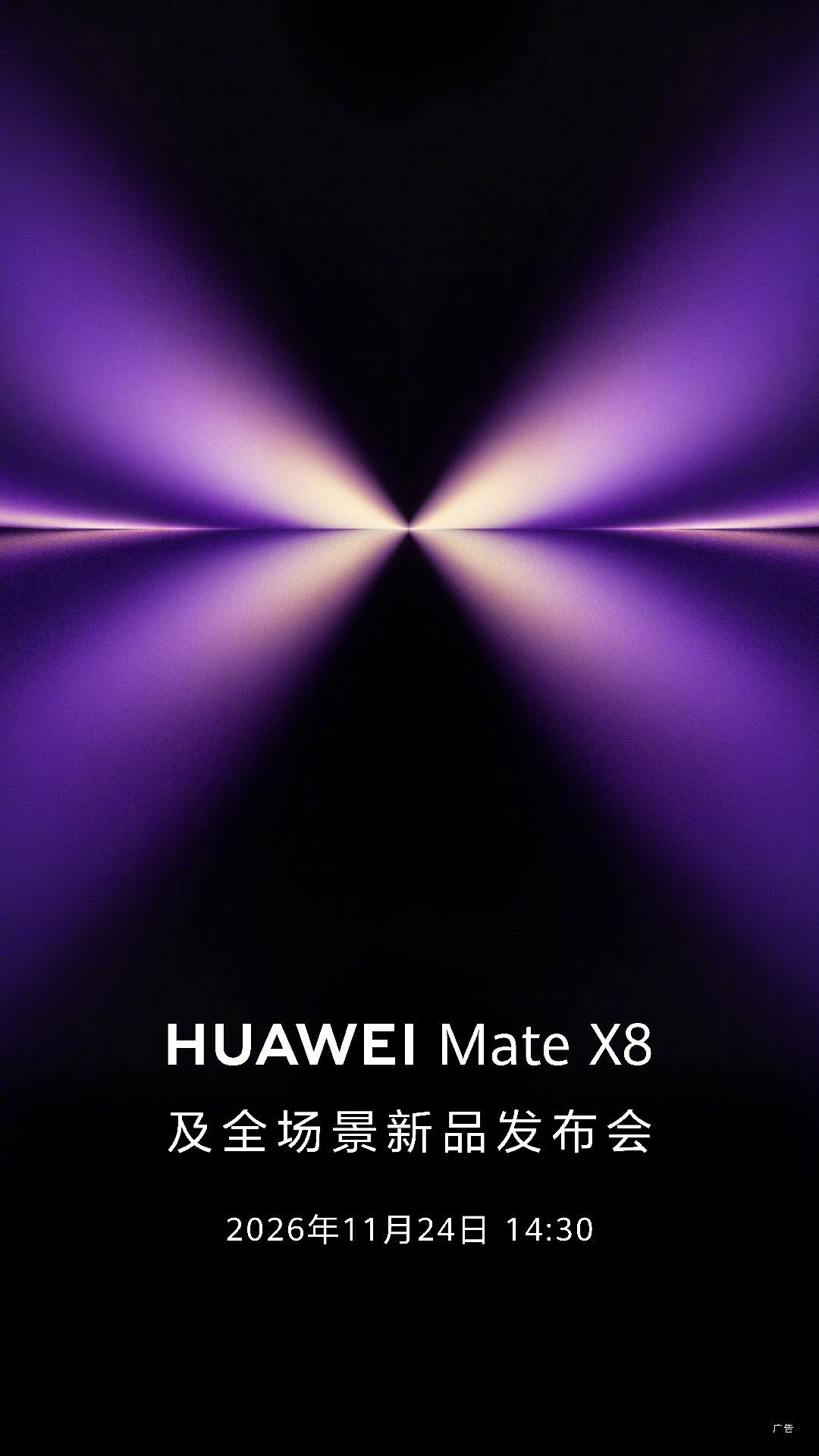
Huawei's Mate X8 and all-scenario new product event takes place today, November 24, at 14:30. The Mate X line has run eight generations over eight years and built a base of 20 million users. Huawei device chief He Gang says the Mate X8 brings a full refresh in design, display, performance and imaging, and Richard Yu has already shown the phone's appearance in public.
Specs and prices wait until this afternoon. Bloggers claim a collector's edition will support the Ruiying Z10 modular camera, but that is unconfirmed. After the event, pricing and sale dates will be the next things to watch.
It is the most important Chinese consumer-electronics event of the week, in a foldable race that has grown fiercely competitive this year.
💡 Lumo’s take
The event has not started yet, so note the time: 2:30 this afternoon. For anyone following Chinese hardware, the real question about the Mate X8 is not the spec sheet but what Huawei can still show after eight generations of foldables and 20 million users — the answer comes this afternoon.
14NO SPEAKER turns a MacBook trackpad into a speaker, even on mute
Image source: MacRumors
Developer Cody Collier posted an open-source tool called NO SPEAKER on X on November 22: it drives the haptic motor in a MacBook's Force Touch trackpad at different frequencies so the glass vibrates audibly — producing a robotic voice even with the speakers fully muted. The roughly 90-second demo includes speech, a melody, a beat and a short rap. Users can type their own text, switch macOS voices, or slide a finger to change pitch.
It works by generating audio with macOS's built-in text-to-speech, extracting the dominant sound frequencies, and turning them into motor vibrations. The voice is quiet and robotic; the author suggests placing the MacBook on a table and reading along. It cannot replace normal speakers for music or video.
The tool is free, MIT-licensed and a single Swift file. It needs a Force Touch trackpad from 2015 or later, macOS 12 or newer on Apple silicon, or macOS 13 or newer on Intel. One catch: it relies on Apple's undocumented MultitouchSupport private framework, so a future system update could break it, and the author says it is unknown whether prolonged use affects trackpad lifespan.
💡 Lumo’s take
A muted computer whose trackpad talks — the perfect true story to close the day. For tinkerers, the lesson is not the sound itself but the approach: a part that only ever vibrated can become a new instrument when used differently. The fun ideas usually hide where everyone assumed there was only one use.
"Agent Checkout": an agentic checkout gateway for indie stores and small merchants.
What it does: let AI agents buy directly from your store. An MCP server plus a checkout plugin: agents use the standard protocol to browse products, check stock and place orders, while the merchant sets the rules in a dashboard (per-order cap, categories that need human confirmation, blocklists). Payment runs through the merchant's existing checkout, prices match human orders, and every agent order is tagged, traceable and refundable.
Who pays: indie-store sellers and small e-commerce brands. They cannot build a Walmart-style gateway themselves, yet they fear being shut out of agent-driven shopping. Muse already has 10 million users and routes around Amazon by default, so traffic is flowing toward stores that accept agents. Take a cut per order or charge monthly: every extra order the gateway brings in earns its share.
Why now: Walmart proved today with its Agent Gateway that agent checkout works, and Black Friday is the live stress test. Amazon closed its door while Walmart opened one, and the gap in between is exactly the opening for indie stores. MCP is already the de facto standard, so there is no protocol to wait for.
Minimum MVP: start with a Shopify plugin plus an MCP server exposing four tools — product search, stock checks, ordering and refunds — with just three rules at first (per-order cap, human-confirmation toggle, agent-order tagging). Payments go through Shopify's own checkout, so no money is touched.
First validation step: onboard 20 indie stores for free and run one Black Friday weekend, measuring agent-driven orders, average order value and refund rate. After 3 documented cases of real agent checkouts, switch to a per-order fee (1-2%), list on the Shopify App Store and in Claude and Muse communities, and sign up the first 20 paying stores.