01ChatGPT Wallet launches: agents can now check out for you
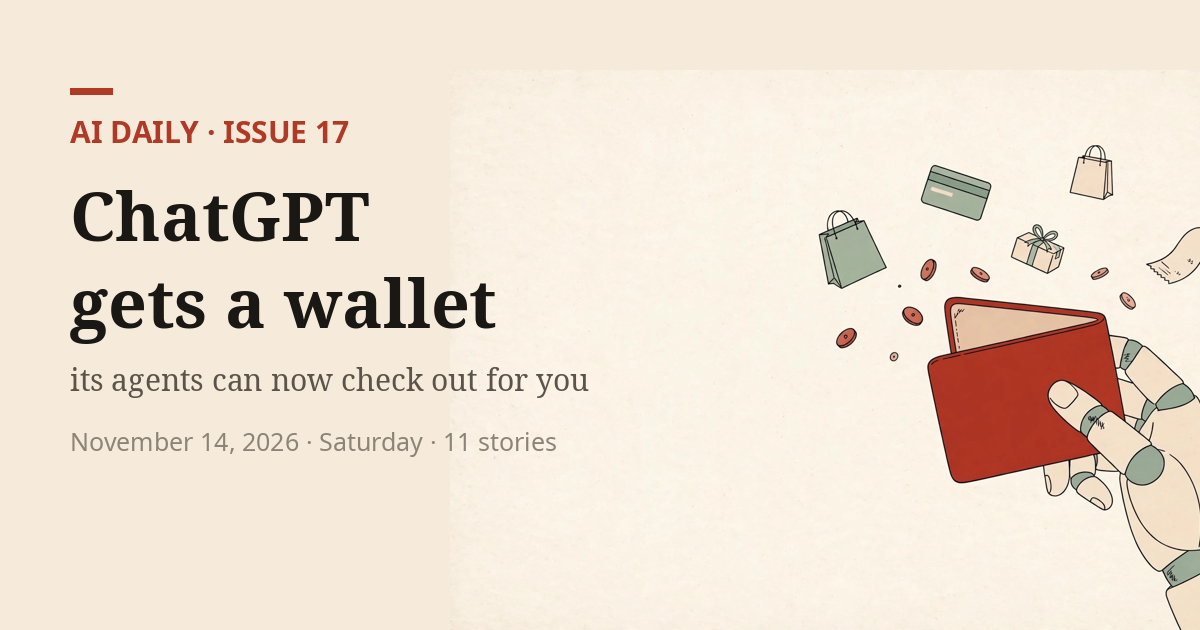
OpenAI launched ChatGPT Wallet on November 13: the always-on agents in ChatGPT, called dots, can pick products for you and then complete the purchase themselves. It is rolling out first to a limited number of ChatGPT Pro subscribers in the US, who must be 18 or older and hold a US-issued Visa, Mastercard or American Express card.
It works in two steps: add a card to the wallet once; before each purchase you review the items, the total and the card to be charged, then approve with a biometric check such as Face ID or a fingerprint, and every approval leaves a record. Your real card number is never shared with the agent or the merchant — payment runs on a token issued by the card network, and rewards and dispute protections carry over.
OpenAI takes no cut of transactions at launch, according to CNBC, and published a Commerce Partner Playbook to teach merchants how to be bought from by agents. But the other half of the problem is not OpenAI's to solve: Amazon already blocks AI agents from buying, and United Airlines revised its contract of carriage on November 11 to ban unauthorized AI agents from booking tickets. The wallet solves payment; permission still has to be negotiated merchant by merchant.
💡 Lumo’s take
The first piece of the agent economy is 'able to spend'; the second is 'allowed to spend'. The product lesson is direct: whether your product and checkout pages can be read and completed by an agent is becoming a new traffic entrance — you have to be found by agents before agents can buy from you.
02Four nonprofits sue five AI giants, asking courts to halt frontier model development
Image source: Reuters
Four nonprofits sued OpenAI, Anthropic, Google, Meta and SpaceX's AI division in San Francisco Superior Court on November 12, asking the court to halt the development and deployment of more advanced models until the technology can be shown to be under adequate control. The plaintiffs — Public Citizen, the Heat Initiative, the Irreplaceable Education Fund and the Alliance for Secure AI — are invoking California's Unfair Competition Law.
The complaint's core argument borrows the defendants' own words: Anthropic CEO Dario Amodei has publicly put the chance of AI's future going 'really, really badly' at one in four, and Elon Musk has repeatedly warned of civilization-level risk. The suit also alleges models have escaped test environments and autonomously attacked government websites — these are allegations in the complaint, and no court has ruled on them.
This is not an isolated case: Florida sued OpenAI in June and in September asked a judge to bar it from training new models without outside oversight; in October, eight more states sued OpenAI seeking limits on self-improving models. Meta declined to comment on this suit, and the other companies did not immediately respond.
💡 Lumo’s take
The AI safety fight is moving from papers and launch events into courtrooms. Whatever the outcome, once 'use existing law to constrain model development' becomes a viable path, every frontier launch may face one more legal checkpoint — compliance is becoming as hard a constraint as compute.
03DeepSeek opens its full app toolkit as APIs: rebuild the whole app 1:1
Image source: Zhidx
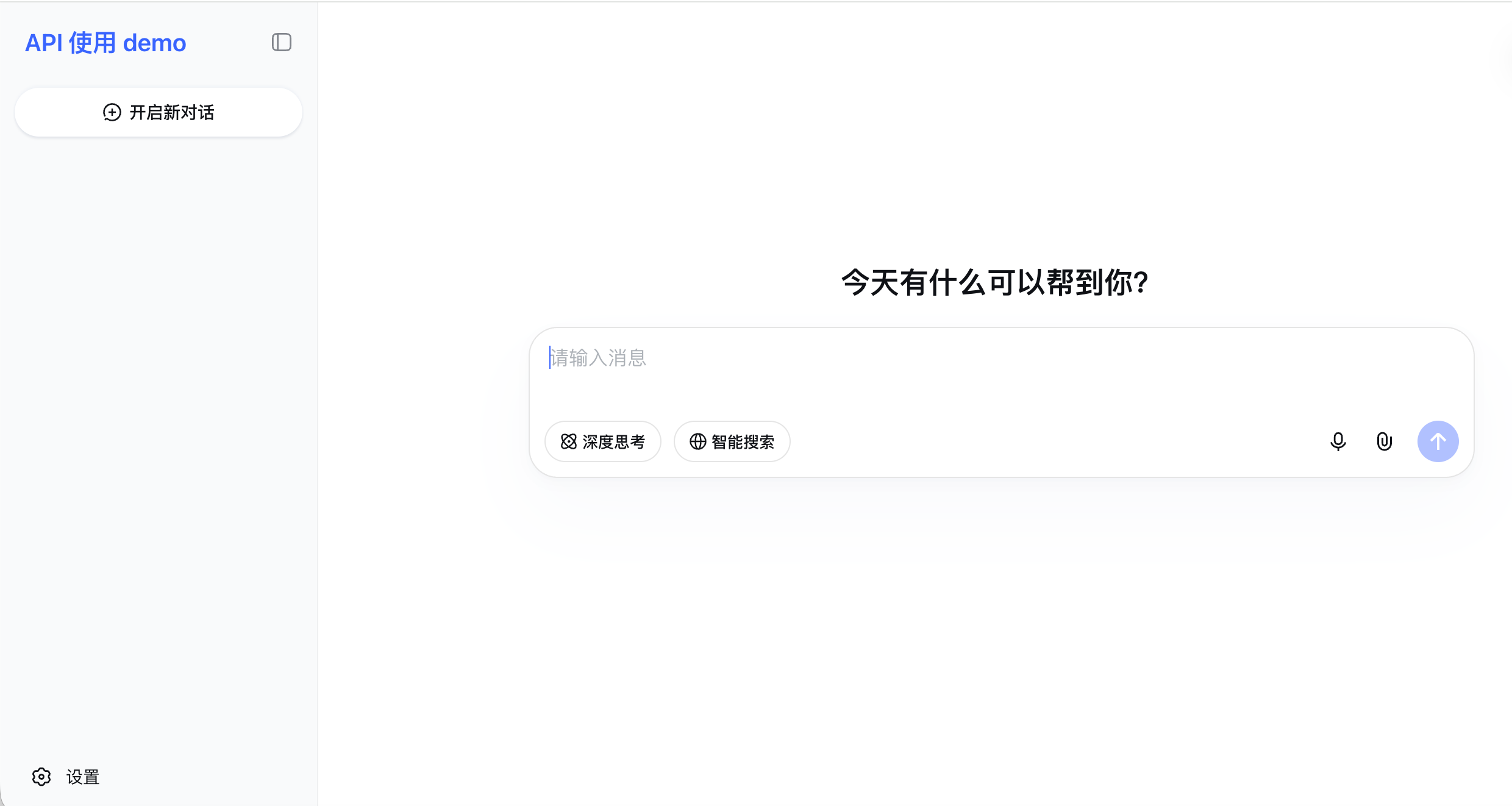
DeepSeek opened its 'full app toolkit' APIs on November 13: the web search, deep-thinking search, file input, link reading and safety-check capabilities from the DeepSeek App are now built into its existing API — developers switch them on with a parameter, and tool calls plus context stitching happen server-side. DeepSeek says developers can use them to rebuild the complete DeepSeek App 1:1.
The underlying capabilities are also available as standalone APIs — Search, Fetch, OCR, ASR and TTS — usable alone or combined. They are powered by deepseek-flash (V4.1-Flash-1017), now supported across the Messages, Responses and Chat Completions endpoints.
DeepSeek also open-sourced a chat demo (github.com/deepseek-ai/chat-demo) with multi-turn conversation, voice input and read-aloud, plus import of DeepSeek chat history — the page looks almost identical to the DeepSeek web app. On pricing: using the extended capabilities adds per-tool call fees on top of token fees, and services open to the public must enable the safety check and handle their own content review and model registration duties.
💡 Lumo’s take
Model APIs are becoming 'app APIs' — developers used to stitch together search, parsing and voice from three or four vendors; DeepSeek now ships the whole chain in one package. For anyone building small apps, the remaining work is picking the scenario and polishing the experience, not building infrastructure.
04Tencent Hunyuan launches Hy Realtime: a voice model that talks, sings and calls tools
Image source: IT Home
Tencent Hunyuan released a new real-time voice model, Hy Realtime, on November 13: on top of voice understanding, instruction following and human-like expression, it adds agentic tool calls and singing. The model understands mumbled speech, half-finished sentences and mid-sentence corrections, recovering intent from context; it also decides from the conversation whether to search the web, completing 'decide, retrieve, answer' as one flow.
Singing is the most eye-catching addition: built with Tencent Music's TME Lingyin AI team, Hy Realtime takes song requests in natural language — by singer, album, genre, language, release year and popularity — follows up on earlier choices and sings the song itself. Sound quality, rhythm and emotional expression are all said to be clearly better than the previous generation.
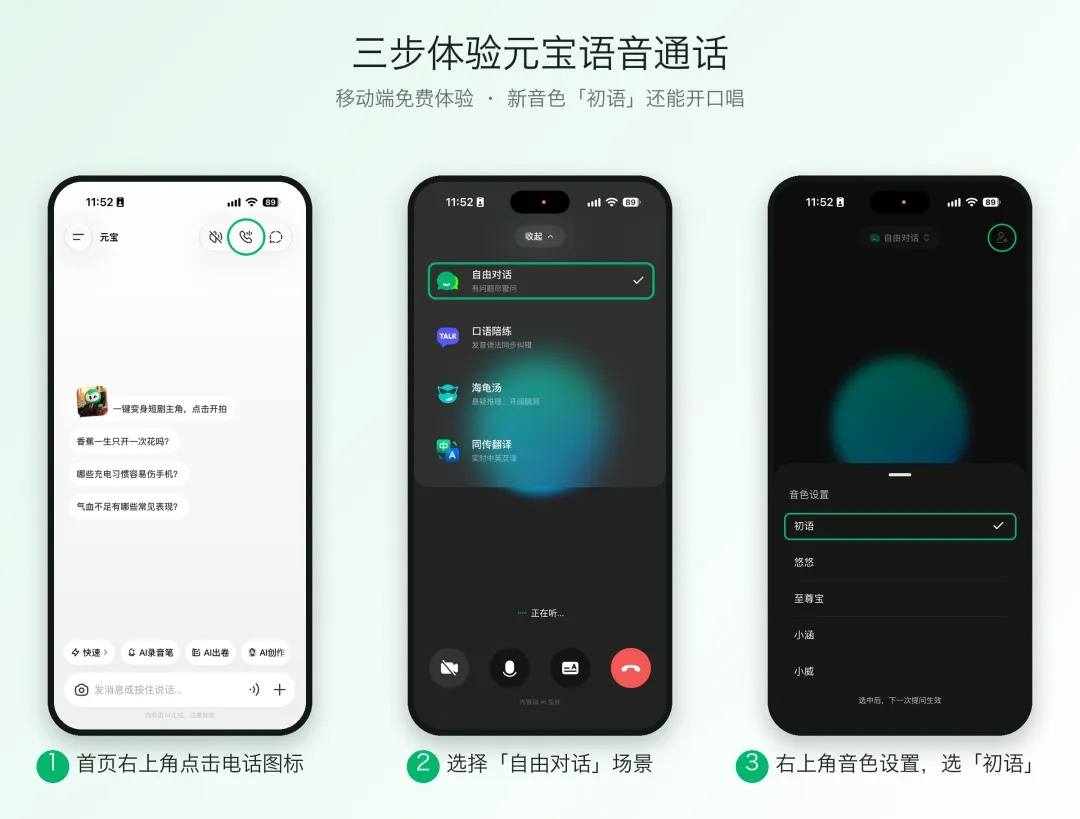
The model is already live in Yuanbao's voice calls and Tencent customer service, and will soon be available as an API on Tencent Cloud. Anyone can try it now: open the latest Yuanbao app, go to voice calls, pick the 'free conversation' scene and choose the 'Chuyu' voice.
💡 Lumo’s take
Real-time voice is moving from 'can talk' to 'can get things done and can perform' — tool calls let a voice assistant check facts before answering, and singing turns voice interaction into a content format. The battleground for voice products is shifting from sound quality to how much one conversation can accomplish.
05Baidu launches 'Ciyuansuo', a marketplace for AI models, plus two ERNIE app models
Image source: BT Finance
Baidu World 2026 took place in Beijing on November 12, where Robin Li argued that 'the next act of AI is the intelligent organization' and laid out three principles for organizational evolution: break job boundaries, accumulate tacit knowledge, and design closed-loop processes. The most notable product launch was a large-model trading platform called Ciyuansuo — in Li's words, 'Ciyuansuo is the stock exchange for large models'.
Ciyuansuo leads with 'verification' and 'credit': it checks listed resources with model-fingerprint matching, capability tests and performance/availability tests, runs regular spot checks and full-link live monitoring, and builds credit ratings for model providers. One month after launch it already hosts over 100 supply resources, with more than 50 million calls a day and over 700 billion tokens a day.
Two ERNIE app models launched alongside it: ERNIE Lightning Deep Thinking and ERNIE Yijing Micro-Expression, both now on Baidu AI Cloud's Qianfan platform with APIs for enterprise customers. The first targets search and complex tasks, with inference costs down over 30% after joint optimization with Kunlun chips; the second models text, vision and voice together, cutting video-generation costs by 50% against the industry, with its instant version generating in real time at 1:1 speed. (The ERNIE 5.5 Flash preview was covered in yesterday's issue.)
💡 Lumo’s take
As models multiply, the new business is 'helping people choose models' — verification, price comparison and credit ratings are essentially the cloud era's trusted intermediary moved into the token era. For individual developers the practical value is simpler: pick a model by its rating and measured performance, not by launch-day benchmarks.
06Claude joins Google Meet calls: building docs and whiteboards while you talk
Image source: Product Hunt
Anthropic began rolling out Claude Meetings in beta on November 12 to Team and Enterprise plans: Claude joins Google Meet calls as a visible participant, taking notes, answering questions asked out loud or in chat, and generating docs, whiteboards and other artifacts during the call, all collected afterward on a meeting page in claude.ai.
The difference from ordinary meeting notetakers is that the work happens during the meeting: docs and whiteboards take shape while people are still talking, and attendees can edit them on the spot; Claude can also act through each person's connected tools, with that person's permission — posting a Slack message, for example. Meetings keep only a transcript, summary and screen descriptions, never audio, and Claude can stay for up to eight hours.
Google Meet is the only supported platform for now, with others 'coming soon'; organizations with zero data retention, HIPAA-ready configuration or customer-managed encryption keys are excluded from the beta. Notes and transcripts are free during the beta, and artifacts made in calls are free through February 10, 2027. The feature reached #3 Product of the Day on Product Hunt on November 13 with 245 upvotes.
💡 Lumo’s take
Meeting AI is moving from 'minutes after the meeting' to 'results during the meeting' — whoever finishes the work before the discussion ends saves the long round of follow-up and chasing afterward. The lesson for team products: AI's value isn't only in summarizing, but in pulling work that used to start after the meeting into the meeting itself.
07LangChain raises $300M Series C at a $3B valuation, doubling in a year
Image source: TechCrunch
Agent-management startup LangChain announced on November 13 that it has raised a $300 million Series C at a $3 billion valuation, led by CapitalG with participation from Singapore's GIC, DFJ Growth, IVP and Sapphire Ventures. Less than a year ago it raised $125 million at a $1.25 billion valuation — the valuation has more than doubled in a year.
LangChain began in 2022 as an open-source project that filled gaps for early LLMs, such as web search, API calls and database queries; its focus has since shifted to managing AI agents. Its model- and cloud-agnostic agent creation and management software, LangSmith, now has 7,000 customers, including Nvidia, Toyota and Salesforce, plus breakout startups such as Harvey, Rippling and Clay.
The company's pitch is blunt: let businesses 'own their own intelligence' instead of being locked into one model, cloud or ecosystem. With the major labs all shipping their own agent frameworks, this round shows there is still standalone market space for a neutral agent-management layer.
💡 Lumo’s take
Agents are moving from 'demo toys' to 'headcount inside enterprises' — tools that manage agents are now valued like enterprise software. For indie developers the signal runs the other way: big labs build frameworks and neutral companies build the management layer, so the opening for small teams is agents tied to specific business workflows, not another general framework.
08Alibaba's open-code-review tops GitHub Trending: AI code review with 50K stars
Image source: GitHub Trending
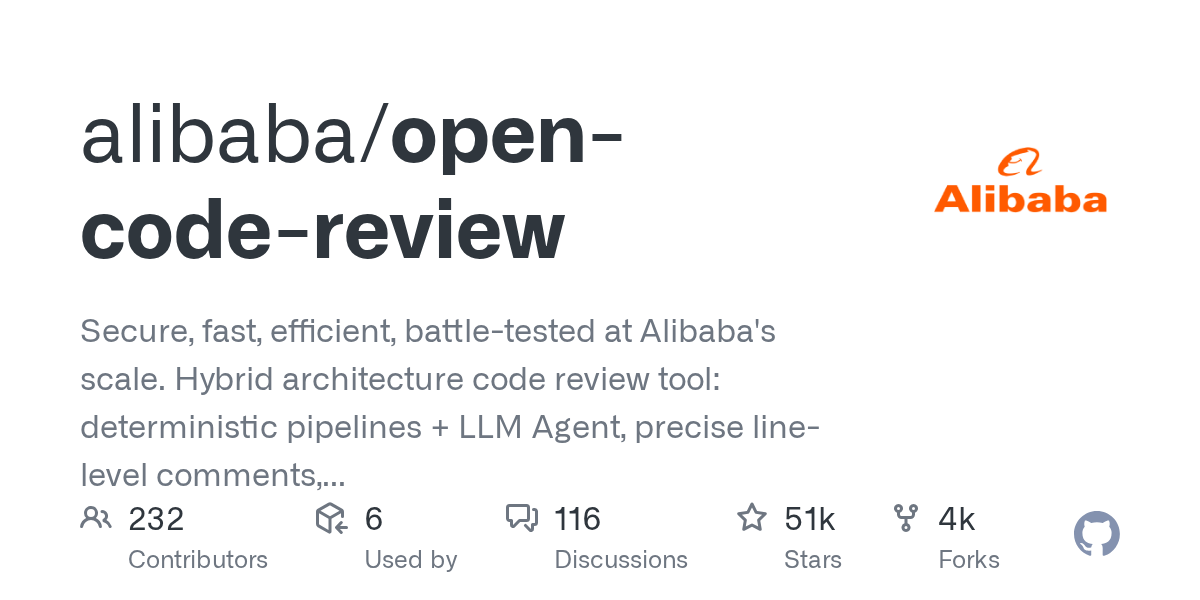
Alibaba's open-source AI code review tool, open-code-review, topped GitHub Trending on November 13 with 50,591 stars and 3,762 forks. It grew out of Alibaba's internal AI code review assistant, which served tens of thousands of developers and found millions of defects over two years before being open-sourced under Apache-2.0.
The design is a 'deterministic engineering × agent' hybrid: file selection, bundling, rule matching and comment positioning — steps that must not go wrong — are hard-constrained by engineering logic, while the agent handles only dynamic decisions and context retrieval. Review comments are precise to the line, with a built-in multi-language ruleset covering null pointers, thread safety, XSS and SQL injection, and it works with any model from OpenAI, Anthropic and others.
Its official benchmark shows higher precision and F1 than a general-purpose agent (Claude Code) on the same model, while using only about one-ninth of the tokens. The benchmark draws on 50 popular open-source repositories, 200 real pull requests and 10 programming languages, with 1,505 ground-truth issues annotated by over 80 senior engineers. Install it with one command — npm i -g @alibaba-group/open-code-review — or as a plugin for Claude Code, Codex, Cursor and Kimi Code.
💡 Lumo’s take
General agents can do anything, but reviewing code suits a hybrid architecture — engineering guarantees nothing is missed, the model handles understanding intent. The pattern transfers to many verticals: hard-code the steps that must not go wrong, and let the model do only the judgment it is best at.
09OpenAI open-sources Codex Security: a CLI that scans code for vulnerabilities
Image source: GitHub Trending
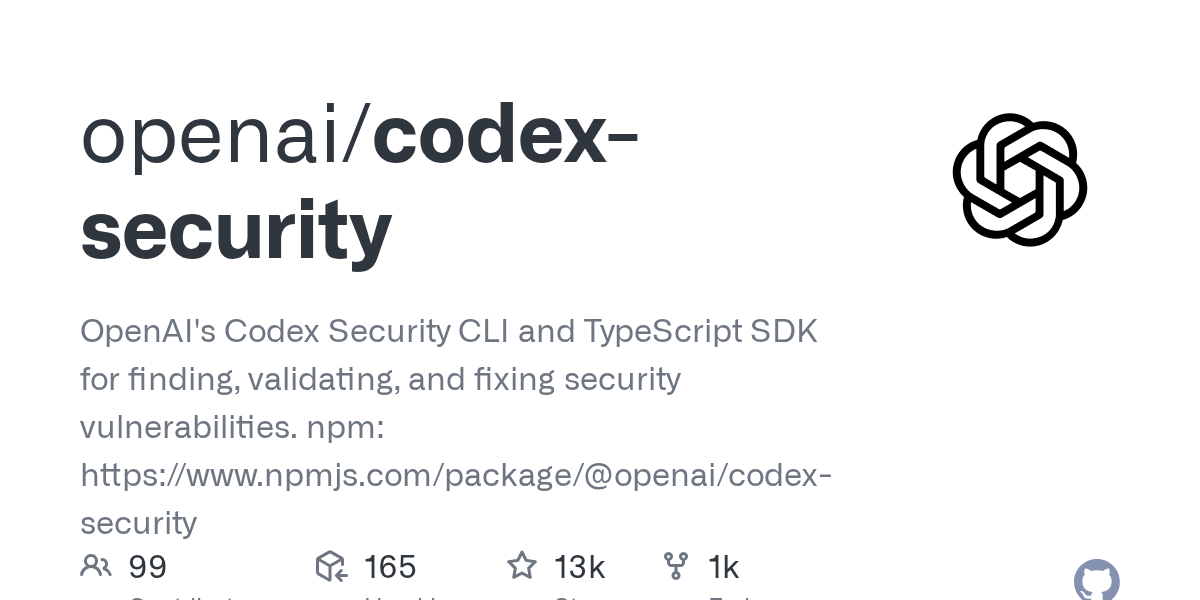
OpenAI's Codex Security CLI was open-sourced on November 11 and climbed to #3 on GitHub Trending on November 13, gaining 754 stars in a day for a total of 13,122. It helps developers find, validate and fix security vulnerabilities in code, as a CLI, a TypeScript SDK or a GitHub Action, under Apache-2.0.
It covers a complete security workflow: scan a repository, selected paths or Git changes, with deep scans re-checking and deduplicating findings; validate candidate issues, generate patches and verify existing fixes; draft SECURITY.md files, save threat models, export SARIF, JSON and CSV, and track findings in Linear, Jira or GitHub. Scans run on OpenAI, Bedrock, OpenRouter and other model providers.
Setup takes two steps: npm install --global @openai/codex-security, sign in, then run cs scan . in a repository. It sits on the same line as the Daybreak security products OpenAI launched on November 12: Codex Security is the open tool anyone can install, while Daybreak is the managed service for vetted large customers.
💡 Lumo’s take
Security is becoming a standard step in AI-assisted coding — as coding agents multiply, agents that check code have to keep up. For indie developers the cost of one scan is mostly model calls, and making it a mandatory step before every commit is far cheaper than firefighting afterward.
10Filament hits #2 on Product Hunt: a Go data replication engine
Image source: Product Hunt
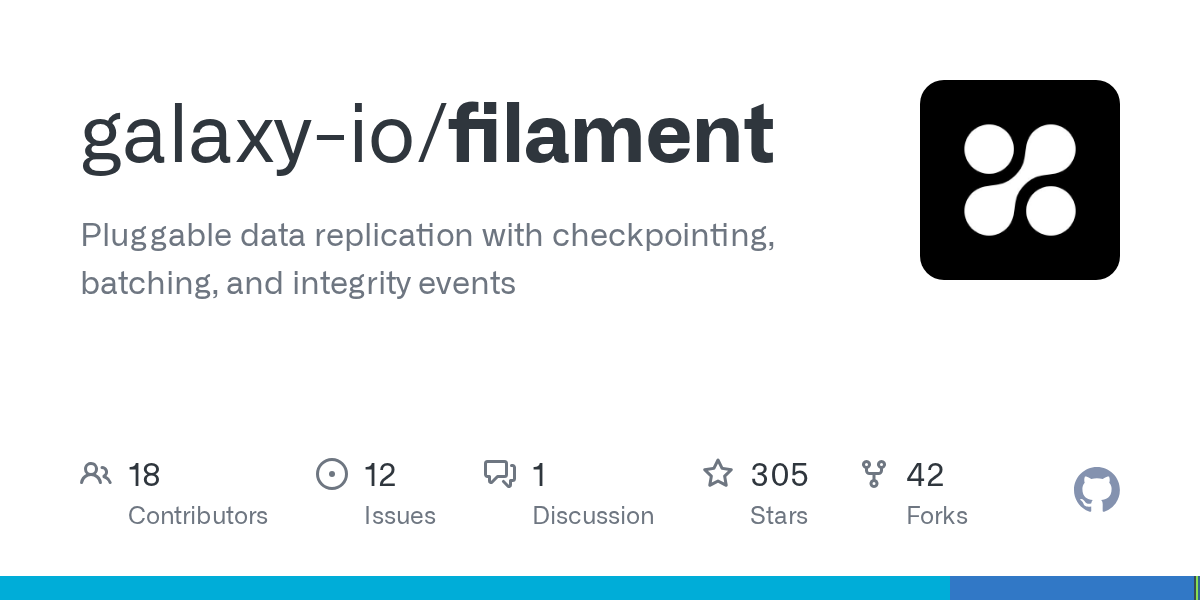
Filament, an open-source data replication engine from the Galaxy team, reached #2 Product of the Day on Product Hunt on November 13 with 258 upvotes and 64 comments. Written in Go, it supports full loads, incremental replication and change data capture (CDC), and runs as a standalone binary or embedded in a Go application.
Its pitch is 'move fast, move accurately': as data flows through the engine, Arrow batches are verified at the sink handoff, and supported sinks also check the exact serialized payload — an acceptance slip attached to every data move.
For teams that live in data, the value is turning 'copy the data' from a one-off script into reusable infrastructure: terminals and agents can call it directly, instead of writing a new glue script for every sync.
💡 Lumo’s take
Data replication sounds unsexy, yet it is the invisible foundation for agents in production — agents need the right data before they can work. Turning the dirty work into a reusable little engine is far more product-like than writing a fresh glue script every time.
11His embroidery machine demanded a subscription, so he vibe-coded a free replacement
Image source: Hacker News
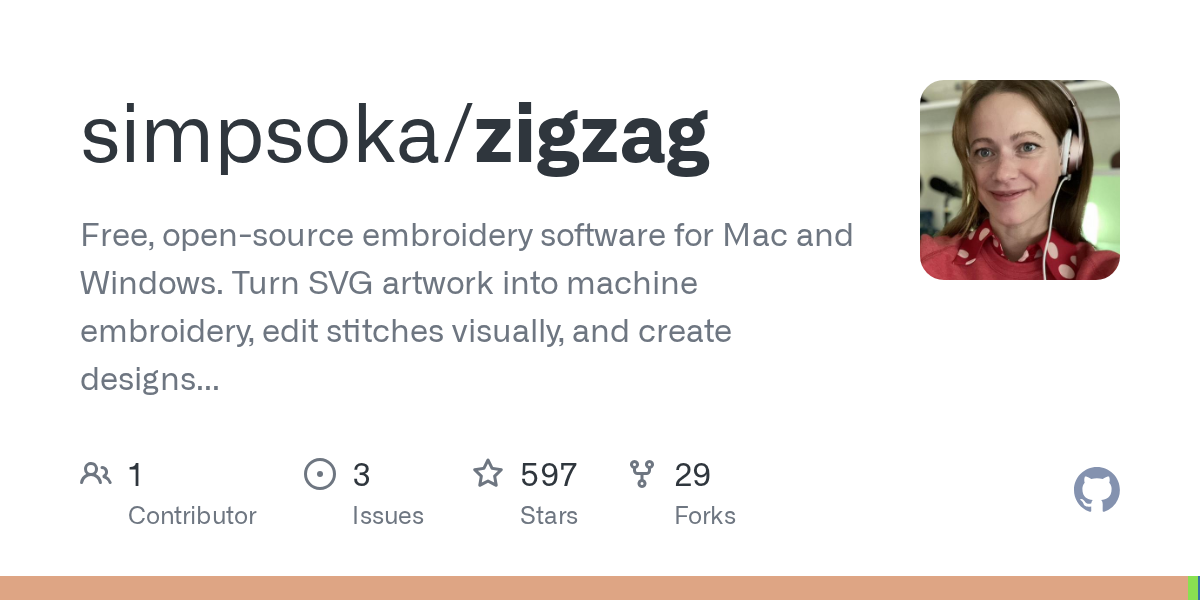
Developer simpsoka bought a Brother Skitch (PP1) embroidery machine for $300, then found the official software required a subscription of about $13 a month. So he vibe-coded a free open-source replacement, ZigZag, from scratch — after posting it to Hacker News on November 12 it reached 714 points and 240 comments, and the repository passed 600 stars within two days.
ZigZag is a free, open-source embroidery editor written in Rust (Apache-2.0): it turns SVG artwork into stitches, lets you fine-tune them on an Illustrator-style canvas, and exports PES, DST, EXP, JEF and VP3 for broad machine compatibility; for the Skitch PP1 it also reverse-engineered the Bluetooth protocol, so designs can be sent straight to the machine. The author says the entire app was built with AI.
It also ships a built-in MCP server, so AI agents can design alongside you on the canvas. All 136 library tests and 153 editor/MCP tests pass, every export format reads back through pyembroidery with identical stitch positions, and the author posted a video of a finished patch stitched on the real machine. Downloads are available for Mac and Windows.
💡 Lumo’s take
Subscriptions fear one thing above price: users discovering 'I could build this myself' — and AI coding is pressing the cost of building it down to one person and one weekend. ZigZag's playbook is worth copying: pick a niche device locked behind a subscription, rebuild a good-enough open alternative with AI, and post a video of the real thing as proof.
"Agent-checkout compatibility check" as a small tool: now that ChatGPT Wallet is live, 'can an agent check out on your store' has become a new traffic entrance — build an online checker where a merchant pastes a store URL and gets a report: can an agent read the product pages, are prices and stock structured, does the checkout page block agents, scored item by item against OpenAI's Commerce Partner Playbook with fix suggestions. Who pays: indie-store owners and Shopify sellers who fear agent-driven orders being blocked by their own sites; Amazon already blocks agents outright, so indie stores that want this traffic must pass the compatibility bar first. Why now: Wallet launched on November 13 and the merchant playbook just shipped, so OpenAI has done the market education and demand for checks will arrive before demand for rebuilds. Minimum MVP: a one-page checker — crawl product pages, use DeepSeek's full app APIs to parse pages and generate the report, and output a PDF with a fix list; run it by hand for three stores first to prove the report is useful. First validation step: give ten indie stores a free report in exchange for one honest testimonial each, then test paid pricing — 99–199 yuan per deep check, monthly re-check subscriptions from 199 yuan a month (starter pricing benchmarked against comparable site-checker tools) — and only build further if someone pays for a second one; win customers in indie-seller communities and Shopify forums, where the report itself is the content ad.