Fable 5.2 and Muse Ember Debut on the Same Day; Meituan Open-Sources LongCat-2.5 Weights Under MIT
Today’s highlights
Fable 5.2 and Mythos 5.2 released: 49.1% on coding benchmark, 30% faster output, and 20% price cut
Meta Muse Ember launches: ~$0.14 per agent task, introducing a lightweight execution layer
Meituan open-sources LongCat-2.5 weights under MIT, releasing full 3.56TB for the 1.6T-parameter model
OpenAI Control Room shuts down research models in 35 seconds; ChatGPT Enterprise lists on AWS Marketplace
Lightpanda, ProtoMap, MCP1, and GBrain: Browser, context, gateway, and memory layers for agents are all in place
01Anthropic Releases Claude Fable 5.2 and Mythos 5.2, Setting a 49.1% Coding Benchmark Record
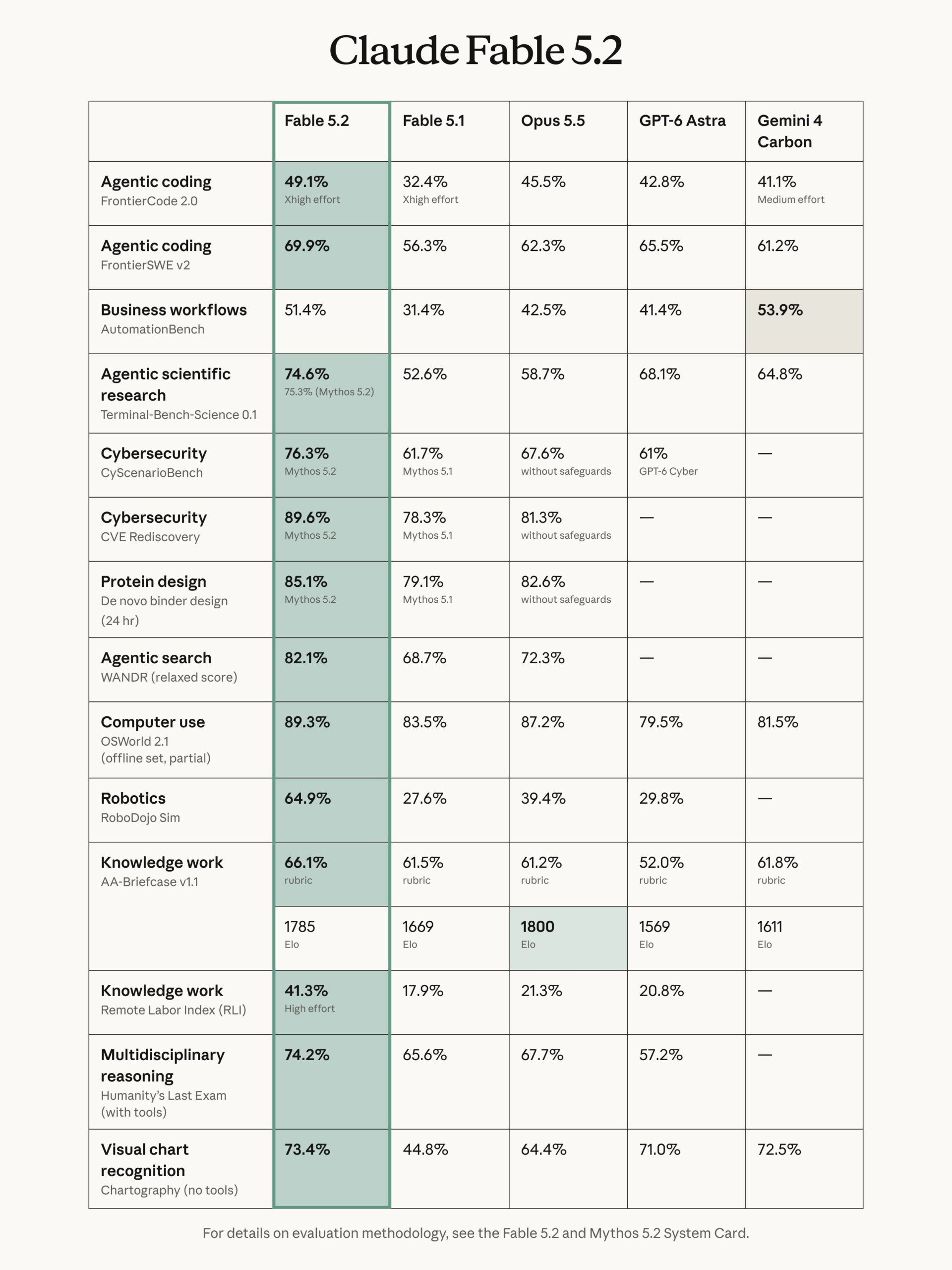
Image source: Anthropic Official Blog
On November 9, Anthropic released Claude Fable 5.2 and Mythos 5.2: two configurations built on the same underlying model. Fable targets general-purpose use cases, while Mythos is restricted to vetted programs (cybersecurity and life sciences). Both share a 1 million-token context window and 128,000 maximum output tokens.
Performance and pricing both saw major updates: Fable 5.2 scored 49.1% on FrontierCode 2.0, up from 32.4% for version 5.1; output speed increased by 30%; and pricing dropped to $8 per million input tokens and $40 per million output tokens (down from $10/$50 in 5.1). An optional fast mode is also available at $16 input and $80 output, boosting speed by 2.5x.
Key metrics on the Mythos side include 89.6% CVE vulnerability reproduction; completing a formal proof of Fermat's Last Theorem using 1,000 agents running in parallel for 30 hours; and designing three working electronic devices from scratch. Third-party benchmark Artificial Analysis gave it an Intelligence Index score of 65, ranking first for now. Devin integrated it on launch day.
💡 Lumo’s take
Builders of agent products can start selecting models in tiers by task rather than defaulting to the most expensive tier across the board.
02Meta Releases Its Lightest Model Muse Ember, Averaging ~$0.14 per Agent Task
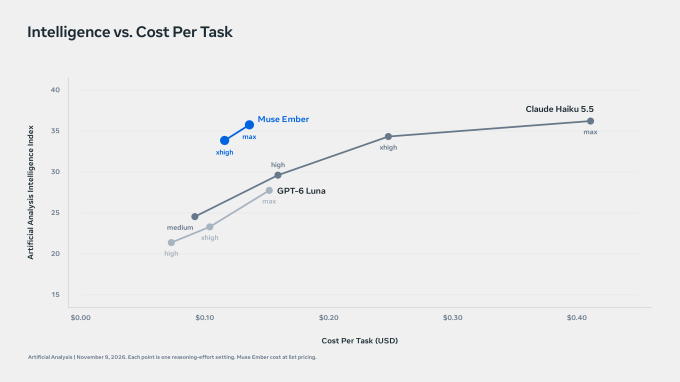
Image source: TechCrunch
On November 9, Meta released Muse Ember, the fourth model in the Muse family, focused on repetitive agent workloads: tool calling, coding subtasks, task routing, information extraction, and long-document parsing. Priced at $0.10 per million input tokens and $0.50 per million output tokens, Meta states the average cost per task is ~$0.14.
Its specifications are solid: a 1 million-token context window and 512,000 maximum output tokens. It scored 36 on the Artificial Analysis Intelligence Index, matching Claude Haiku 5.5 at roughly one-third the per-task cost. Identified as muse-ember-1.0, it is now live on the Meta Model API and Muse Code.
This marks the fourth release in the Muse lineup this year—following Spark in April, open-source Glimmer in August, and Wonder in October—as Meta builds out a full product line spanning from flagship models to low-cost execution layers.
💡 Lumo’s take
Breaking down costs by stage saves far more than using a flagship model end-to-end—planning, execution, and verification should naturally use different model tiers.
03Meituan Open-Sources LongCat-2.5 Weights Under MIT, Releasing Full 3.56TB of 1.6T-Parameter Model
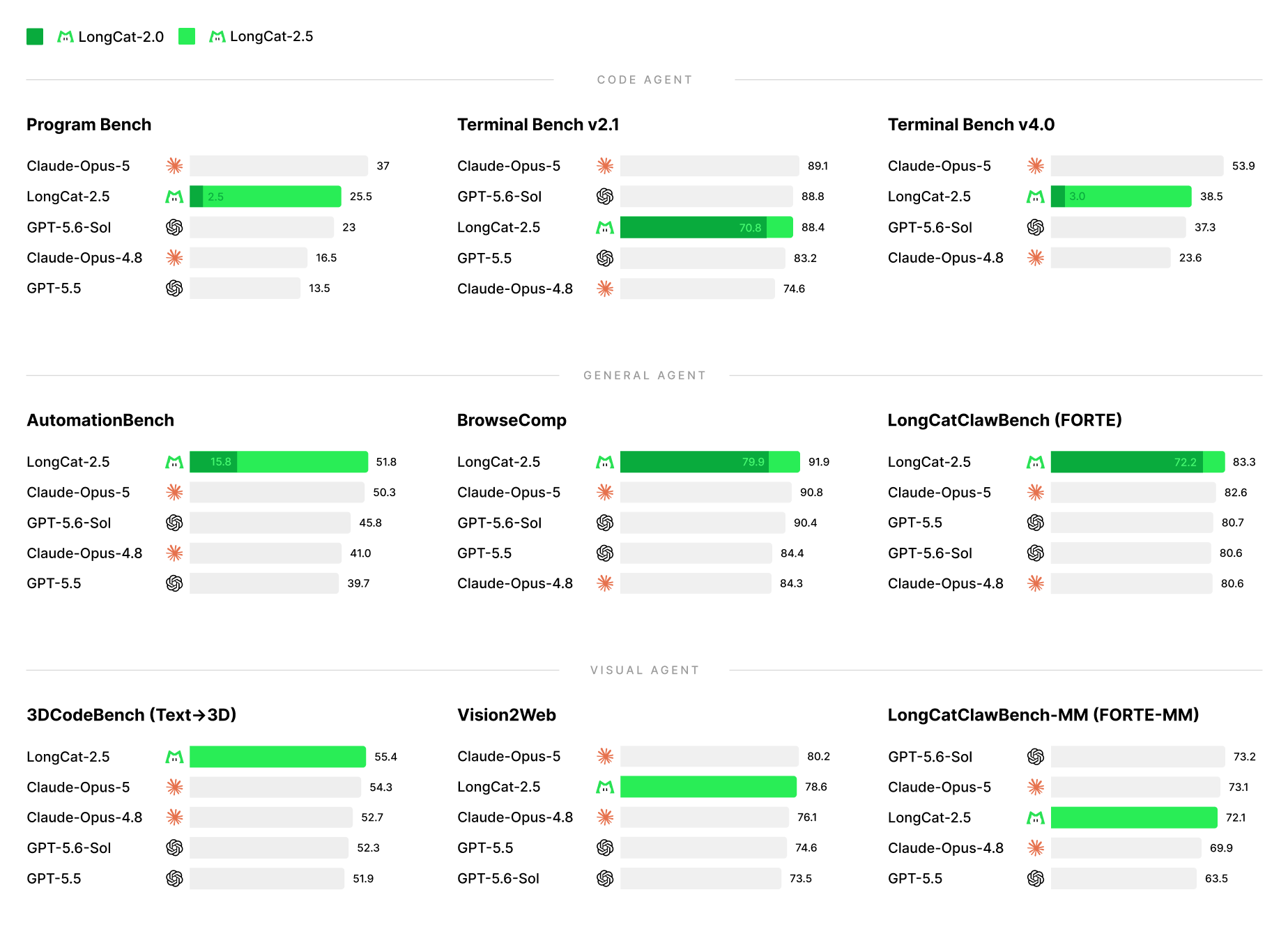
Image source: VentureBeat
Meituan has open-sourced the model weights for LongCat-2.5 under the MIT license: featuring 1.6 trillion total parameters with roughly 48 billion activated per token, the BF16 weights total 3.56TB across 208 files and have been uploaded to Hugging Face. Originally released on November 2, this marks the open release of its weights.
Benchmark scores show a generational leap: 88.4 on Terminal Bench v2.1 (up from 70.8 on v2.0), 64.6 on DeepSWE (up from 9.7 on v2.0), and 91.9 on BrowseComp. The MIT license excludes trademark and patent rights, imposing minimal restrictions on use.
Supporting offerings are also rolling out: official API promotional pricing is set at $0.30 per million input tokens and $1.20 per million output tokens, alongside a W4A4 quantized version supporting domestic NPUs.
💡 Lumo’s take
For builders of agents and coding tools, open weights mean you can build your own evaluations and fine-tune models independently instead of relying solely on official APIs.
04OpenAI Launches Control Room, Enabling One-Click Shutdown of Research Models Within 35 Seconds
On November 9, OpenAI launched Control Room, a central authorization layer for its research infrastructure. Following a safety or security intervention, it can cut off model outputs within a maximum of 35 seconds—directly addressing an internal incident on September 20 this year where a manual shutdown took 2.5 hours.
The mechanism operates at the inference layer rather than within workload code: every agent inference workload must be linked to an approved safety case. Before returning an output, the inference engine verifies authorization with Control Room; once a job is flagged to stop, the very next request is immediately rejected.
At launch, coverage includes all frontier model research workloads, with remaining workloads rolling out over the following days. It is designed to fail-closed—if the service itself goes down, all inference requests are rejected rather than allowed through.
💡 Lumo’s take
Safety layers are evolving from procedural guidelines into core infrastructure—a critical lesson for anyone building multi-agent systems.
05ChatGPT Enterprise Launches on AWS Marketplace, Supporting AWS Procurement and Billing
OpenAI has brought ChatGPT Enterprise to AWS Marketplace, allowing enterprises to purchase and manage subscriptions through existing AWS procurement and billing relationships, with eligible spend counting toward AWS commitment agreements (EDP/PPA).
The bundle remains unchanged: Chat, ChatGPT Work, Codex, and dots are sold together, offering identical features and simultaneous updates as direct purchases. Healthcare and financial services editions are available through the same channel, with pricing undisclosed and handled via private quotes.
One caveat to note: purchasing through AWS does not mean all data stays on AWS—data residency and procurement are separate matters that require separate confirmation.
💡 Lumo’s take
Teams selling AI products should take note: getting into procurement catalogs and leveraging customers' existing billing relationships can sometimes win enterprise deals more effectively than price cuts.
06Disney and Adobe Form Multi-Year AI Alliance; Firefly Foundry Builds Custom Private Models for Disney
Image source: Adobe Official Press Release
On November 9 at Adobe MAX, Adobe and Disney announced a multi-year strategic alliance naming Adobe as Disney's "Official AI Innovation Partner."
At the center is Firefly Foundry: Adobe is building custom private generative models for Disney trained exclusively on Disney's own characters, environments, and visual styles to produce commercially viable, brand-compliant assets. Disney also receives priority access to Firefly, Firefly Foundry, Premiere, and Photoshop, along with Adobe engineering and research support.
Deployment spans theme parks, cruise lines, StudioLAB, and ESPN Edge. Walt Disney Imagineering R&D is already using Firefly Foundry for concept exploration, including models that convert hand-drawn sketches into full concept art. Financial terms of the deal were not disclosed.
💡 Lumo’s take
For content owners, rather than worrying about AI copying your style, turn that style into your own proprietary model.
07Anthropic Reportedly Takes Over $3.4B Gas Turbine Order as AI Compute Power Race Enters a New Phase
Image source: TechCrunch
According to a November 8 Financial Times report, Anthropic has taken over a generator order placed with Caterpillar by energy company OnePWR, covering roughly 1.7GW of capacity valued at around $3.4 billion. Neither Anthropic nor OnePWR commented, and Reuters stated it could not independently verify the report—treating this item as unconfirmed.
The context is notable: Anthropic has historically rented compute rather than purchasing hardware, and its S-1 filing disclosed monthly compute payments of $1.25 billion to xAI (a SpaceX subsidiary) through May 2029. If confirmed, this order signals a shift toward directly owning power-generation assets.
Across the industry, gas turbine backlogs already stretch into the early 2030s—power shortages for AI data centers are turning model companies into direct energy buyers.
💡 Lumo’s take
When a model company starts buying power plants, electricity has officially joined GPUs as a hard constraint on AI infrastructure.
08Lightpanda: Headless Browser Written in Zig, 16x Lighter and 9x Faster Than Chromium
Image source: GitHub
Lightpanda is a headless browser written from scratch in Zig specifically for AI and automation—not a fork of Chromium. Officially, it is 16x lighter and 9x faster than Chromium, with over 41,000 stars on GitHub under the AGPL-3.0 license.
It supports CDP, native MCP, and an Agent mode: lightpanda agent can record actions and replay them as PandaScript, making it well-suited for delegating browser tasks to agents.
For builders working on agents and data collection, its significance lies in finally offering a lightweight browser alternative that can be spun up and shut down on demand wherever Chromium proves too heavy.
💡 Lumo’s take
Lightweight, programmable, and capable of recording and playback—combining these three traits defines a browser built for agents.
ProtoMap is a context engine built for gRPC/Protobuf services: it scans codebases to show engineers and coding agents how services depend on one another, where call sites are located, and how field-level data flows.
Integrated via MCP, it plugs directly into coding agent workflows. Vendor benchmarks claim that running on Claude Code + Opus 5.5 reduces token usage by 13x and speeds up tasks by 7.7x, cutting single-prompt costs from $4.46 down to $0.20—note that these are self-reported vendor figures and have not been independently verified.
A free self-hosted edition is available for teams looking to keep context services within their own infrastructure.
💡 Lumo’s take
Middleware like context engines represents one of the fastest-moving avenues for driving down agent costs.
10MCP1: MCP Gateway by Appwrite Connects All MCP Servers via a Single URL
Appwrite has launched MCP1, an MCP gateway that connects all MCP servers through a single URL while centrally handling authentication, permissions, usage analytics, and audit logs.
It is free for individuals and priced per seat for teams, featuring SOC 2, GDPR, and HIPAA compliance with hosting in Frankfurt.
Its positioning is straightforward: as the number of connected MCP servers grows, the tangle of authentication and permissions requires a unified entry point.
💡 Lumo’s take
Whoever turns connecting MCP servers into a one-click experience first will capture the gateway to the agent toolchain.
11GBrain: Agent Memory Layer Used by YC President Garry Tan, Open-Sourced With 32,000 Stars
Image source: GitHub
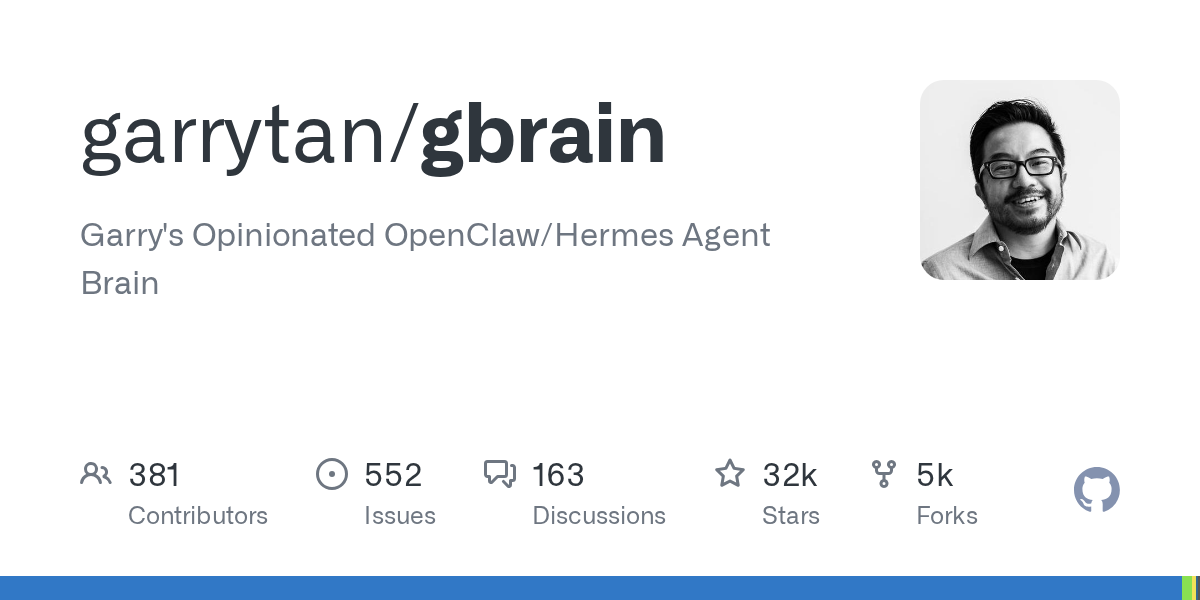
GBrain is the agent memory layer used personally by YC President Garry Tan: facts carry source citations, can be corrected or retracted, and can be shared across agents. Its GitHub repository has over 32,000 stars under the MIT license.
It structures memory as a citation-backed knowledge base: agents query their memory before calling external APIs and honestly admit when they do not know an answer. It supports self-hosting alongside a hosted version at gbrain.io. According to the author, his production brain already holds 155,000 pages of content, 24,000 people, and 5,340 companies.
Integrations cover major clients including Claude Code, Codex, Cursor, and ChatGPT via MCP, alongside a "dream cycle" mechanism that runs overnight to deduplicate entries, surface contradictions, and prepare tasks for the next day.
💡 Lumo’s take
Memory is becoming core agent infrastructure: whoever builds a memory layer that is source-backed, correctable, and shareable first will secure the entry ticket to long-term companion agents.
"Task-Tiered Model Cost Routing": Build a lightweight agent cost-routing utility placed in front of coding agents like Claude Code and Codex. It splits tasks into three tiers—planning, execution, and verification: using a capable model for planning, switching to a lightweight model costing ~$0.14 per task like Muse Ember for repetitive execution, and returning to a strong model for verification. Routing rules are configurable and can automatically downgrade based on token spend. Who pays: Small teams and indie developers running agents daily whose API bills are visibly climbing and who are willing to pay to "save 30% without losing quality." Why now: With Fable 5.2 and Muse Ember debuting on the same day, model tiers are now complete—flagship, lightweight, and open-source weights are all available, missing only the routing layer to connect them. Minimum MVP: An open-source CLI wrapping common agent commands that automatically selects models by task type and tracks costs, generating a personal cost comparison table within a week; a paid tier starting at $19/month offers teams usage and savings reports broken down by person and project. First validation step: Run your own agent bills through it for one week to calculate the exact price difference between "flagship all the way" and "tiered routing"—the money saved becomes the product's very first tagline.