OpenAI Secures First $11B Tranche at $1.25T Valuation; Anthropic Lets Agents Organize Memory by "Dreaming"
Today’s highlights
OpenAI secures its first $11B tranche at a $1.25T valuation
Anthropic lets agents organize memory offline via "dreaming," lifting wiki QA from 13% to 48%
Alibaba teases Qwen4 with "A Fish in the Northern Ocean"; QuantumBit reports internal Anthropic Model 4 reaches a 178.6 capability index
Meta Muse launches Spaces to build mini-apps inside chat; AWS enables Claude Code to run remotely on Bedrock AgentCore
T3 Code controls 7 coding agents from a phone and gains 16K stars in a week; dsh plugin gains 11K stars in a week
01OpenAI Secures First $11B Tranche at $1.25T Valuation
On November 6, Bloomberg and Reuters reported that OpenAI has received the first tranche of roughly $11 billion in its current funding round at a $1.25 trillion valuation. This marks new progress following the November 1 report that the fundraising target had been trimmed to $20 billion—turning commitments into actual cash. The initial target in late September was over $30 billion at a $1.4–1.5 trillion valuation, which was reduced in late October to roughly $20 billion at a $1.25 trillion valuation; with the initial $11 billion now received, the remaining ~$9 billion is expected to arrive over the coming weeks. Reuters reported that SoftBank and MGX are participating in the round, while Bloomberg named Coatue and T. Rowe Price among investors in the first tranche; OpenAI declined to comment, though CFO Sarah Friar confirmed on CNBC on November 6 that the company is raising funds. For comparison, the March round this year was $122 billion at an $852 billion valuation, representing a roughly 47% valuation increase over eight months.
💡 Lumo’s take
Takeaway: A $1.25T private valuation essentially locks in the fundraising ceiling for top foundation model companies. When building AI products, do the math: the more expensive upstream models become, the more downstream products must rely on concrete use cases to make money rather than competing on the model itself. Direct: None (no official announcement); News: https://www.unite.ai/openai-secures-11b-in-initial-funding-at-1-25t-valuation/ ; Image: No image
02Anthropic Lets Agents Organize Memory Offline via "Dreaming," Lifting Wiki QA from 13% to 48%
Image source: explainx.ai
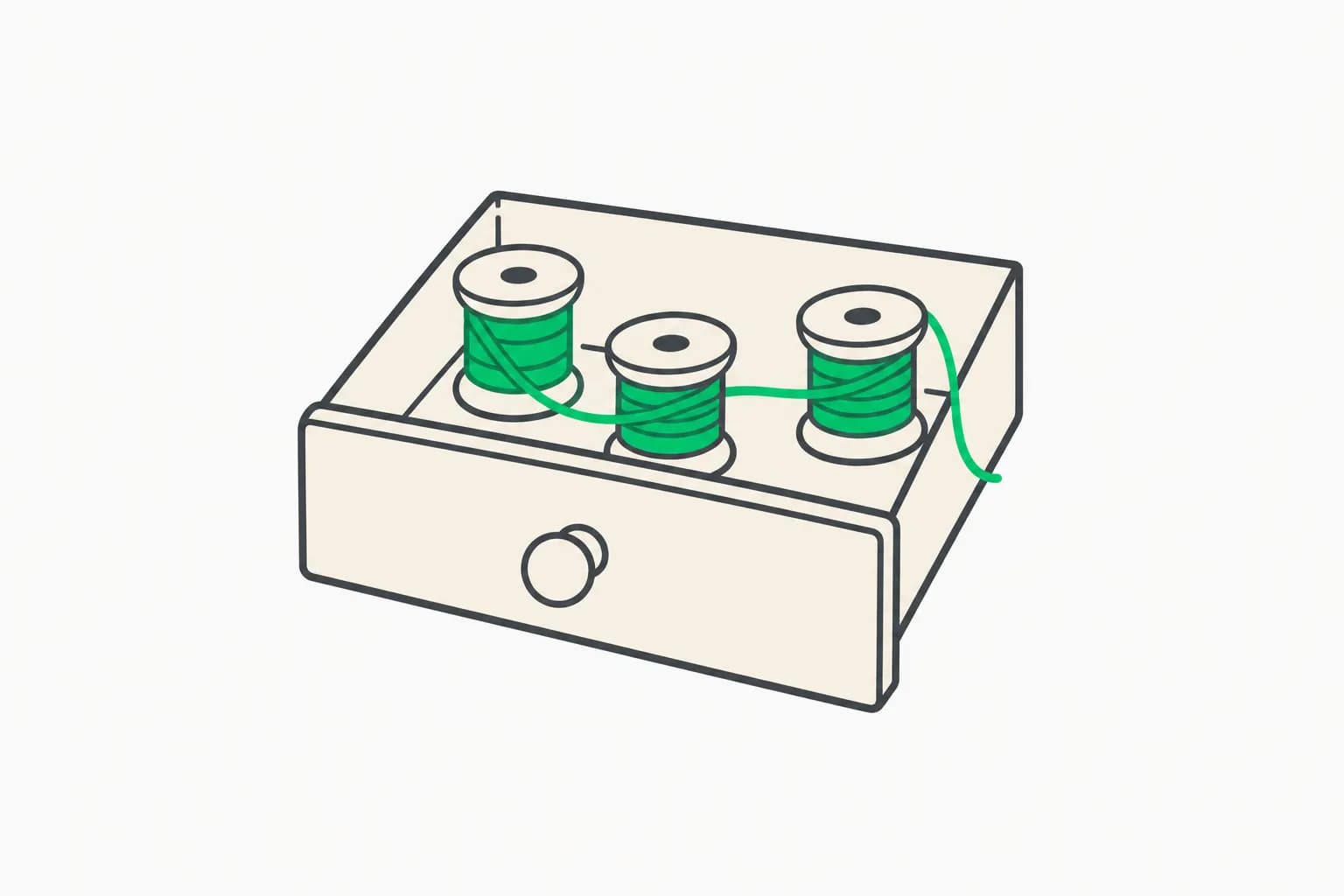
On November 6, the Anthropic engineering blog published "The components of agent memory," systematically outlining how agent memory should be structured. At its core is a four-layer architecture: raw transcripts, distilled notes, structured representations (wikis), and always-loaded content injected into context. The most notable mechanism is "dreaming": the agent organizes its own memory while offline—cross-checking transcripts to fix errors, merging duplicates, building wikis, and deciding which content stays permanently loaded. After 128 dreaming rounds across roughly 350,000 internal Stainless files (~420 million tokens), scores on 25 wiki QA questions rose from 13% to 48%; search plus wiki reached 61%, compared with 53% for search alone, while also saving roughly 20,000 tokens per question. The same memory system also drove large gains on long-horizon tasks: on CL-Bench 1.0, Opus 5.5 rose from 0.655 to 0.838, and in Pokémon Red, Opus 5.5 completed the entire game. Anthropic also offered a design rule: "Tell Claude what the memory is for, not how to use it." Note that this is a research post rather than a general product launch; the Dreams API and cookbook have been added to anthropics/claude-quickstarts.
💡 Lumo’s take
Takeaway: Once an agent has been used for a long time, its memory is more valuable than the model itself. This "transcript → notes → wiki → injection" methodology can be copied directly into your own agent projects, especially the idea of keeping only the first 200 lines or 25KB of MEMORY.md as an index. Direct: https://www.anthropic.com/research/components-of-agent-memory ; News: https://explainx.ai/blog/anthropic-components-of-agent-memory-dreaming-cl-bench-pokemon-wiki-stainless-2026 ; Image: https://explainx.ai/_next/image?url=%2Fimages%2Fblog-library%2Fagent-long-term-memory.webp&w=3840&q=75
03Alibaba Teases Qwen4 with "A Fish in the Northern Ocean" as Next-Gen Model Approaches
On the evening of November 6, Alibaba's official Qwen account posted a teaser poster captioned "In the Northern Ocean there is a fish, its name is _," alongside the English tagline "The becoming begins." By November 7, the post had garnered over 2.2 million views and more than 17,000 likes. To be clear about the boundaries: the post itself did not mention the name Qwen4, nor did it give a release date, pricing, license, or parameter count. Interpreting it as an imminent Qwen4 release is a reasonable inference based on public information—Alibaba has already stated publicly that Qwen4 is in training. Groundwork has been underway for some time: Qwen3.8-Flash-Next (a 125B main model plus 51B N-gram Embedding, activating only 6B per token) was positioned as an early preview of the Qwen4 architecture; Qwen3.8-27B was open-weighted on August 14 (Apache 2.0, 262K native context, extendable to 1M). At the Apsara Conference on September 22, Alibaba also disclosed that Qwen had surpassed 3 billion downloads and 300,000 derivative models, with Qwen3.8-Max reaching 2.4 trillion parameters. Even more notable is its RSI track: Qwen3.8-Max completed 33 rounds of fully automated self-improvement iterations in one month, raising its Artificial Analysis score from 40 to 45; in a chip design experiment running over 60 hours and invoking EDA tools more than 10,000 times, chip area was reduced by 42%.
💡 Lumo’s take
Takeaway: The release cadence of domestic open-source models now rivals major overseas labs. Keep a close eye on Qwen4's weight release format and license—if it opens under Apache 2.0, it will be another wave of flagship capability available for free, worth testing right away. Direct: None (official teaser is a social media post); News: https://news.zhiketui.com/article/6aedd85d8e9f09295a162900/ ; Image: No image
04QuantumBit Reports on Three Internal Anthropic Models, with Model 4's 178.6 Capability Index Topping Opus 5.5
Image source: QuantumBit (reposted via 66bidu)
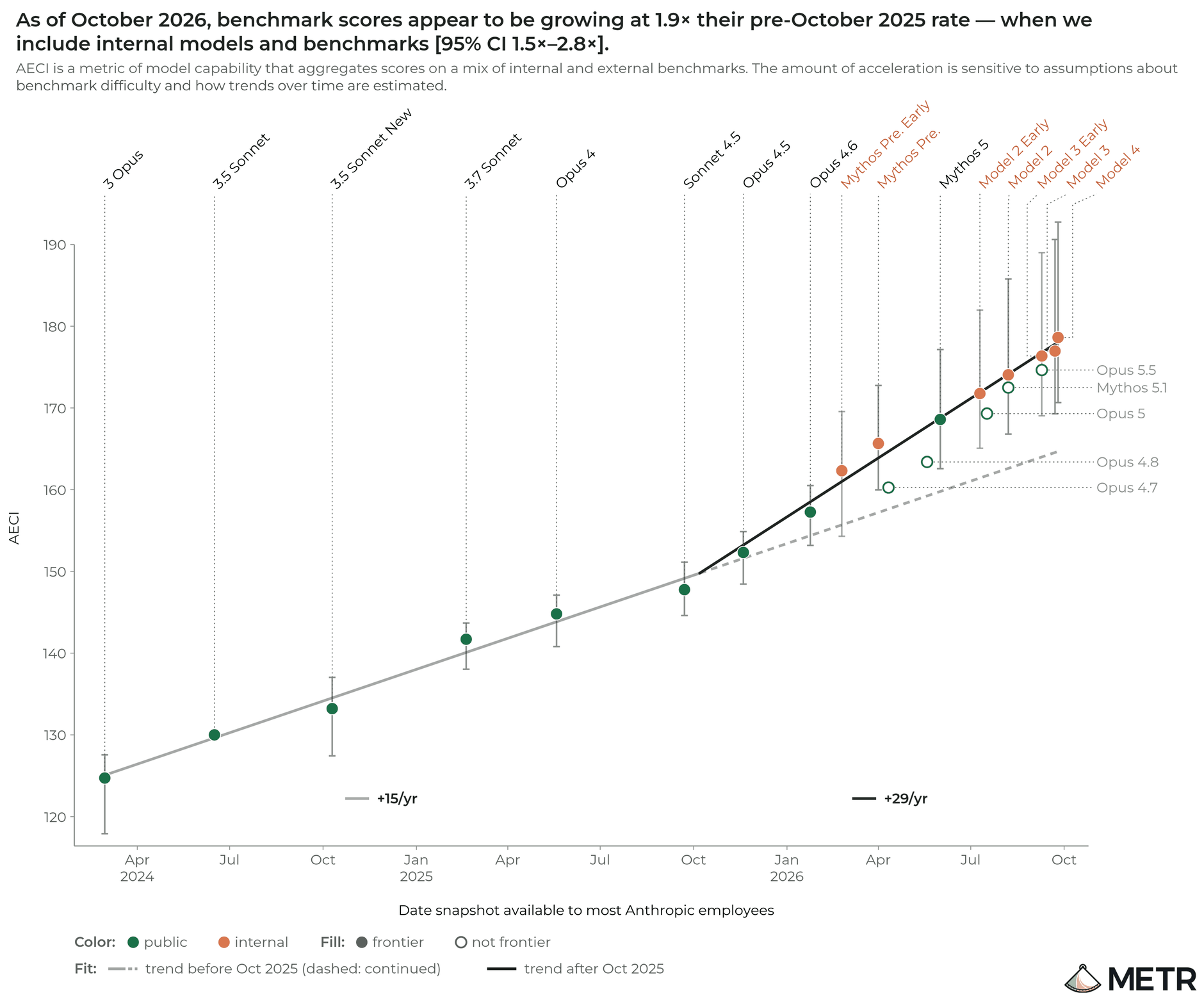
QuantumBit reported at 23:21 on November 6 on a November 5 report from METR. The report disclosed three internal Anthropic models: Model 2 (trained by July 2026), Model 3 (August–September), and Model 4 (September–October). Key figures: Model 4 scored 178.6 on the AECI (AI R&D Capability Index), and 179.7 after excluding three benchmarks suspected of saturation—roughly 3.9 points higher than the public Opus 5.5, equivalent to about three months of progress. It exceeded 50% across all 15 AECI benchmarks, becoming the first model to do so—nine months earlier, Opus 4.6 still fell below 50% on multiple benchmarks. The report also quantified the acceleration itself: since October 2025, the pace of capability growth has been roughly 1.9x the prior rate (95% confidence interval: 1.5–2.8), with roughly 80% driven by AI-assisted R&D; researchers reported an ~80% reduction in time from idea to experiment; as of August, Claude was already handling 26% of model R&D work, up from under 1% six months earlier. One caveat to note: co-founder Sam McCandlish acknowledged that substantial information was redacted from the public version, and Anthropic will publish its own progress analysis in the coming weeks. A strong internal model does not mean the public version will immediately match it.
💡 Lumo’s take
Takeaway: The flywheel of AI helping AI conduct R&D is already spinning, and that 26% figure matters more than any benchmark score—it means the pace of model iteration itself is being rewritten by models. Plan products around "models changing every quarter," not on an annual cycle. Direct: None (original METR report link unverified); News: https://www.66bd.net/article/40034 ; Image: https://metr.org/assets/images/ai-rd-acceleration-assessment/aeci-main.png
05Meta Muse Spaces: Build Your Own Mini-Apps Inside Chat
On November 6, Meta Newsroom published "Design the Muse App, Just for You," introducing Spaces inside Muse: describe an idea to Muse, and it generates a dedicated, persistent interface such as a holiday gift tracker, calendar word game, freelance client hub, or travel itinerary. Spaces are not one-off conversations, but persistent mini-apps: they can be pinned to the sidebar, placed in main navigation, hidden, or scheduled to appear automatically—for instance, showing a work planner on weekdays and switching to weekend plans on Saturday. Once connected to frequently used apps, they update themselves in the background—tracking new concert dates, price changes, or savings progress without needing to be prompted again. Mark Zuckerberg posted on X the same day that he had already used Spaces to build a BBQ game, an event tracker, and a home control panel. Sharing features are still being explored, so Spaces cannot yet be shared with others. On the same day, Meta also noted it is rolling out a specialized model version to Muse tuned with learnings from Muse Wonder training. The timeline is noteworthy: this marks Muse's second update within roughly 23.5 hours, following the launch of real-time voice avatars on November 5.
💡 Lumo’s take
Takeaway: "Generating a persistent mini-app from a single sentence" is a key form factor for practical agent deployment—conversations are disposable, whereas Spaces are assets. This offers a clear lesson for utility products too: let users describe what they need and generate a bookmarkable, revisit-ready dedicated page instead of forcing them to search from scratch every time. Direct: https://about.fb.com/news/2026/11/introducing-spaces-customize-muse-app/ ; News: https://fourweekmba.com/ai-metas-muse-now-builds-custom-mini-apps-called-spaces/ ; Image: No image
06South Korea's Darwin-180B Self-Improving Open-Source Model Scores 73.68 in Math Reasoning
Image source: labmemo
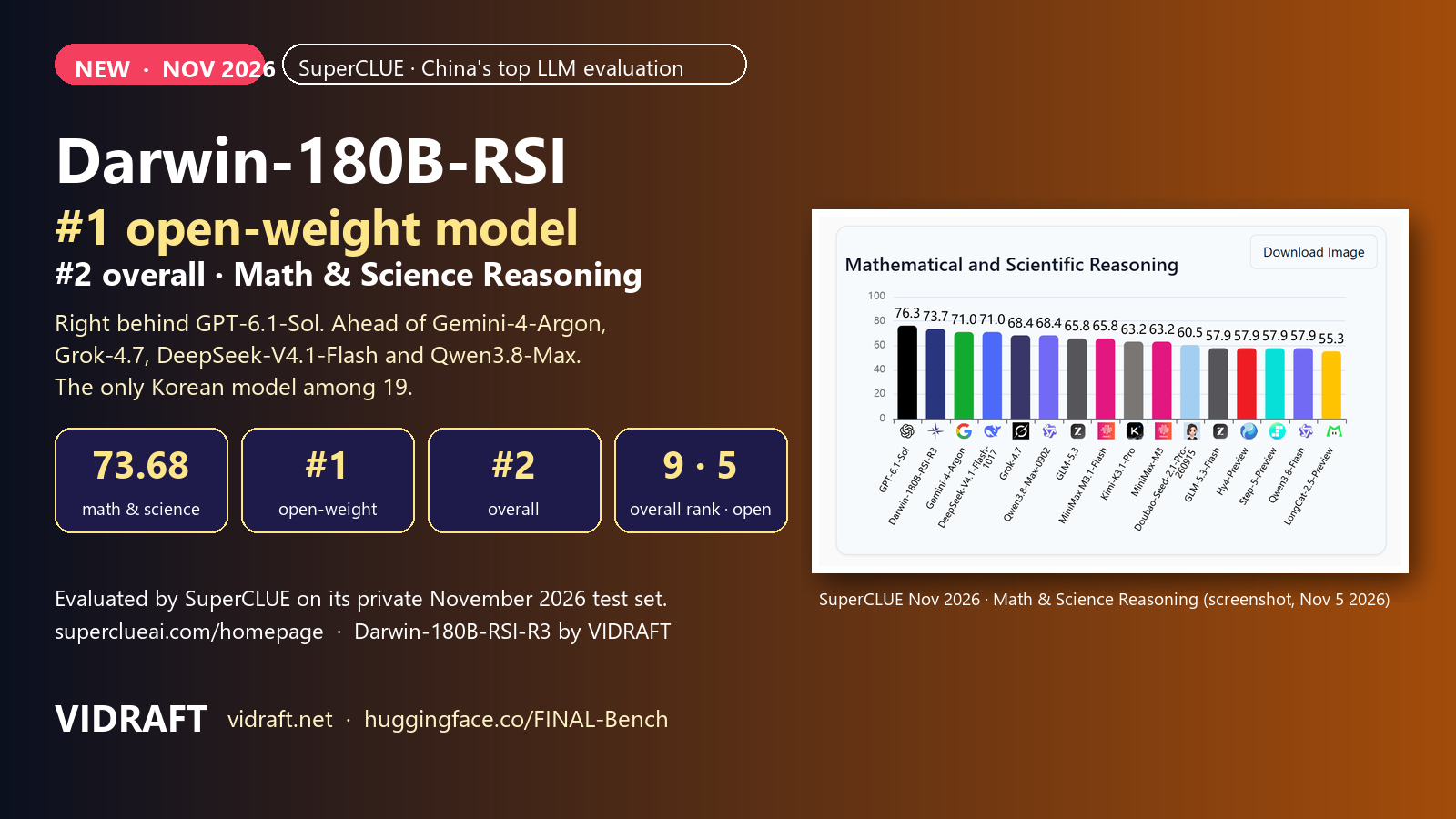
On November 6, South Korean team VIDRAFT released the weights for Darwin-180B-RSI-R3 on Hugging Face. It is a 180B MoE model (512 experts, activating roughly 3B parameters and 10 experts per token) with a 262K context window and multimodal image-text input support. In SuperCLUE's November 2026 evaluation (private test set), it scored 73.68 in math and scientific reasoning—first among open-weight models and second overall out of 19 models, trailing only GPT-6.1-Sol's 76.32 while outperforming Gemini-4-Argon and DeepSeek-V4.1-Flash (both at 71.05). Its overall index score was 43.08, ranking 9th out of 19 and 5th among open-source models. Notably, its parent model is Alibaba's Qwen3.8-Flash-Next, which scored only 57.89 on the same metric, meaning Darwin delivered a substantial jump. R3 represents the second round of RSI (Recursive Self-Improvement)—training solely on solutions verified as correct by the model itself, without human-written answers or reasoning traces. It also ranked first on ExtractBench with a score of 90.29. Deployment barriers are modest as well: the 4-bit GGUF version is 111GB, capable of running on a laptop with 8GB of VRAM and achieving 18–21 tokens per second even on CPU alone.
💡 Lumo’s take
Takeaway: RSI is moving from academic papers into a reproducible playbook—without human answers, models can train themselves to become stronger. Even more practically, a 180B-class open-source reasoning model can now run on a laptop, adding another strong option for local deployment. Direct: https://huggingface.co/FINAL-Bench/Darwin-180B-RSI-R3 ; News: https://labmemo.com/ai-news-roundup-2026-11-07/ ; Image: https://huggingface.co/datasets/VIDraft/press-assets/resolve/main/press/superclue_banner_darwin_2026-11.png
07Five Major Labs Jointly Launch "Jailbreak Rating Framework" 1.0 to Score and Classify Cyber Jailbreaks
On November 5, the Frontier Model Forum released version 1.0 of its "Jailbreak Rating Framework." Endorsed jointly by the safety leads of its members—OpenAI, Anthropic, Google DeepMind, Microsoft, and Amazon—the release marks a rare moment of alignment among rivals on safety ratings. The framework evaluates individual reproducible jailbreaks (against a specific model version and safeguard setup) across four dimensions—capability uplift, capability scope, deployment ease, and discovery ease—each scored 0–3 on a logarithmic scale, then combined along severity and likelihood axes into five tiers: Negligible, Low, Medium, High, and Critical. A capability uplift score of 0 automatically classifies a jailbreak as Negligible. The baseline is set as the strongest publicly available model at the time of evaluation (currently October 2026 versions), using ExploitBench and ExploitGym for initial screening. The framework explicitly notes that this is a preliminary, voluntary, non-binding draft open for public comment until December 21. Seen alongside GPT-6 Cyber from the November 6 issue (which scored 48.5% on ExploitGym), offense and defense are standardizing simultaneously: one finds vulnerabilities, while the other grades them.
💡 Lumo’s take
Takeaway: AI safety is shifting from "every lab using its own yardstick" toward a "shared scale." For AI product builders, this framework could become a common language in procurement and compliance, making it worth learning its five tiers early. Direct: https://www.frontiermodelforum.org/specifications/jailbreak-rating-framework-for-frontier-cyber-threats/ ; News: https://alphasignal.ai/news/frontier-model-forum-unites-openai-and-google-on-ai-jailbreak-ratings ; Image: No image
08Ai2 ToyBlocks: A Controlled Testbed for Robot Learning
Image source: labmemo
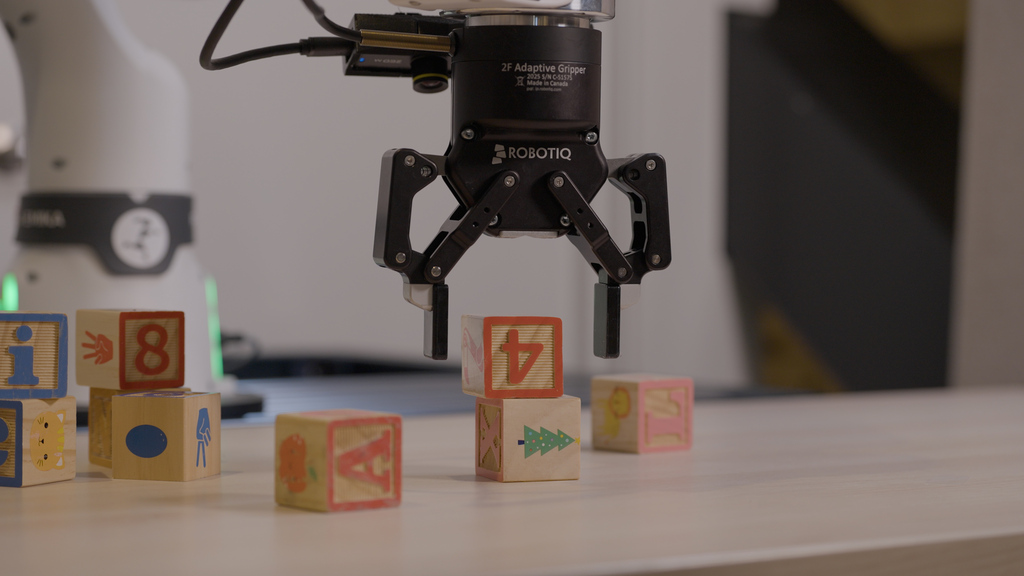
On November 6, the Allen Institute for AI (Ai2) published ToyBlocks on the Hugging Face blog, marking the first installment of its FoundationWorlds initiative: a controlled simulation environment featuring a robotic arm and tabletop blocks built specifically for robot learning control experiments. The approach is pragmatic: tasks and demonstrations are generated automatically and trained on NVIDIA Isaac Lab using reinforcement learning plus motion planning at up to 24x real-time speed, with no human teleoperation required. The blocks feature letter patterns, enabling verifiable tasks such as searching, sorting, and spelling, while domain randomization is used to test generalization. Code, data, models (Molmo2-4B-tb, maniflow-tb), and documentation are all publicly released. Its web interface connects directly to Claude or other frontier models, allowing users to command the robotic arm in natural language. In testing, Claude Opus 5.5 invoked skills via MCP to run search-and-spell experiments, solving or correctly identifying infeasibility in 63% of tasks. A toy setup tackling a real problem: breaking robot learning down into reproducible, scorable micro-tasks addresses one of the field's biggest missing pieces of infrastructure.
💡 Lumo’s take
Takeaway: Embodied AI is also shifting toward a "benchmarks-first" path. ToyBlocks' approach is worth borrowing: rather than building a general-purpose robot right out of the gate, get a single verifiable micro-task running at 24x simulation speed with automated task generation and automated scoring. Direct: https://huggingface.co/blog/allenai/toyblocks ; News: https://labmemo.com/ai-news-roundup-2026-11-07/ ; Image: https://cdn-uploads.huggingface.co/production/uploads/638e39b249de7ae552d977b5/ov2i4rZoAkJw4z9FBaGfm.jpeg
09DEEP Robotics Jueying X50: Runs 2 km Continuously Carrying a 50 kg Load
Image source: 21st Century Business Herald
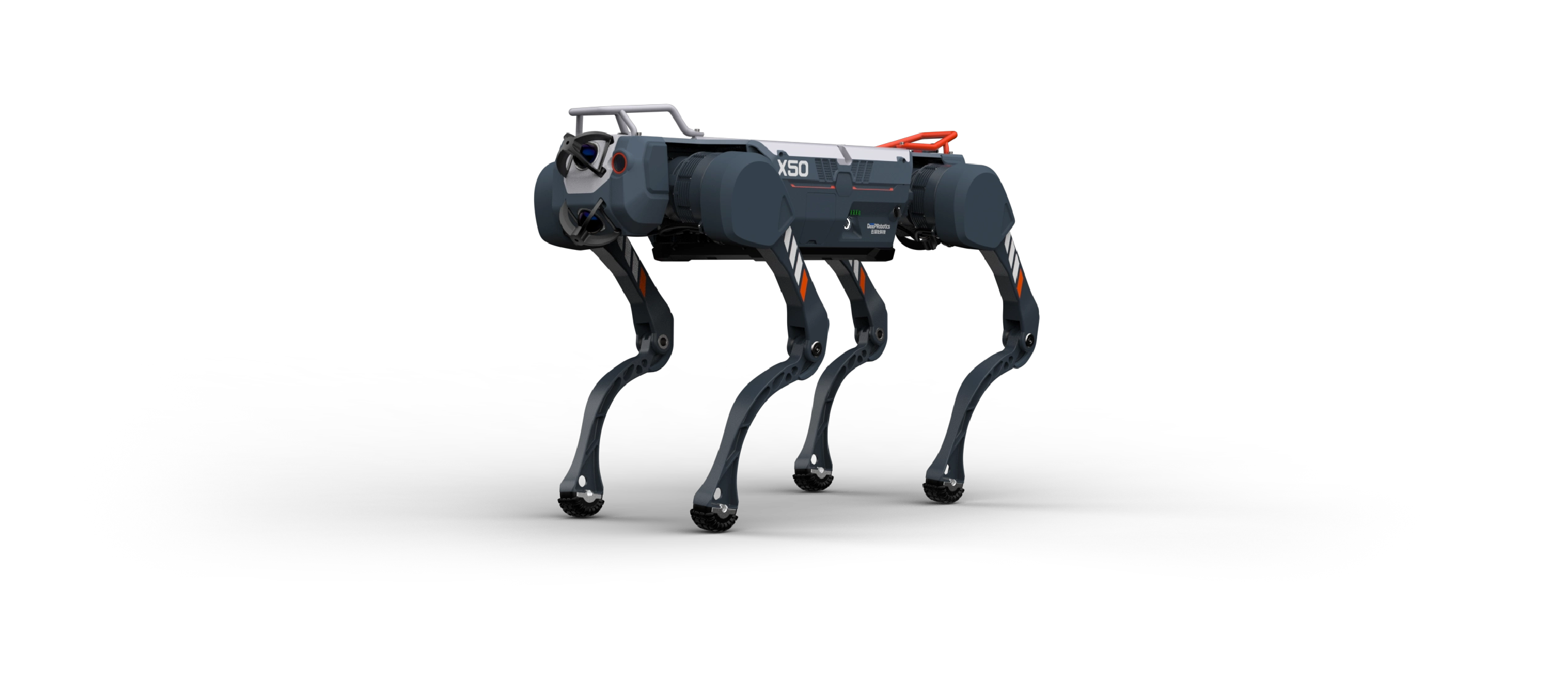
On November 6, DEEP Robotics unveiled the Jueying X50 quadruped robot. Its standout figure is payload capacity: a continuous locomotion payload of 50 kg without increasing body dimensions, under which it can run continuously for over 2 km at 3 m/s. Weighing roughly 57.5 kg overall, it carries an IP67 rating, operates across -20°C to 55°C, reaches a top speed of 4.5 m/s, and runs for 2 hours under a 50 kg load. Motion control fuses LiDAR point clouds with IMU data, using reinforcement learning algorithms to anticipate terrain and plan footholds, enabling it to scale 80 cm high platforms, cross stepping stones spaced 70 cm apart, and climb open-riser stairs. Its positioning is clear: emergency firefighting, energy, and power inspection scenarios requiring heavy payloads and complex terrain traversal. Announced alongside it was the X50pro, weighing roughly 60 kg and equipped with three 8-core processors; pricing and release dates have not yet been disclosed. Industry context is also worth noting: global humanoid robot shipments in the first half of 2026 totaled roughly 19,100 units, with Chinese manufacturers accounting for over 97%—Agibot ranked first at around 8,400 units, and Unitree second at around 5,900 units.
💡 Lumo’s take
Takeaway: Competition in quadruped robots has shifted from "whether it can walk" to "how much weight it can carry and how far it can go." A 50 kg payload paired with a 2 km range means it is transitioning from a "demo prop" into a practical "transport crew member." Direct: https://m.ybclled.com/products-detail-10.html.html ; News: https://www.21jingji.com/article/20261106/herald/310ded3822e202c0440404a66d3cde95.html ; Image: https://m.ybclled.com/bocupload-2026-11-06-179397462028962o6f4.webp.jpg
10AWS Enables Claude Code to Run Remotely on Bedrock AgentCore, Finishing Tasks Even After Closing Your Laptop
Image source: AWS Machine Learning Blog
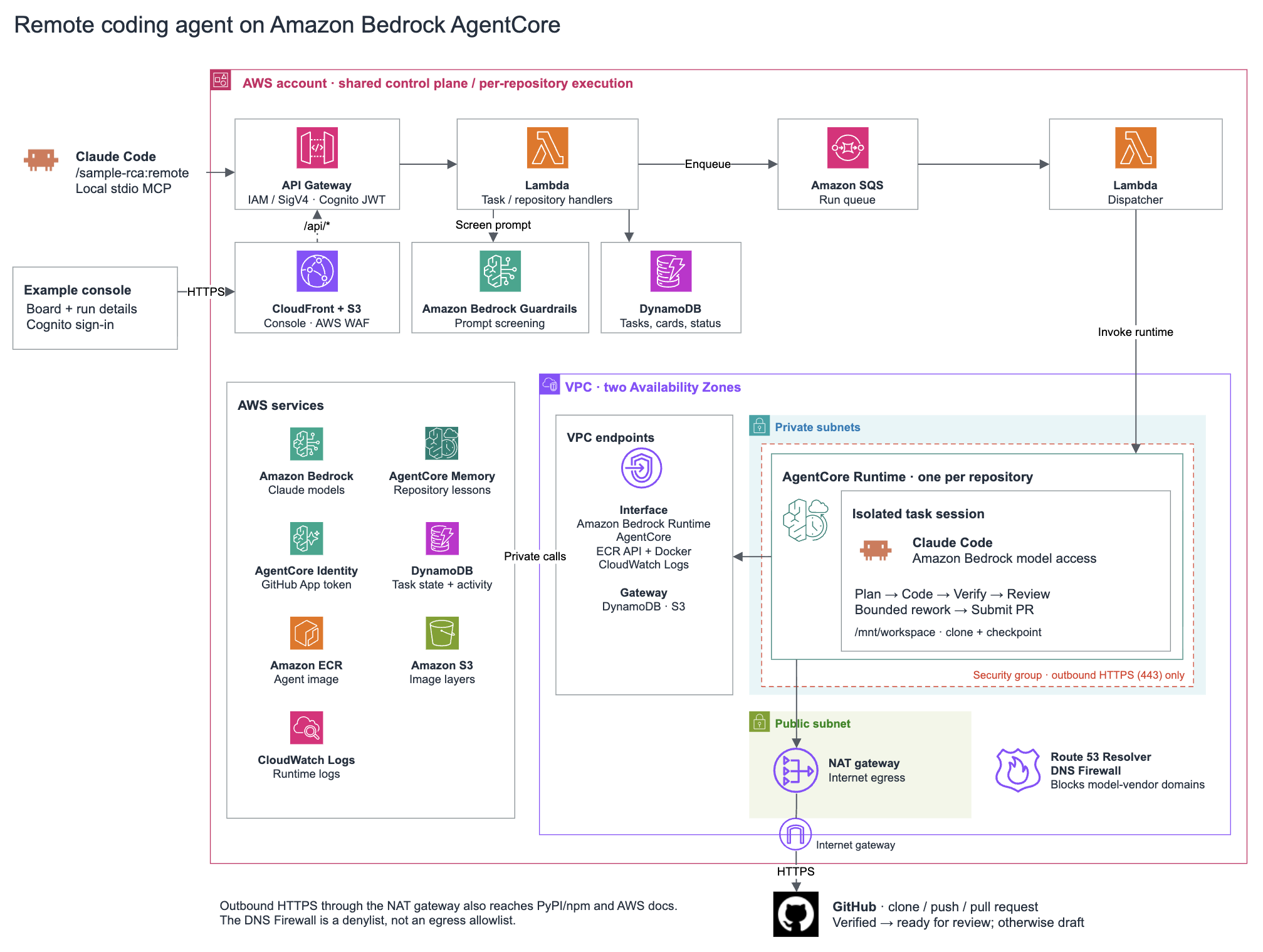
On November 6, the AWS Machine Learning Blog announced that Claude Code can now run remotely on Bedrock AgentCore, accompanied by the sample project sample-remote-coding-agent. Each task executes inside an AgentCore runtime session within the customer's own AWS account—an isolated microVM inside a VPC, with model calls routed exclusively through Bedrock. The workflow assigns planning and review to Opus and coding to Sonnet for up to 3 attempts; once finished, it pushes to an agent/<taskId> branch and opens a GitHub PR, removing draft status only after verification passes, while never merging automatically. Task prompts pass through Bedrock Guardrails first, though screening applies only to inputs and not to prompt injections inside repository files. Setup takes 15–25 minutes and registering a repository takes 8–12 minutes; a default $200/month Bedrock budget alert is configured—acting strictly as an alert rather than a hard cap. Its scope is clearly defined: well-scoped features, bug fixes, and test writing in trusted repositories, rather than untrusted code or open-ended tasks. In short, it turns "leaving your laptop open waiting for an agent to finish" into "dispatching a task, closing your laptop, and waiting for the PR to arrive."
💡 Lumo’s take
Takeaway: Coding agents are evolving from "local toys" into "cloud workers." This pattern is worth watching: offload time-consuming tasks to the cloud and use your local machine only to review PRs—you can finally close your laptop. Direct: https://aws.amazon.com/blogs/machine-learning/extend-claude-code-to-remote-sessions-on-amazon-bedrock-agentcore-with-security-controls/ ; News: https://aws.amazon.com/blogs/machine-learning/extend-claude-code-to-remote-sessions-on-amazon-bedrock-agentcore-with-security-controls/ ; Image: https://d2908q01vomqb2.cloudfront.net/f1f836cb4ea6efb2a0b1b99f41ad8b103eff4b59/2026/11/04/ML-21719-1.png
11T3 Code: Control 7 Coding Agents from Your Phone, Gaining 16K Stars in One Week
Image source: AI Frontier Post
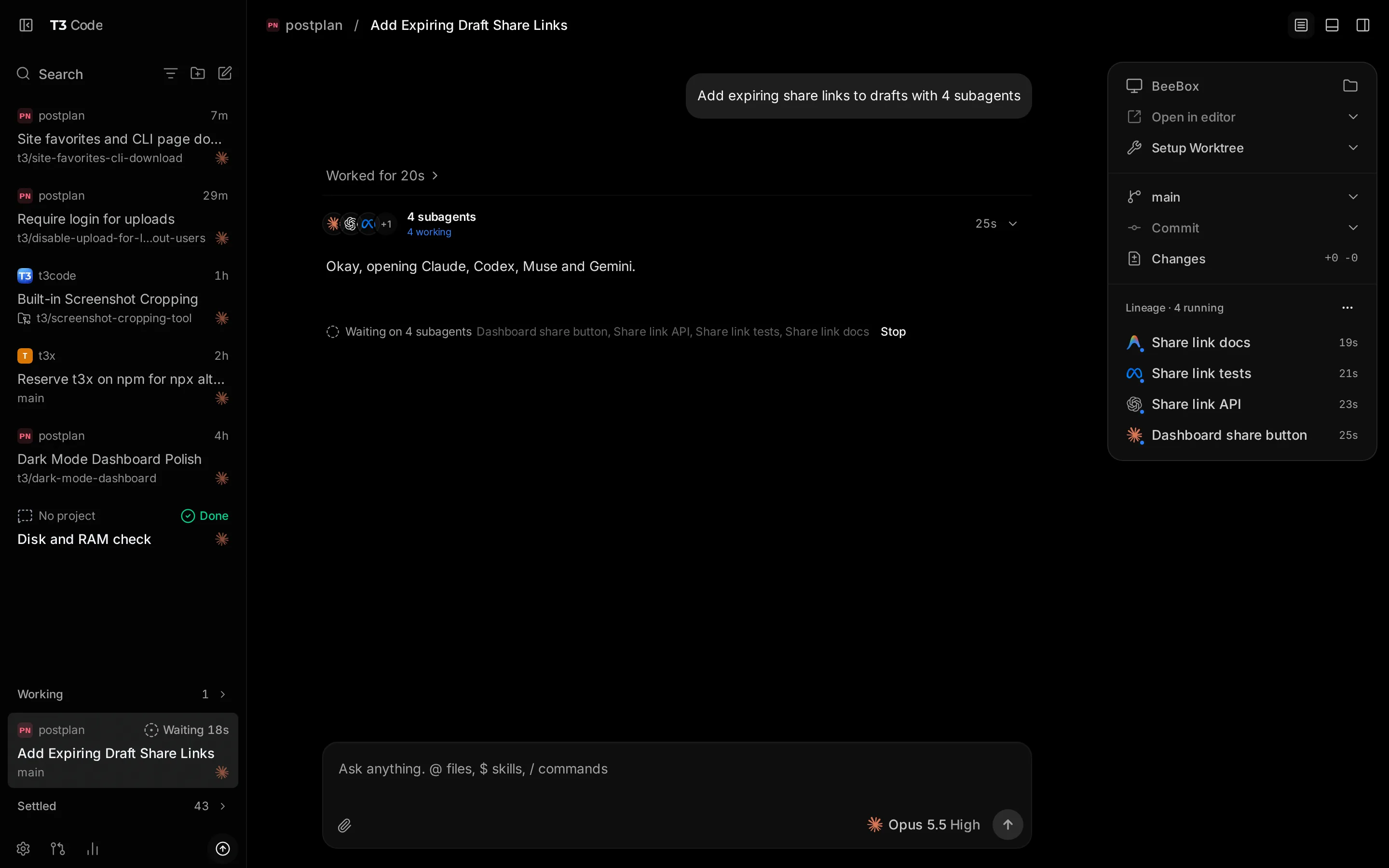
T3 Code on GitHub (pingdotgg/t3code, MIT license) was the fastest-growing AI repository by stars this week, reaching 51,242 stars when checked on November 8—up 16,235 stars in seven days. Created on February 8, 2026, its current stable release is v0.1.7. It solves a concrete pain point: run a local server alongside desktop, web, mobile apps, and the t3 CLI to remotely control already-installed instances of Claude Code, Codex, Cursor, OpenCode, Grok Build, Google Antigravity, and fx from your phone, with additional support for Kiro, Pi, and Muse Code. It runs on your existing subscriptions rather than reselling tokens, and T3 Connect links up to 3 machines for free. The author is candid in the README: "We are very very early in this project. Expect bugs." Installation takes a single command: curl -fsSL https://t3.codes/install.sh | sh, or npx t3@latest. Running multiple agents in parallel is fast becoming the default workflow—T3 Code's star growth shows developers aren't short on agents, they're short on a "remote control" to manage them all at once.
💡 Lumo’s take
Takeaway: The value of tools like this is concrete—open-source, directly solving multi-agent coordination pain points, and immediately usable in daily development workflows. Install it and try assigning tasks to your home computer from your phone so your agents keep working during your commute. Direct: https://t3.codes ; News: https://aifrontierpost.com/articles/t3-code-remote-control-coding-agents-tutorial/ ; Image: https://t3.codes/_astro/app-desktop.BHuzLVLF.webp
12dsh Plugin Gains 11K Stars in One Week, Offering Login-Free Access to Frontier Models Including DeepSeek V4.1 Flash
On GitHub, dsh-our-free-model (Ebony-Vinyl/dsh-our-free-model, MIT license) gained 11K stars in a single week, reaching 65,394 stars as of November 8. Created on September 24, 2026, it is a plugin for DeepSeek Harness (dsh). Usage is straightforward: install the plugin inside dsh to access frontier models such as DeepSeek V4.1 Flash and Kimi K3 free of charge and without limits—no login, registration, or API key required. Upstream traffic connects directly to the OpenCode Zen gateway and Kilo AI public gateway without third-party relays. It also packs substantial features: 76 bring-your-own-key aggregated providers, a local OpenAI-compatible gateway, tool-output compression to save tokens, fallback chain routing, and a usage dashboard with data kept locally. The EAC co-pay channel requires GitHub login and starring the repository to unlock. One note of caution: the unscoped package on npm is not the official release—the official package is scoped as @ebony-vinyl/dsh-our-free-model, so make sure to install the right one.
💡 Lumo’s take
Takeaway: Another avenue has opened up for accessing frontier models at no cost—and because it is an open-source plugin that keeps data local, compliance risk is far lower than unofficial workarounds. When building small apps without model quota, this serves as a ready-made "free tier." Direct: https://github.com/Ebony-Vinyl/dsh-our-free-model ; News: https://findarepo.com/categories/ai-agents/ ; Image: No image
On November 7, LiveReview by hexmos reached #5 on Product Hunt's daily chart (snapshot prior to publication). It is a risk-aware AI code review tool that assigns a risk score to every pull request, automatically approving the lowest-risk 30–50% according to custom policies while routing higher-risk changes to human reviewers. Before enabling it, teams can replay their policies against historical PRs to inspect how it would have judged past changes. Its review framework covers 10 risk categories and over 100 failure modes, continuously learning from production incidents and rollbacks. The codebase is source-auditable and self-hostable, supporting GitHub, GitLab, Bitbucket, Gitea, and Azure DevOps. The free tier covers 30,000 lines of reviewed code per month, with paid plans starting at $32 per 100,000 lines—billed by line volume rather than per seat. The bottleneck in code review has never been "not understanding the code," but "not daring to approve it"—LiveReview bets on delegating approval decisions to verifiable risk scores instead of luck.
💡 Lumo’s take
Takeaway: Review bandwidth is the scarcest resource for small teams. Auto-approving low-risk changes while escalating high-risk ones is a tiered pattern you can adopt directly in your own workflow—even without this tool, building a "replay first, enable second" rule is well worth the effort. Direct: https://hexmos.com/livereview/ ; News: https://dev.to/lovestaco/you-tried-git-lrc-meet-livereview-7od ; Image: No image
14Hallmark: Removes the Tell-Tale AI Look from AI-Built Websites, Gaining 7,000 Stars in One Week
On GitHub, Hallmark (Nutlope/hallmark, MIT license, built by Together AI) gained 6,994 stars in one week, reaching 50,264 stars when checked on November 8. Created on April 27, 2026, v2 is its latest release. In one sentence, it is a design skill for Claude Code, Codex, Cursor, and OpenCode built specifically to eliminate the "obviously AI-generated look" from AI-built websites. It works through 50 themes (each modeled on a physical material), task-driven layouts, and real-browser linting (sloplint), alongside 755 open-licensed real photographs while banning AI-generated images, plus redesign and audit commands to overhaul or inspect existing sites. The "AI clichés" it targets are specific: eyebrow labels above every heading, all-caps tags throughout, a single colored accent word inside headings, screens full of empty boxes, hero sections that miss above-the-fold framing, newsletter signups at the bottom of every page, and dead forms that do nothing on click—details builders often overlook when putting pages together. Installation takes a single command: npx skills add nutlope/hallmark -g.
💡 Lumo’s take
Takeaway: AI already writes code fast enough; the bottleneck has shifted to "things looking like they were made by AI." Hallmark turns aesthetic judgment into an executable checklist—which is exactly what a tool directory site needs so every listed tool page looks clean and intentional. Direct: https://github.com/Nutlope/hallmark ; News: https://github.com/Nutlope/hallmark ; Image: No image
"Agent Memory Checkup": Help small teams clean up AI agent memory that grows messy over time—auditing and rebuilding MEMORY.md and project wikis following Anthropic's newly published dreaming methodology, starting at RMB 199–499 per repository.