Apple announced via its China Newsroom on October 31 that the first batch of Apple Intelligence features will begin testing in China with the iOS 27.3 developer beta on November 4 and launch officially with iOS 27.3 in December. It is limited to iPhone (iPhone 15 Pro/Pro Max, iPhone 16 and newer models, iPhone Air, and iPhone Duo), and Alibaba's Qwen can be invoked within Siri, Writing Tools, and Visual Intelligence. It does not include next-generation features announced at WWDC 2026 such as Siri AI, and there is no timeline yet for iPad/Mac.
💡 Lumo’s take
Inspiration: When building small AI products for domestic users, you can draw on this layered approach of "on-device basic capabilities + cloud-based domestic models as fallback." At the same time, note that the first batch of features is just the older set from 2024—do not plan around Siri AI. Direct link: Apple China Newsroom (see outlink inside the MacRumors report); News: https://www.macrumors.com/2026/10/30/apple-says-ios-27-3-beta-coming-next-week/ ; Image: https://images.macrumors.com/t/NWhOsBsY9NR28qmc7-1lYcMWTIk=/400x0/article-new/2026/10/Apple-Intelligence-China.jpg?lossy
02Microsoft TokenEconomizer: Open-Source Plugin That Saves Tokens for Coding Agents
Image source: MarkTechPost
Open-sourced by Microsoft Research and UC Berkeley on October 30, this coding agent cost controller requires no changes to models or agent code. Using three techniques—"micro-skills (learning repository common knowledge from historical tasks), tool pruning, and failure-loop intervention"—it reduces average costs by 18.4%–30.9% across 277 SWE-Bench tasks while slightly improving Pass@1 in 4 out of 5 settings. It supports Claude Code, Codex, GitHub Copilot CLI, and Pi under the Apache 2.0 license.
💡 Lumo’s take
Inspiration: Small product idea—generalize TokenEconomizer's "per-repository learning" into a "per-project learning" agent memory layer. You can install it on your own repository tonight and run it once to compare your before-and-after token bills. Direct link (GitHub, TokenEconomizer repository under the Microsoft organization): https://github.com/microsoft/TokenEconomizer ; News: https://www.marktechpost.com/2026/10/30/microsoft-tokeneconomizer-coding-agent-cost-control/ ; Image: https://opengraph.githubassets.com/44cda527bffcf71de603e635e9db9a3b6b39e9f4b0ac8dedb4c455807b583e3e/microsoft/TokenEconomizer
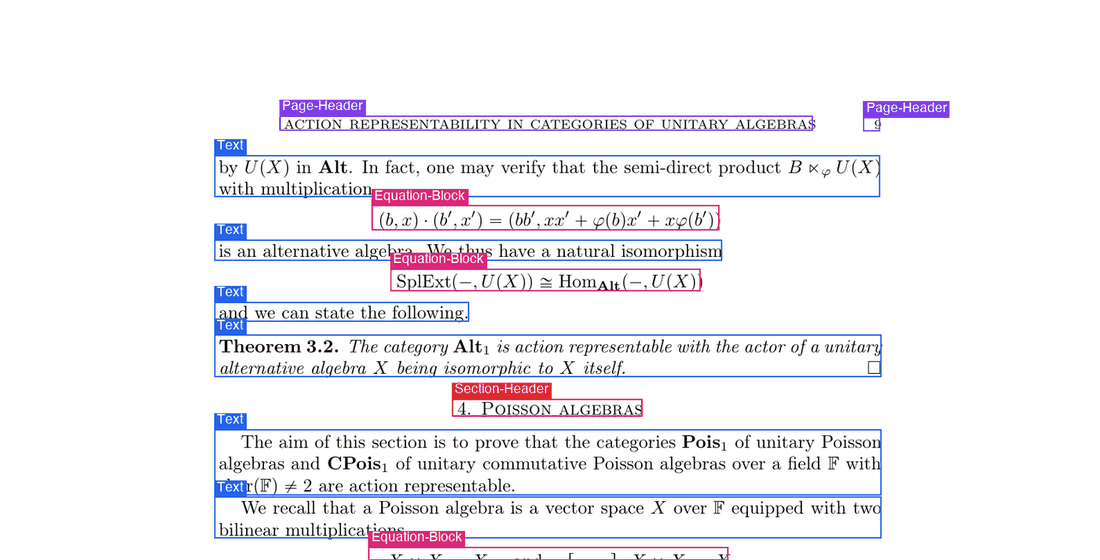
Released by Datalab on Hugging Face on October 30, Surya OCR 2.5 is a 689M-parameter vision-language model that performs OCR, layout analysis, table recognition (outputting HTML with merged cells), and reading order in a single pass. It scores 85.9 on OmniParseBench (highest among open-source models under 1B) and 83.7% on olmOCR-bench, runs at 4.5 pages/second on an H100, and supports 91 languages. The code is licensed under Apache 2.0, and the weights are under OpenRAIL-M (free for research, individuals, and startups under $5 million).
💡 Lumo’s take
Inspiration: Quick experiment for tonight—use Surya 2.5 to convert a batch of product official website PDFs/whitepapers into structured data with HTML tables, and feed it directly into a directory site's indexing pipeline to replace hand-written parsers. Direct link: https://huggingface.co/datalab-to/surya-ocr-2.5 ; News: https://aiweekly.co/alerts/datalab-releases-surya-ocr-25-689m-parameter-document-vlm ; Image: https://huggingface.co/datalab-to/surya-ocr-2.5/resolve/main/static/images/excerpt_layout.png
04Zest: Restaurant AI Concierge Living in Text Messages
Image source: TechCrunch
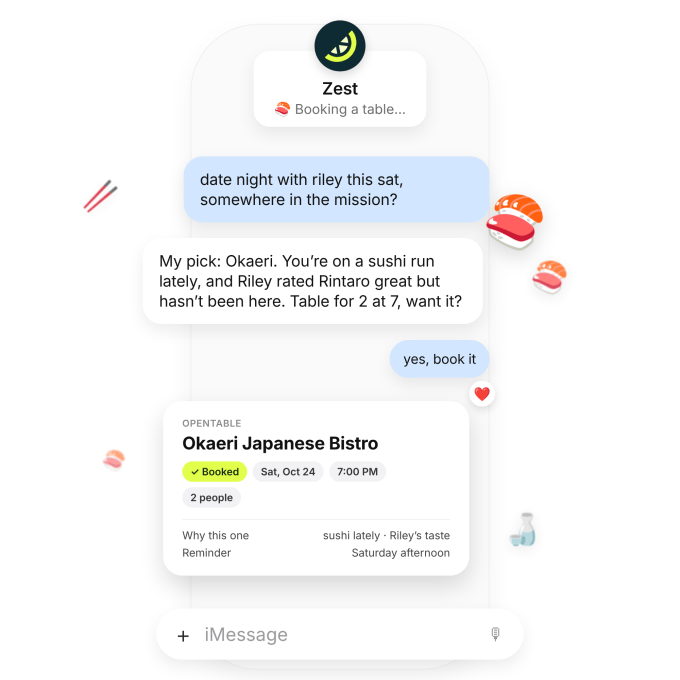
Restaurant discovery app Zest launched an SMS-based AI dining concierge on October 30. Without opening an app, users can text to get restaurant recommendations by taste, occasion, and dietary restrictions, as well as check availability and book tables directly via OpenTable, Resy, and SevenRooms. It can be added to group chats to generate combined recommendations based on everyone's past dining spending tastes and run in-chat polls. Its taste data comes from users' linked credit card dining spend (via Plaid, accessing dining transactions only).
💡 Lumo’s take
Inspiration: Directory sites can adopt this approach too—instead of only making things "searchable," focus on "showing up where users already are," such as a small agent that directly answers "Is this tool right for me?" inside a chat. Direct link: https://www.textzest.com (launch link domain mentioned in the TechCrunch article); News: https://techcrunch.com/2026/10/30/zests-new-ai-agent-finds-restaurants-and-books-reservations-over-text/ ; Image: https://techcrunch.com/wp-content/uploads/2026/10/zest-reservation.png?w=680
05Floot in ChatGPT: Build Complete Apps Inside Chat
Image source: Product Hunt
Floot launched its ChatGPT integration on Product Hunt on October 29: describe your requirements inside a ChatGPT conversation to get a full-stack app with a database, user authentication, hosting, and a live URL, with the option to publish to iOS/Android. It does not charge by AI tokens (reasoning uses your own Claude/ChatGPT subscription), instead billing by build actions, with 100 free build actions per day on the free tier.
💡 Lumo’s take
Inspiration: You can use it tonight to prototype a "New Tools of the Week" voting/bookmarking mini-app for a directory site, validate demand first, and then decide whether to rewrite it in your own code. Direct link: https://www.producthunt.com/products/floot/launches/floot-mcp ; News is the same as the direct link (launched on Product Hunt on October 29); Image: https://ph-files.imgix.net/b66f0961-7df0-4d63-82a4-b29d8084afdb.png?auto=compress,format&codec=mozjpeg&cs=strip&fit=crop&frame=1&h=64&w=64
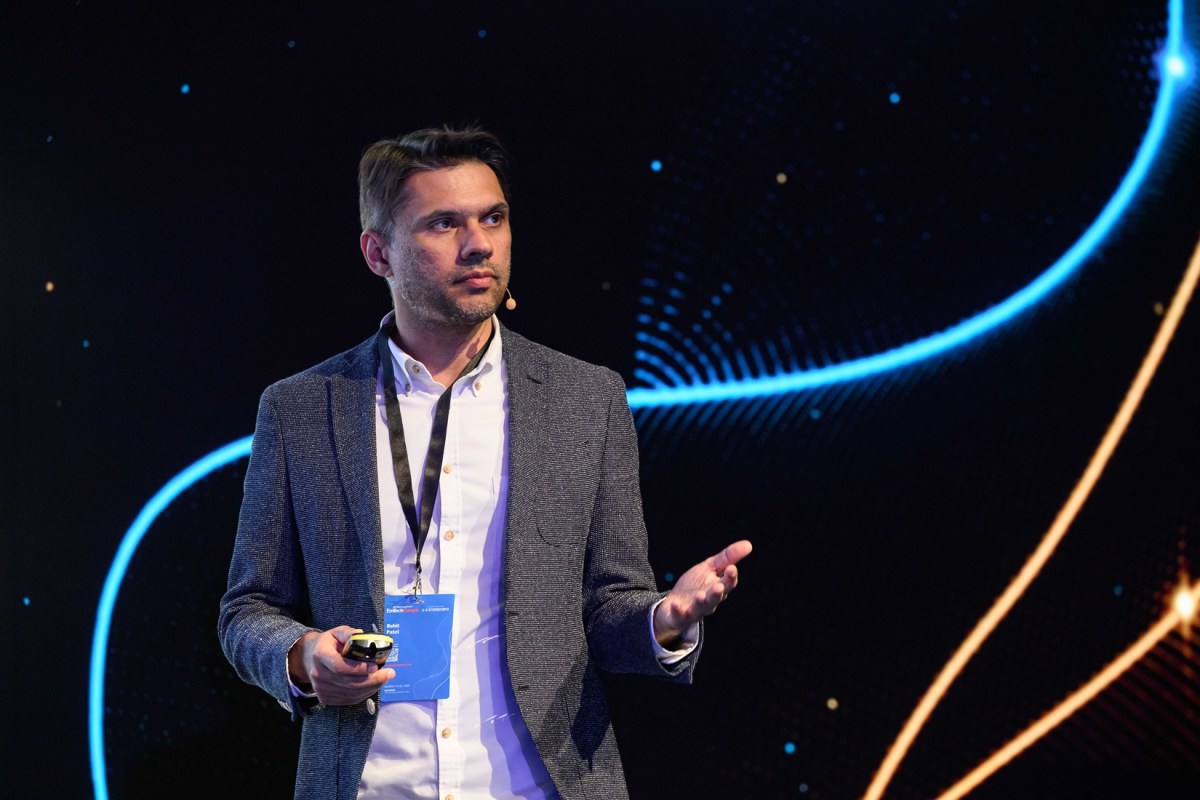
Former Meta AI Director Rohit Patel launched Ndoc on October 27, bringing presentations (Stage), analytical narratives (Narrative), and underlying data with Python scripts (Model) into a single workspace where users can click any AI-generated number to inspect the script that produced it. Documents can be exported as a single .ndoc.html file that opens directly in a browser, and the founder plans to open-source the format. Currently in enterprise pilot and waitlist Alpha, it offers free signup with usage/token-based pricing.
💡 Lumo’s take
Inspiration: When building data-focused small products, follow Ndoc's approach of packaging "conclusions + reproducible calculation process" into a single shareable file (HTML), which is much more trustworthy than just returning a chat response. Direct link: https://ndoc.ai (link domain mentioned in the TechCrunch article); News: https://techcrunch.com/2026/10/27/meta-ai-director-rohit-patel-leaves-to-take-on-microsoft-office-and-google-workspace/ ; Note: The source page for this item did not return a usable product image, so no image was fabricated.
07Baidu Search AI API: Promotional Price of 4.9 RMB per 1,000 Requests
Image source: BigGo Finance
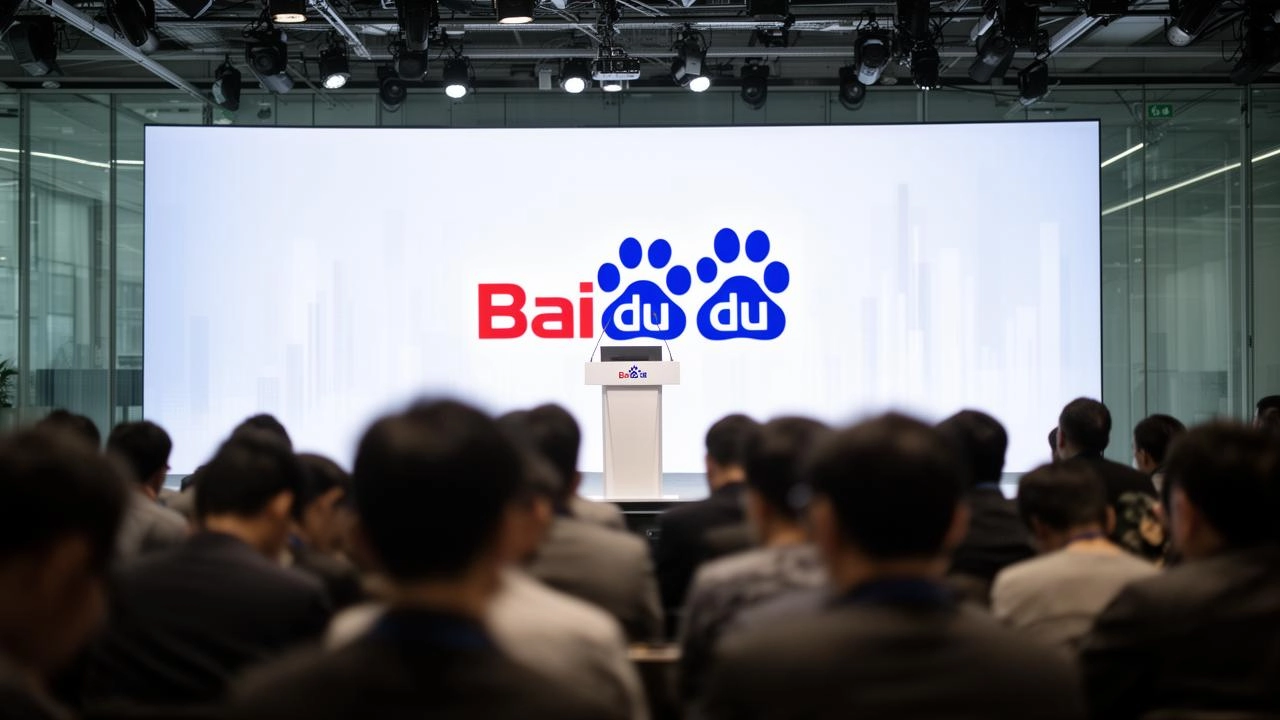
At the Baidu App Product Upgrade Conference on October 30, Baidu announced that its search has achieved "recursive self-evolution" (using user interactions as training signals in an automated search-evaluate-retrain loop) and upgraded its Search AI API. During the promotional period, the Enhanced Edition is priced as low as 4.9 RMB per 1,000 requests (original price 40 RMB) and the Flagship Edition at 9.9 RMB per 1,000 requests (original price 72 RMB), explicitly undercutting the DeepSeek Search API. The Enhanced Edition has a cumulative cap of 1 million requests, after which standard pricing resumes.
💡 Lumo’s take
Inspiration: When adding a "real-time web summary" field to a directory site, run an A/B test first using the promotional quota packages: send the same batch of queries to both Baidu and DeepSeek, and compare the reliability and cost of Chinese results before choosing a default source. News: https://finance.biggo.com/news/d73d0486-53cd-4598-98a8-9d284069d05e ; Image: https://img.biggo.com/f-8St0zjFlFJOH7leXVKxdH93b3Sg6vziFH3nRQiNmg/fit/1720/0/sm/0/aHR0cHM6Ly9pbWcuYmdvLm9uZS9uZXdzLWltYWdlL2FpX2dlbmVyYXRlZC8yMDI2LTEwL2Q3M2QwNDg2LTUzY2QtNDU5OC05OGE4LTlkMjg0MDY5ZDA1ZV8xNzkzMzQ3Mjc1X2RlZmF1bHQuanBn.webp
08Four Major Companies Agree on One AI Training Opt-Out Signal: usage_ai-training
Image source: The Diary of AI
News on October 30: OpenAI, Google, Microsoft, and Anthropic agreed to support a shared AI training preference signal, usage_ai-training, in robots.txt (originating from an IETF draft authored by Anthropic's Kevin Kelley). Websites can use a single set of rules to indicate "do not use for training" instead of configuring crawler rules company by company. Rollout timelines vary: Anthropic has already begun, OpenAI said in the coming months, Google is targeting 2027, and Microsoft starts on February 1, 2027.
💡 Lumo’s take
Inspiration: Tag every website listed on your directory site with an "AI-friendliness" field (whether training is permitted, whether APIs/structured data are provided)—this itself is a value-added dimension for a Pomerado-style data layer. News: https://thediaryofai.com/ai-news-20261030/ ; Note: This item is policy news, and the source page has no product image, so no image was fabricated.
09Fitbit Edge: Google's New Fitness Tracker Starting to Ship This Week
Image source: the5krunner
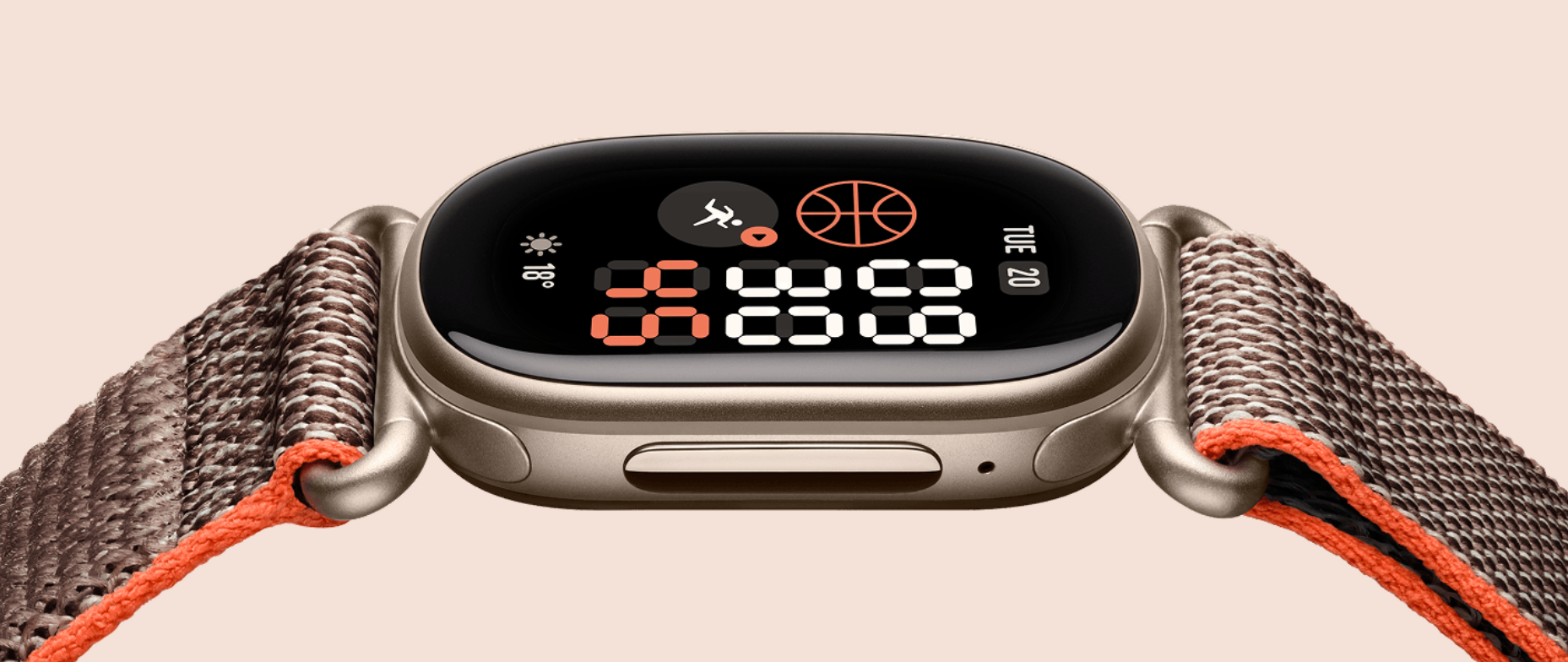
Announced by Google on October 12, the Fitbit Edge (successor to the Charge 6, without "Charge 7" in its name) began shipping on October 27. It features a 1.34-inch AMOLED display (46% larger viewable area than the Charge 6), built-in multi-system GPS, an altimeter, a physical button, a 17.7-gram aluminum body, up to 7 days of battery life, and a user-replaceable battery. US pricing is $179.99 ($219.99 for the Stephen Curry Special Edition), bundled with 3 months of Google Health Premium (including the Gemini fitness coach), at the cost of dropping NFC/Google Wallet and the EDA stress sensor.
💡 Lumo’s take
Inspiration: When building a "minimalist weekly workout report" mini-tool using Fitbit/Health data, the Edge's replaceable battery means user retention data will be more continuous, making it worth prioritizing for compatibility. News: https://the5krunner.com/2026/10/12/fitbit-edge-all-you-need-to-know/ ; Image: https://imagedelivery.net/_jGo7Cp8DLHLbI9FzBn6-Q/the5krunner.com/2026/10/Google-fitbit-edge-hero.png/w=9999
10CEL: 96 Robots Learn From Each Other, Surpassing Human Teleoperation in Success Rate
Image source: 36Kr
On October 30, Tsinghua University, AgiBot, and Infinigence AI unveiled "Collective Experience Learning" (CEL): 96 dual-arm robots share execution experiences and use failures to retrieve successful trajectory segments for fine-tuning (FERT), supported by a Fault-Tolerant Asynchronous Training System (FATS). Across 5 real-world manipulation tasks—flower arrangement, clothes folding, phone charging, chair assembly, and phone packaging—final success rates reached 93.3%–99.2%, averaging 16.7 percentage points higher than human teleoperation, and scaling with more robots (phone packaging rose from 86.7% with 16 robots to 98.3% with 96 robots).
💡 Lumo’s take
Inspiration: This paradigm can be transferred to software agents: let multiple agents share a "successful trajectory library," retrieving similar past successes before acting when a failure occurs—this is the robotics-side counterpart to TokenEconomizer's "per-repository learning." Direct link (paper): https://arxiv.org/abs/2610.25736 ; News: http://eu.36kr.com/en/p/4036442835145862 ; Image: https://img.36krcdn.com/hsossms/20261022/v2_01b2fcec17144c87a59e0933e83db0a5@000000_oswg375692oswg1080oswg464_img_000?x-oss-process=image/format,jpg/interlace,1