ChatGLM Deep Dive: An Agent-Based Assistant for Chinese Office Work
Positioning and maker
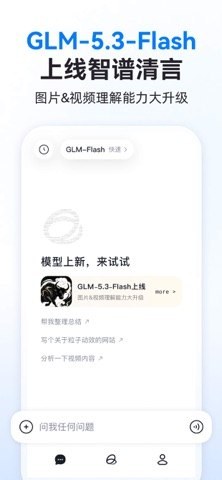
ChatGLM comes from Zhipu AI and is built on its own GLM model family, positioned as a general conversational assistant and agent service for Chinese-speaking users. It does more than answer questions: it packs many specialised helpers into one entry point so users can call on different assistants per task.
It is listed under chat assistants in the Lumo library; as of 23 November 2026 the Lumo hub lists 2,289 tools, 60 of them in the chat category, including ChatGLM. Its answers feel close to how domestic users speak, and its adaptation to Chinese office scenarios is where it pulls away from foreign counterparts.The GLM family is Zhipu's own model base; both the assistant and its agents are built on it, so model updates show up directly in what the assistant can do.
Core features
Beyond basic conversation, it has many built-in agents and tools: different agents handle writing, translation and data analysis, with document upload and parsing, web search, image understanding and generation, covering most of the text work that comes up in a normal office day.
It also offers an agent creation entry point, letting users assemble specialised assistants for their own needs and hand off repetitive text work. AI drawing and video generation tools are integrated as well, so one entry point serves both office work and a bit of creation.Uploading and parsing documents is a frequent entry point in Chinese office work: contracts, reports and meeting minutes can be uploaded and asked about, which is far faster than reading page by page.
How it differs from similar tools
Against assistants that only do general Q&A, ChatGLM differs in its agents: writing, translation and data analysis each get a dedicated entry point, so tasks are routed more precisely, which suits people juggling several kinds of chores at once. General Q&A is the base; agents are the layer on top.
Against foreign counterparts, it differs in Chinese language and localisation: understanding of Chinese context, domestic user habits and Chinese office scenarios is built in. Its trade-off is equally clear: heavier use and stronger models need a paid plan, so check the free allowance before going deep.The agent creation entry point pays off through reuse: an assistant assembled once for a task can be called on again next time the same kind of work appears, without re-explaining the need.
Who it fits and typical scenarios
It fits Chinese office workers, students and operations staff who write material, look things up and brainstorm; it also fits people who want a low-cost way to try agent workflows and hand off repetitive text work. Calling on several small helpers at once to clear a pile of chores is where it feels most natural.
Access note: ChatGLM can be opened directly in China. It uses a freemium model: basic conversation and some agents are free, while higher usage, stronger models and some advanced features need a paid plan, subject to the official website.A typical student use is research and writing: let it organise a pile of sources into an outline first, then write from that outline, which beats starting from zero.
Tools mentioned

Sources
This article is compiled from the public sources above and does not reproduce the originals in full; see the official sources for details.