Task Agent Comparison: Can Manus, Genspark, Fellou, and Others Handle End-to-End Delivery Yet?
The Verdict First
To experience the most complete form of end-to-end delivery, start with Manus: according to its official website, it can autonomously plan and complete complex tasks. The task types listed on its homepage include creating presentation decks, building websites, making games and videos, and conducting deep research. The workflow is simple: give it a task and wait for the result. In Lumo's listing, it is priced as freemium, and its accessibility in mainland China is yet to be confirmed—check the official website for the latest information.
If your work centers on research and information gathering, Genspark is a better fit: it is a workspace combining AI search with agents, and its strength is searching broadly first and then organizing the results. Note that Lumo's listing marks its accessibility in mainland China as limited, so check its official website and your actual network conditions for access stability.
For tasks that must be completed inside websites where you are already signed in, look at Fellou: it is an agentic browser that, according to its official website, can autonomously perform deep searches and cross-website automation tasks, and it offers desktop and mobile versions. Its pricing and accessibility in mainland China are both listed as to be confirmed in Lumo, so check the official website before ordering.
If you do not care whether it is fully automatic and just want to start using a free, directly accessible tool: iFlow (from Alibaba) offers a free personal edition with direct access in mainland China and is good at search, knowledge Q&A, and long-form text; Doubao (from ByteDance) is also free and directly accessible in mainland China, and serves as the entry point to ByteDance's Agent product line. If you want to set up an assistant for long-term use, use Coze to build your own agent with no code and publish it to the platforms you use regularly—freemium pricing with direct access in mainland China.
How They Work: Cloud Execution, Browser Operation, and Collaboration—Three Routes
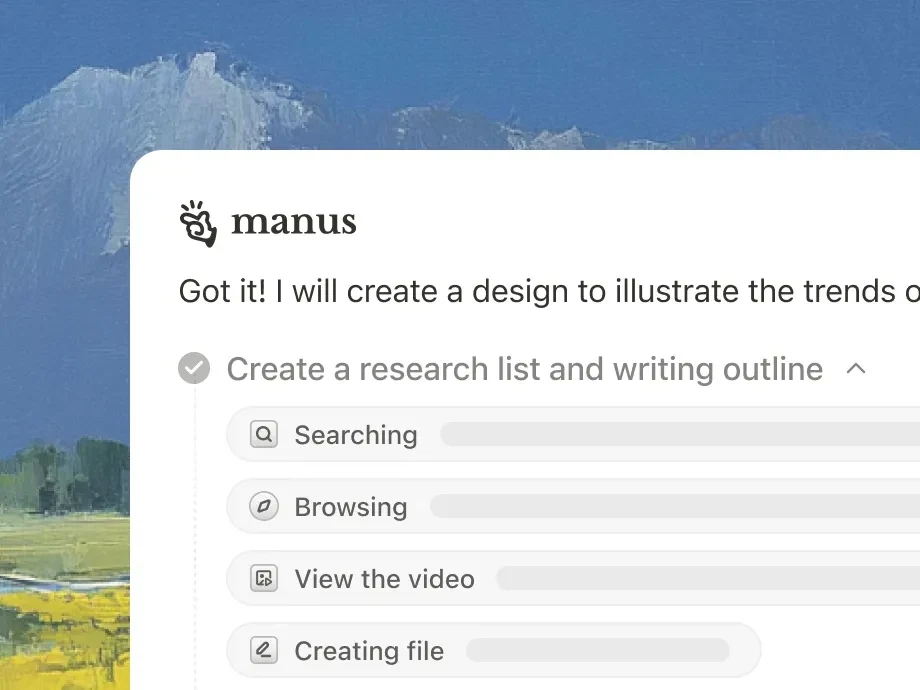
Cloud execution (Manus, Genspark): after you hand over a task, it runs in the provider's cloud environment. It keeps running even if you close the page, and hands back the finished result when done. The advantage is that it does not use your computer and can handle long tasks; the trade-off is that files must be uploaded to its environment, and you can only review the playback and the result during the process, with little room to intervene midway.
Browser operation (Fellou): the agent lives inside your browser and can open web pages, search across sites, click, and fill in forms. It suits tasks that require your signed-in state—such as comparing prices across several websites or moving information between them. Conversely, this is also the most permission-sensitive category: whatever it can reach is everything your browser can reach.
Building and collaboration (Coze, Flowith): Coze is about building an agent first and then using it long-term, which suits tasks with fixed workflows that need to be run repeatedly; Flowith is a canvas-style workspace that breaks tasks into nodes on an infinite canvas and advances them across multiple threads, letting you step in and change direction at any time—more like collaborating with a person than handing over full control. iFlow and Doubao lean toward assistants with agent capabilities: they focus on Q&A, search, and reading documents, while also handling some lightweight tasks.

A Look at All Seven (with Lumo Verification Data)
Manus: the representative general-purpose agent, categorized as agent in Lumo, priced as freemium, with accessibility in mainland China to be confirmed. It suits tasks with clear goals, many steps, and a willingness to wait for results, such as an industry research report or a small website prototype.
Genspark: categorized as search in Lumo, priced as freemium, with accessibility in mainland China marked as limited. Search is its foundation, making it suitable for casting a wide net first and then having the agent organize the results into structured output.
Fellou: categorized as agent in Lumo, with both pricing and accessibility in mainland China to be confirmed. According to its official website, it focuses on cross-site execution of open-ended tasks and provides desktop and mobile versions. Whether it suits you depends first on which browser permissions it requests.
Coze (ByteDance): categorized as agent in Lumo, priced as freemium, with direct access in mainland China. Its signature is no-code building of chatbots and agents, with one-click publishing to various platforms—it solves not 'run this once for me,' but 'leave me something I can use anytime.'
Flowith (Shanghai team): categorized as agent in Lumo, with direct access in mainland China and pricing to be confirmed. According to its description, it uses a node-based infinite canvas and multi-threaded AI interaction, automatically breaking down and executing tasks, making it suitable for creative work and complex tasks that require repeated revision.
iFlow AI Assistant (from Alibaba's Wanxiang Creative): categorized as search in Lumo, with a free personal edition (its open-platform API is billed separately) and direct access in mainland China. Intelligent search, knowledge Q&A, intelligent reading, and assisted creation are its main strengths, with particular strength in long-form text analysis—hand it a light task first to test it at zero cost.
Doubao (ByteDance): categorized as chat in Lumo, free, with direct access in mainland China. As a mainstream AI assistant, it handles everyday Q&A, writing, and lightweight tasks smoothly, making it a good starting point for getting a feel for task agents.
Pricing and Quotas: The Real Threshold Is the Quota Rules
The paywall for this category of products is often not about features, but about quotas: how many runs you get, and how long a single task can run. In Lumo's listings, Manus, Genspark, and Coze are freemium, iFlow and Nano AI are Free, and Fellou and Flowith have pricing to be confirmed. Specific plans change frequently across providers, so check the official websites for the latest details—this article compares rules, not prices.
A common point of confusion is worth clarifying here: ByteDance's Doubao Work is the office-oriented version of Doubao, designed for document, spreadsheet, and presentation tasks. It is not a task agent built for end-to-end delivery, so it is not included in this comparison.
Practical advice: start by using your free quota to hand it a real, small task that would normally take you one or two hours, and observe three things—where it gets stuck, how fast it burns through your quota, and how much rework the result needs. If it passes all three checks, then consider paying for it or handing it bigger tasks.
Data and Privacy: Set Permission Boundaries Before Handing Over a Task
The precondition for a task agent to do its work is access to data and permissions: cloud execution requires you to upload files, browser operation may use your signed-in state, and building-type tools need to connect to your knowledge base and accounts. Before granting permissions, sort them by sensitivity: public information and non-sensitive files can go first, while tasks involving client data, finances, and account passwords should not be outsourced wholesale.
For outward-facing actions (sending, publishing, submitting, or deleting), prioritize products and settings that pause at key steps and ask for your confirmation; after a task finishes, check the output files and operation logs it leaves behind to confirm that it did not change anything you did not ask for.
For the tools with direct access in mainland China (Coze, Flowith, iFlow, and Doubao), data interactions are completed on domestic services; for Manus, Genspark, and Fellou, refer to each provider's privacy policy on its official website, and read it before handling sensitive materials.
Tools mentioned






Sources
This article is compiled from the public sources above and does not reproduce the originals in full; see the official sources for details.