Hugging Face Deep Dive: Home Base for Open Models — Find, Try, and Ship in One Place

Positioning and Maker
Hugging Face (huggingface.co) is one of the central platforms of the global open-source AI community. Our library places it in the platform category, with the tags models, open source, and community, and its description calls it a global open-source AI model and dataset community. The platform is run by the company of the same name and is where many open-source projects launch first.
As of November 22, 2026, Lumo Hub had published 2,191 tools, including 803 in the platform category. Among those 803 platform tools, Hugging Face's position is clear: it is not only a model repository, but a chain from finding a model to trying it to shipping it, with community, hosting, and evaluation in the same place.
Core Features
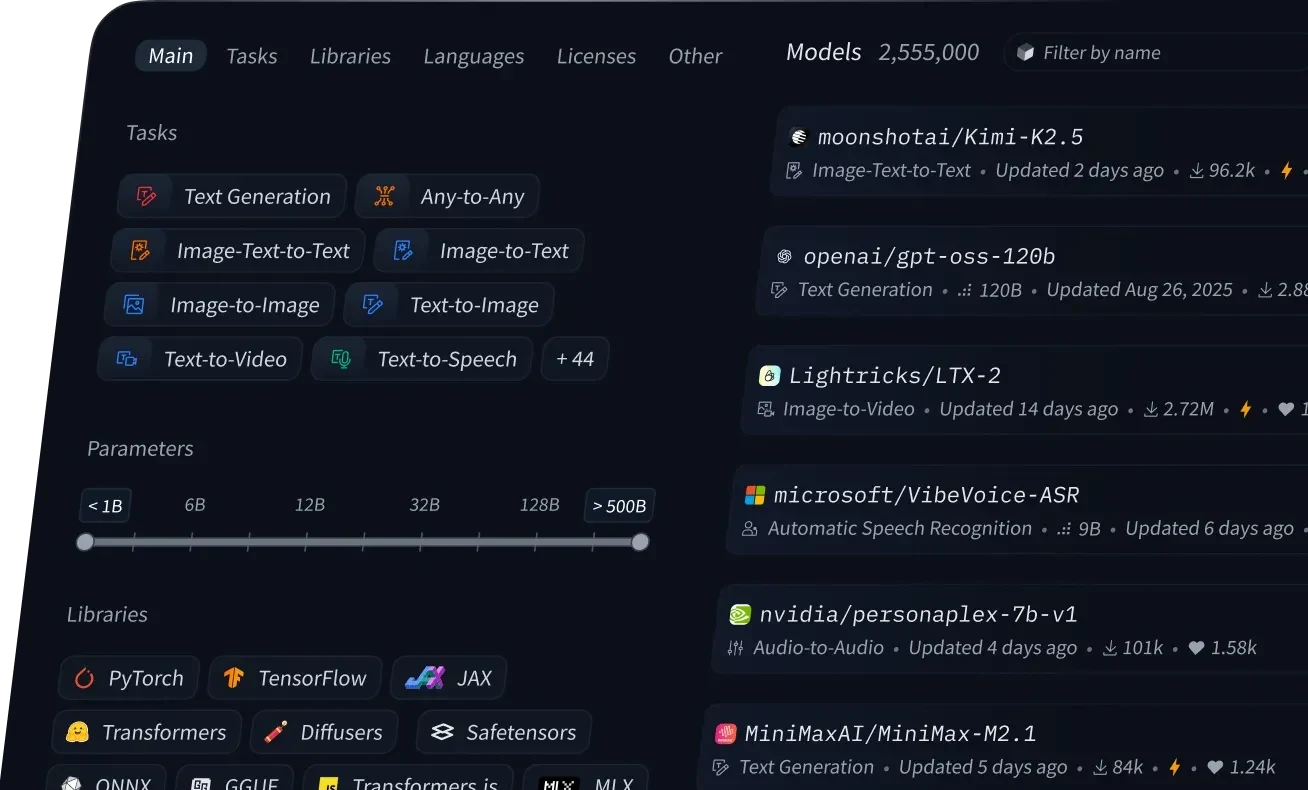
At its core is the hosting of models and datasets: pre-trained models and datasets published by organizations and individuals can be filtered by task, language, and framework, then downloaded and used. Spaces lets developers deploy interactive model demos online, so others can try the effect directly without setting up an environment.
The platform also provides model inference APIs, hosted training and fine-tuning services, and model evaluation leaderboards, together with open-source libraries such as Transformers. From picking a model to checking a leaderboard, running a demo, and connecting an inference API, selection and validation can be done in one place, which suits a try-before-you-commit approach.
How It Compares with Similar Tools
Compared with platforms that only offer inference APIs, Hugging Face differs in community and breadth: models, datasets, demos, and discussions live in the same place, so while looking for a model you can also see how others use it and how it is rated, instead of only getting an API address. Inference platforms solve the problem of getting something running in production; Hugging Face solves the problem of what to pick and how to choose.
One thing to note is that model quality on the platform varies: popular models come with thorough documentation and evaluations, while newly released ones may carry only a brief note. When choosing, check that the task type matches, look at the leaderboards and update history, and try the effect in Spaces before downloading; that is more reliable than judging by name alone.
Who It Suits and Typical Scenarios
It suits engineers and researchers doing machine learning research and development who need models and data, and developers and teams who want to try open-source models at low cost and pick the technology for their own product. Students and self-learners can also start from public models and demos to see what models for different tasks look like.
For access, the situation with Hugging Face follows the official website; our library records its cnAccess as unknown, and users in China can look into its mirrors and acceleration options. Pricing is freemium: browsing and downloading from the community are free, while paid tiers provide compute, private repositories, and enterprise support; details are as stated on the official website. The exclusive material in this article is our own site data: as of November 22, 2026, Lumo Hub had published 2,191 tools, including 803 in the platform category.
Tools mentioned
Sources
This article is compiled from the public sources above and does not reproduce the originals in full; see the official sources for details.