Which AI Tool to Use for Legal Work? Four Tools Matched to Contract Review, Legal Research, and Law Firm Client Acquisition
1. Conclusion First: Divide by Legal Workflow Stage
One-sentence breakdown: for batch contract review and due diligence, look to Harvey and Luminance; for drafting and rewriting contract clauses in Word, look to Spellbook; and for law firm client development, look to Osmaura. The division of labor among the four lies not in model strength, but in the stage of legal work.
Draw a line before choosing: who are you? For law firms and corporate legal teams, only platform-level tools match the workload; for individual users who occasionally need to review a contract or revise a few clauses, look first at lightweight forms like Spellbook that embed into everyday software. Once this line is drawn, the four-choose-one scope narrows by more than half.

2. A Closer Look at Each of the Four Tools
Harvey is a legal AI platform oriented toward law firms and corporate legal departments that handles contract review, due diligence, and legal research, with its library description stating that it is adopted by top global law firms. Luminance is likewise a legal AI platform that uses machine learning to review, negotiate, and analyze contracts in batches, serving law firms and corporate legal departments; batch processing is its primary scenario.
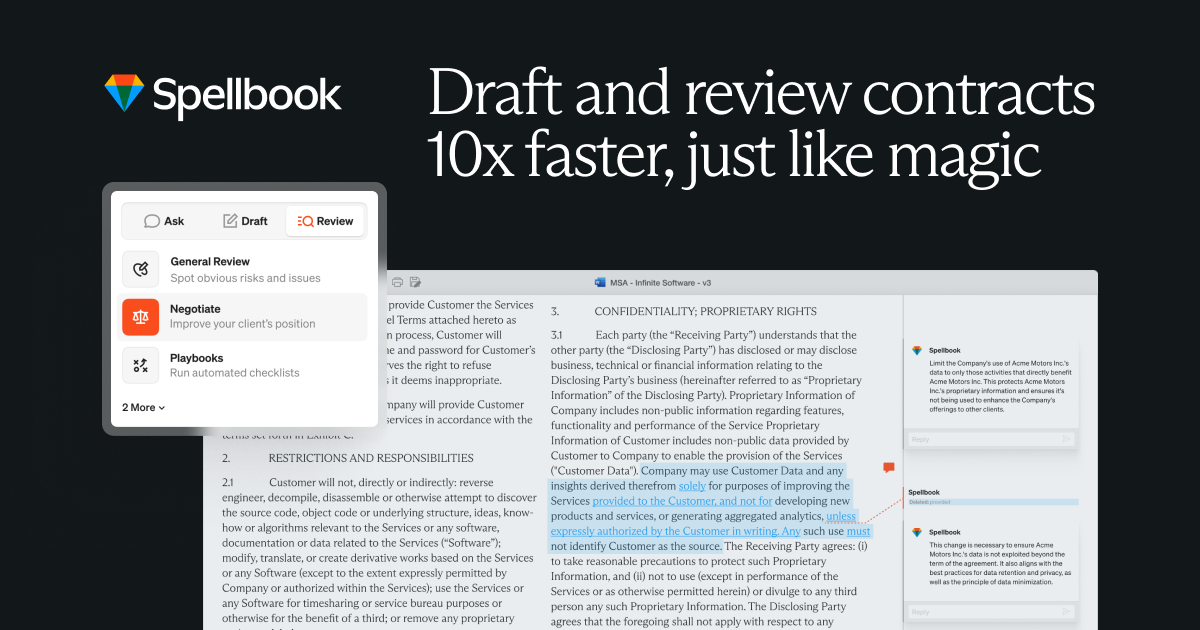
Spellbook is an AI contract assistant for lawyers that embeds into Word to draft, review, and rewrite contract clauses: without switching software, it is invoked directly inside the contract currently being edited. Osmaura provides a business development intelligence hub for law firms to assist them in carrying out client development work: what it manages is not the contract itself, but the law firm's case leads and client development.
3. Matching by Scenario
Batch contract review and due diligence: Harvey and Luminance take priority, as both are designed for the high-volume contract work of law firms and corporate legal departments; only when reviewing dozens or hundreds of contracts at once does batch review make sense. Daily drafting and rewriting of clauses: Spellbook takes priority, embedding in Word so revising contracts requires no switching of software, allowing lawyers to invoke it directly in the contract being edited.
Law firm client development: Osmaura takes priority, as business development is its primary scenario, handing case lead and client development work over to it. Individual users occasionally reviewing contracts: look first at lightweight forms like Spellbook, as the workload and pricing of platform-level tools may not match individual needs.
4. Precautions
Two reminders. First, what AI provides are initial drafts and leads, not legal opinions: identified risk points and drafted clauses must all be verified once by a practicing lawyer before formal use; the party responsible for a contract is always a person, not a tool. Second, all four target law firms and corporate legal departments, and pricing and onboarding methods are subject to their official websites; individual users should confirm their own usage volume first before deciding whether to pay for a platform-level tool.
Access and pricing notes: all four are marked in the library as directly accessible in China; Harvey is marked in the library as a paid model, while pricing for Luminance, Spellbook, and Osmaura is subject to their official websites. Confirm free trials and onboarding methods before use, then decide which one to use as your primary tool.
Tools mentioned




Sources
This article is compiled from the public sources above and does not reproduce the originals in full; see the official sources for details.